Active mode (forward-active mode) is the BJT operating region used for amplification: the emitter–base junction (EBJ) is forward-biased and the collector–base junction (CBJ) is reverse-biased. It’s the BJT analogue of the MOSFET’s saturation region, where the device acts as a controlled current source and can amplify a small signal. Watch the naming clash: the active BJT region corresponds to MOSFET saturation, not BJT saturation.
How the current gets across
Take an npn. Forward-biasing the EBJ lowers the barrier of that junction, so a large current of electrons floods from the emitter (n-type, electron-rich) into the base (p-type). Inside the base those electrons are minority carriers. The base is deliberately thin and lightly doped, so most of the injected electrons diffuse straight across it before they recombine with the base’s holes. When they reach the edge of the depletion region around the reverse-biased CBJ, that junction’s field points the right way to pull electrons toward the collector and sweeps them across and out the collector terminal. This is Minority-carrier injection.
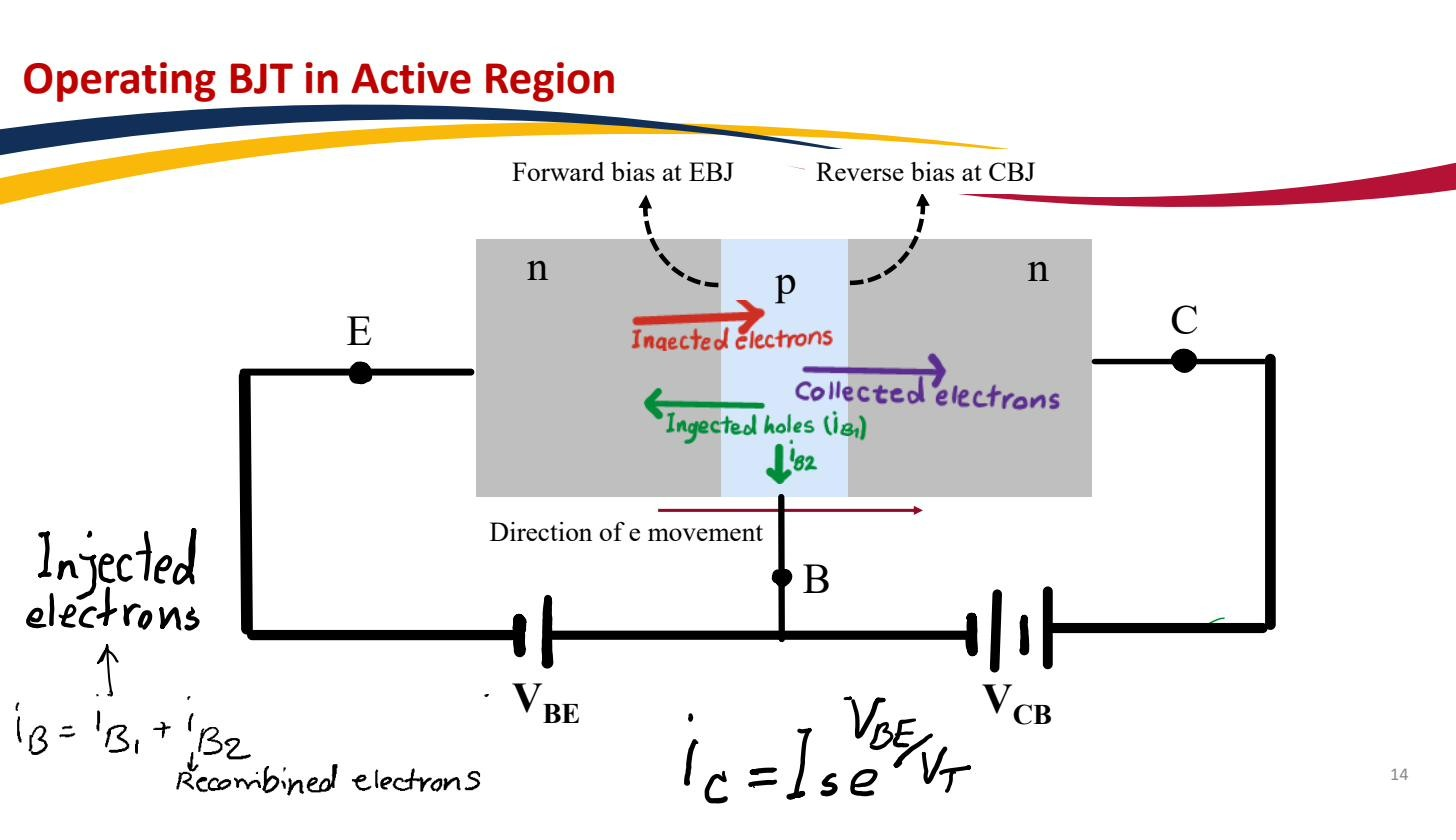 Operating the BJT in the active region: the forward-biased EBJ sends emitter electrons across the thin base; the reverse-biased CBJ field sweeps them to the collector.
So almost all of the emitter current reaches the collector. The collector and emitter currents differ only by the tiny fraction of carriers that recombined in the base on the way across, and that small lost fraction is the base current . So , with the difference being .
Because the current is set by carriers crossing a forward-biased junction, the collector current depends exponentially on the EBJ forward voltage:
with the saturation current and the Thermal voltage.
The current relations
In active mode the three terminal currents are tied together by the gain ratios:
- is the Common-emitter current gain, , typically 50–100.
- is the Common-base current gain, , just under 1.
- KCL at the device closes the system: .
For a large the three currents differ by less than 1 %, but those small differences are what the amplifier exploits, so don’t throw them away carelessly.
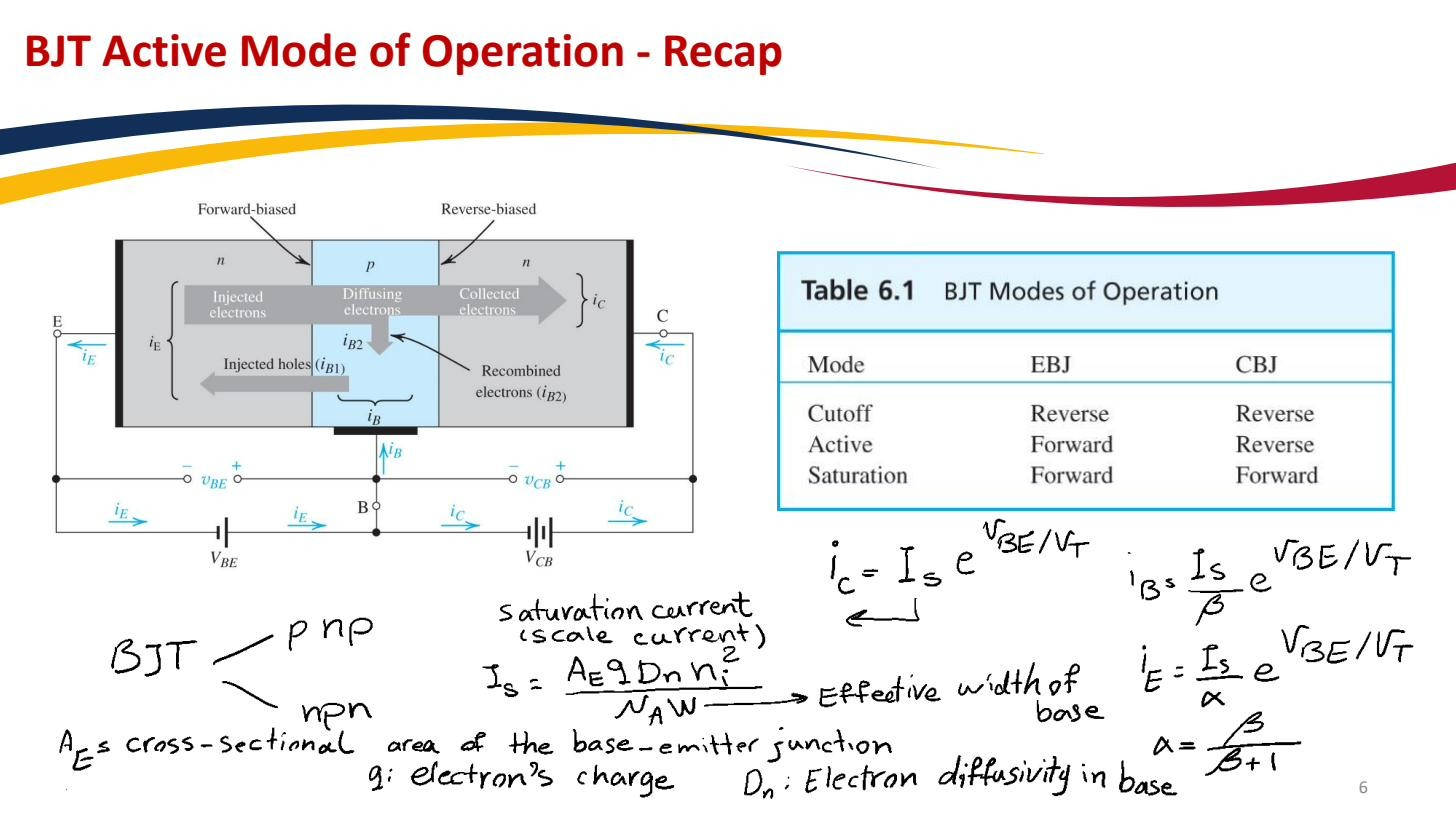 Active-mode recap: . The three currents differ by less than 1 % when β is large, but the small differences matter.
In hand analysis you assume active mode, model the EBJ as a 0.7 V drop and the collector as a current source (the BJT large-signal model), solve, then check the assumption: the CBJ must really be reverse-biased, i.e. for an npn. If that fails the device is actually in BJT saturation mode and the whole analysis has to be redone.