The BJT large-signal model is the DC equivalent circuit you substitute for a BJT when finding its operating point. In active mode it has two pieces: the emitter–base junction as a forward-biased diode, and the collector as a current source controlled by the base current.
The active-mode model
- Emitter–base junction: a forward diode. For hand analysis use the Constant-voltage-drop model: replace it by a fixed from base to emitter.
- Collector: a current source equal to times the base current, pointing into the collector for an npn:
where is the Common-emitter current gain, the saturation current, and the Thermal voltage. The two forms of are the same physical current expressed two ways.
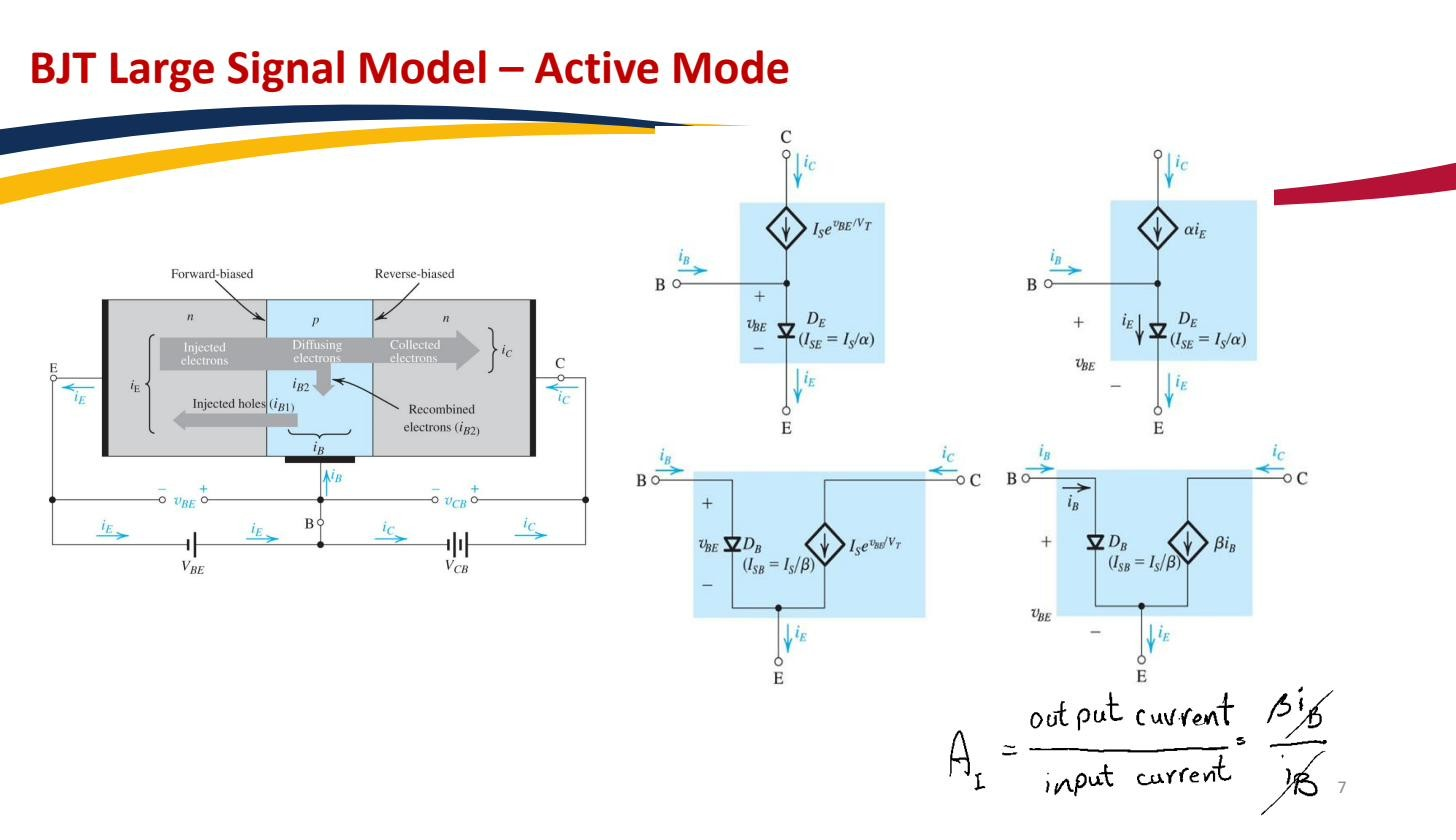 BJT large-signal model in active mode: the EBJ is a diode with ; the collector is a current source .
CVD-mode versus exponential-mode
There are two equivalent ways to use this model, and they give nearly the same numbers:
- CVD mode (constant-voltage-drop): fix . Then is whatever the external circuit forces through . This is the standard recipe in BJT DC analysis, almost always good enough.
- Exponential mode: keep the full law , so and are linked and both adjust to the external circuit. More accurate, more algebra.
They agree closely because the exponential is so steep that moves only a few tens of millivolts across orders of magnitude of , so pinning it at 0.7 V costs almost nothing. Use CVD mode unless a problem specifically demands the exponential.
Simplified model: drop the Early effect
The full active-mode model also includes an output resistance from the Early effect (collector current rising slightly with ). For introductory DC hand analysis you drop (treat the collector as an ideal current source), which gives the standard ”, ” model used in nearly every textbook bias problem.
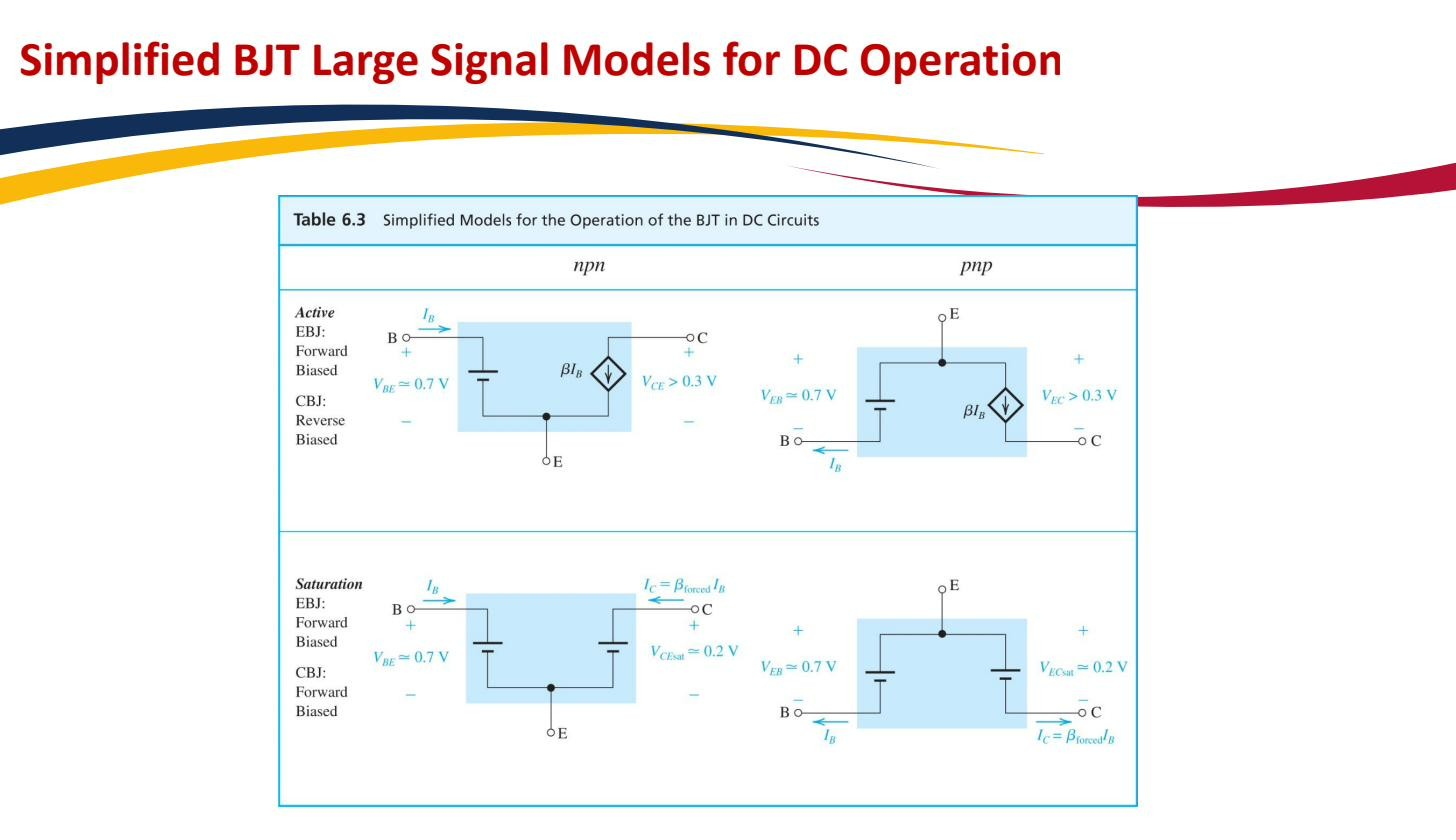 Drop the Early effect for hand analysis at this level. That gives the standard ”, ” model used in most introductory problems.
A separate large-signal model applies in saturation (fixed and fixed ), and the pnp version has the diode and current-source directions reversed. Once the DC operating point is known, you linearise this model around it to get the BJT small-signal model.