In active mode the BJT collector current depends exponentially on the base–emitter voltage, the same way a diode current depends on its forward voltage:
- — collector current.
- — base–emitter voltage (the forward voltage across the EBJ).
- — the transistor’s saturation current (a scaling constant, often around ). Set by device geometry and doping. It’s the analogue of the diode’s Reverse saturation current, and itself depends weakly on through the Early effect.
- — the Thermal voltage, at room temperature.
Compare the MOSFET square law . The MOSFET’s drain current grows as the square of the overdrive; the BJT’s collector current grows exponentially with . An exponential is far steeper than a square law, so a given fractional change in current needs a far smaller change in control voltage. That steepness is why the BJT has a higher BJT transconductance per unit current than a MOSFET, and why it delivers more current for the same bias. The same exponential underlies the Diode equation; a BJT’s EBJ really is a forward-biased PN junction.
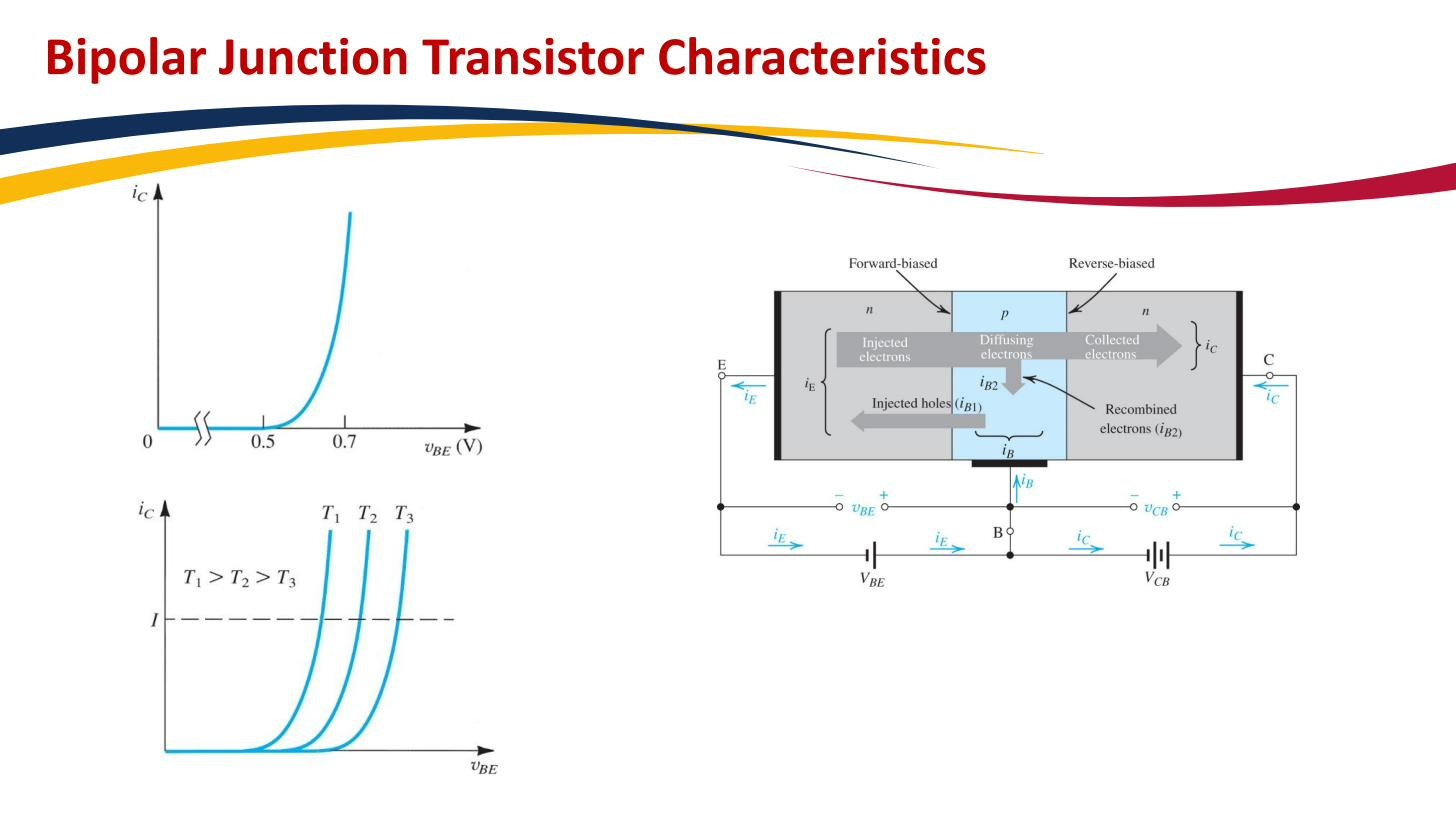 is exponential in (like a diode). At higher temperature the same is reached at a lower , roughly in at constant current. The right side shows the underlying carrier-diffusion mechanism.
temperature coefficient
Hold fixed and warm the device up: the needed to sustain that same collector current drops by about
Intuition: rises steeply with temperature (it depends on the intrinsic carrier concentration, which climbs fast with ), and also rises. Both effects mean that at a higher temperature you reach the same at a lower . The net result is the figure. This is why a fixed- bias is a bad idea: a small temperature rise would run the collector current away. Good bias circuits set the current (via Emitter degeneration / Voltage-divider bias) rather than the voltage. The same temperature coefficient gets exploited deliberately in temperature sensors and bandgap references.
Because the exponential is so steep, moves by only a few tens of millivolts across several decades of . That is what justifies the constant-voltage-drop simplification used in the BJT large-signal model and BJT DC analysis. Linearising this exponential around a bias point is exactly how you get the small-signal BJT transconductance .