The BJT transconductance is how strongly the collector current responds to a small change in base-emitter voltage about the DC bias point:
where is the DC collector current and is the Thermal voltage. This is the parameter that turns the BJT into an amplifier: an input voltage becomes an output current.
Derivation by linearisation
Bias the BJT in active mode at , then add a small signal on top: . Substitute into the exponential law:
The DC bias factor collapses to . Expand the remaining exponential for small (Taylor series ):
- The constant term is just the DC current, no signal.
- The linear term is the small-signal collector current:
- The quadratic and higher terms are distortion; keeping small (small-signal operation) keeps them negligible. Same linearisation logic used for the MOSFET in Common-source amplifier.
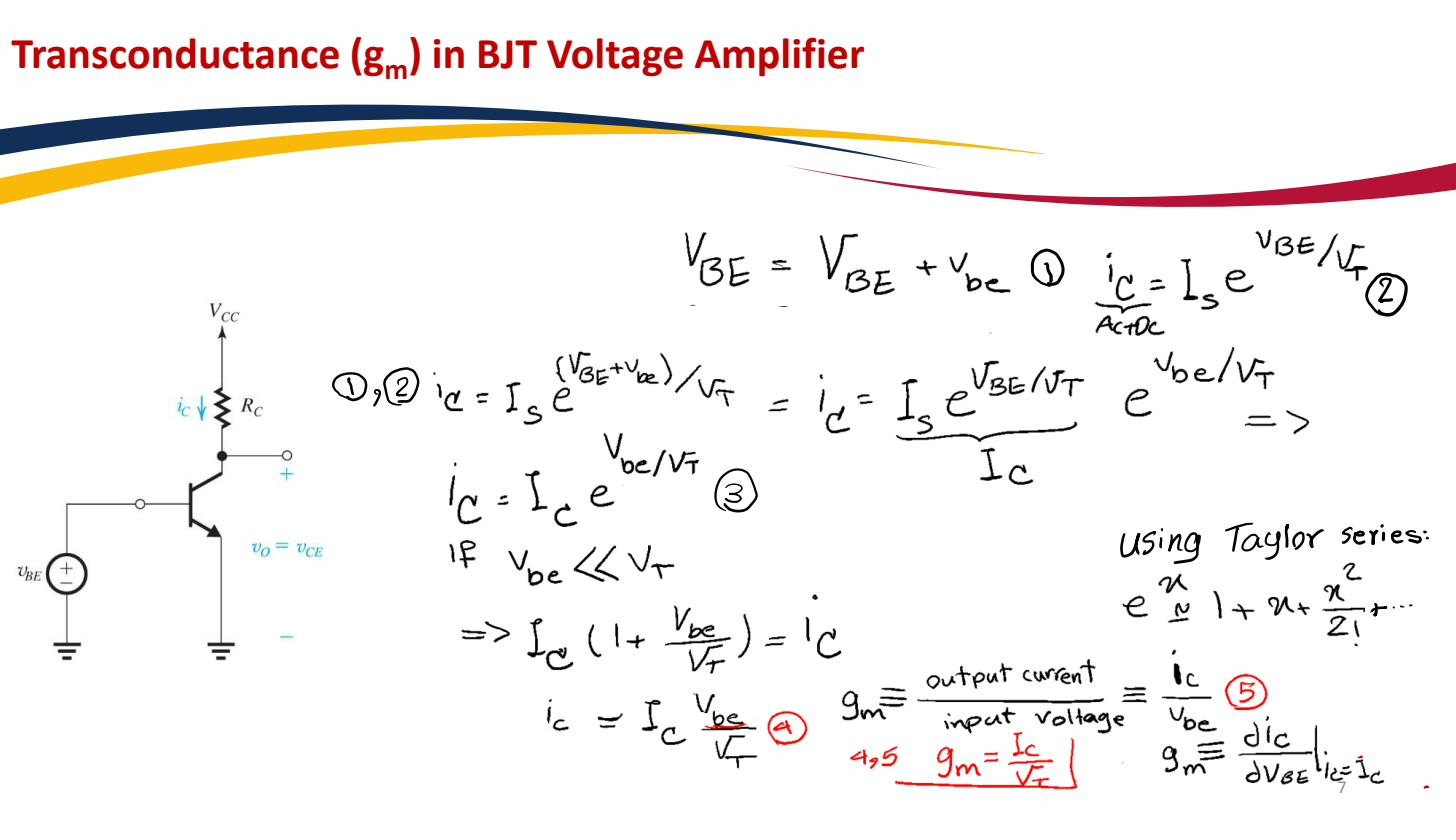 Transconductance of the BJT amplifier: at with , higher than a MOSFET at the same bias current.
Why it beats the MOSFET
At and :
Compare a MOSFET carrying the same biased at an overdrive . Its MOSFET transconductance is . The BJT delivers four times the transconductance for the same bias current. The cause is structural: depends only on the thermal voltage (a constant ≈ 25 mV), while the MOSFET’s is throttled by an overdrive that’s usually hundreds of millivolts. The exponential i–v law is steeper than the MOSFET square law. This high transconductance-per-current is why BJTs are still chosen for high-gain, low-noise analog front-ends even with CMOS dominating digital.
is the central element of the BJT small-signal model; combined with it sets the BJT input resistance , and it directly sets amplifier gain — e.g. a Common-emitter amplifier has .