The common-source amplifier is the single-transistor MOSFET amplifier you reach for first: input at the gate, output at the drain, source held at AC ground. It’s the MOSFET analogue of the Common-emitter amplifier. High gain, inverting, near-infinite input resistance.
Why it amplifies
Bias the MOSFET in saturation at some operating point (see Operating point), then add a small signal on top of the DC gate–source bias. In saturation the device is a voltage-controlled current source: the small signal produces a drain-current change
where is the MOSFET transconductance. That current flows through the drain resistor , and the output is the drain voltage. Because flowing into the drain pulls the drain voltage down,
The minus sign means the stage is inverting (180° phase shift). The transistor turns an input voltage into a current via , and the resistor turns that current back into a much larger output voltage.
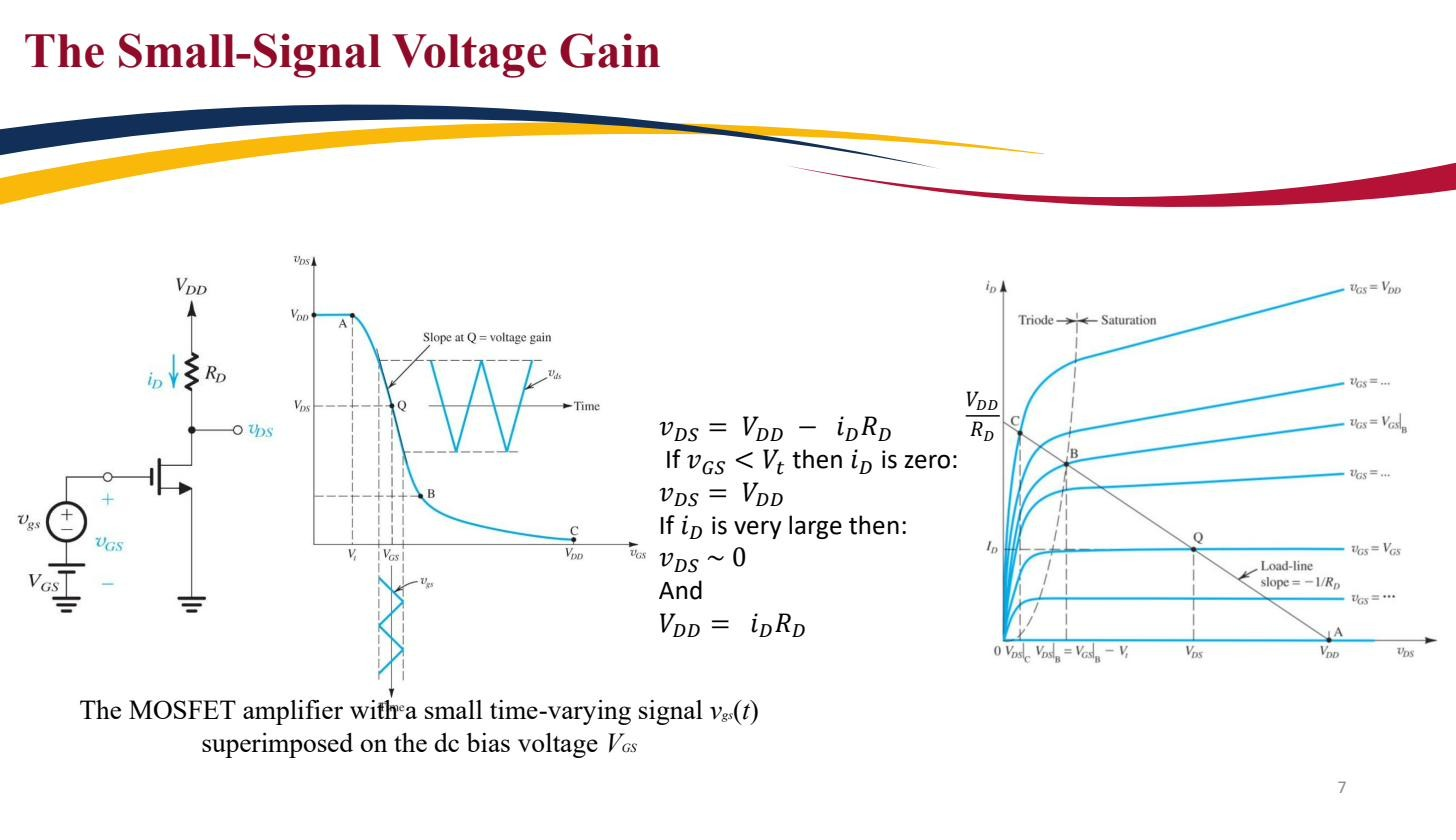 A small input on top of the DC bias produces a current which drops across to give a much larger output ; the negative sign makes the amplifier inverting.
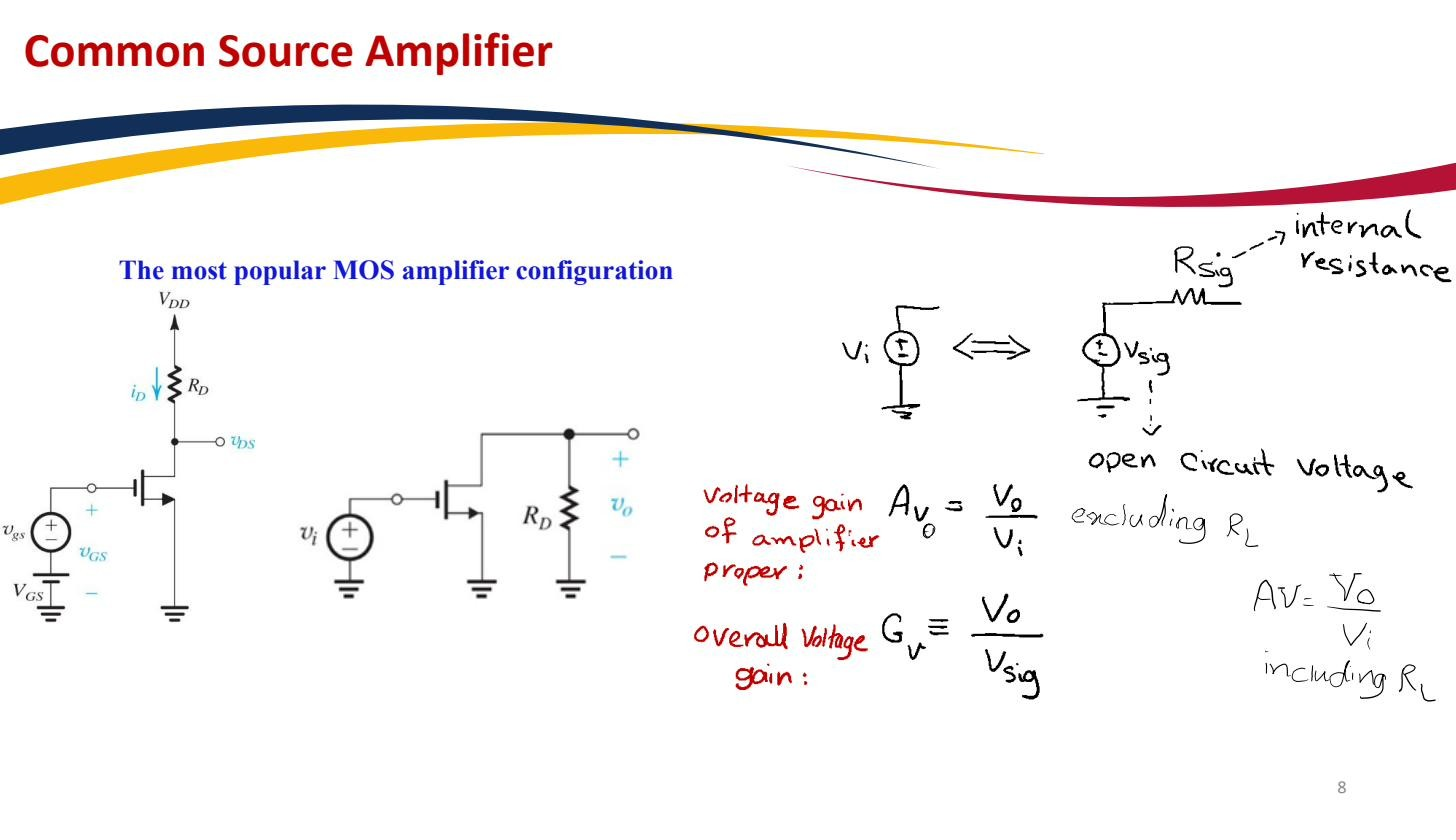 Input at gate, output at drain. Inverting, high gain.
Including the transistor’s own output resistance (from Channel-length modulation), the load on the drain is , so
- Input resistance: essentially infinite. The gate is insulated by the Gate oxide and draws no current.
- Output resistance: , looking back into the drain.
Maximum gain trade-off
Using and the fact that the DC drop across is ,
Large gain wants small (more room for the drop across ) and small Overdrive voltage (larger ). But cannot fall below without leaving saturation, and very small leaves almost no signal swing before clipping. Trading this excess gain away deliberately is exactly what Source degeneration does.
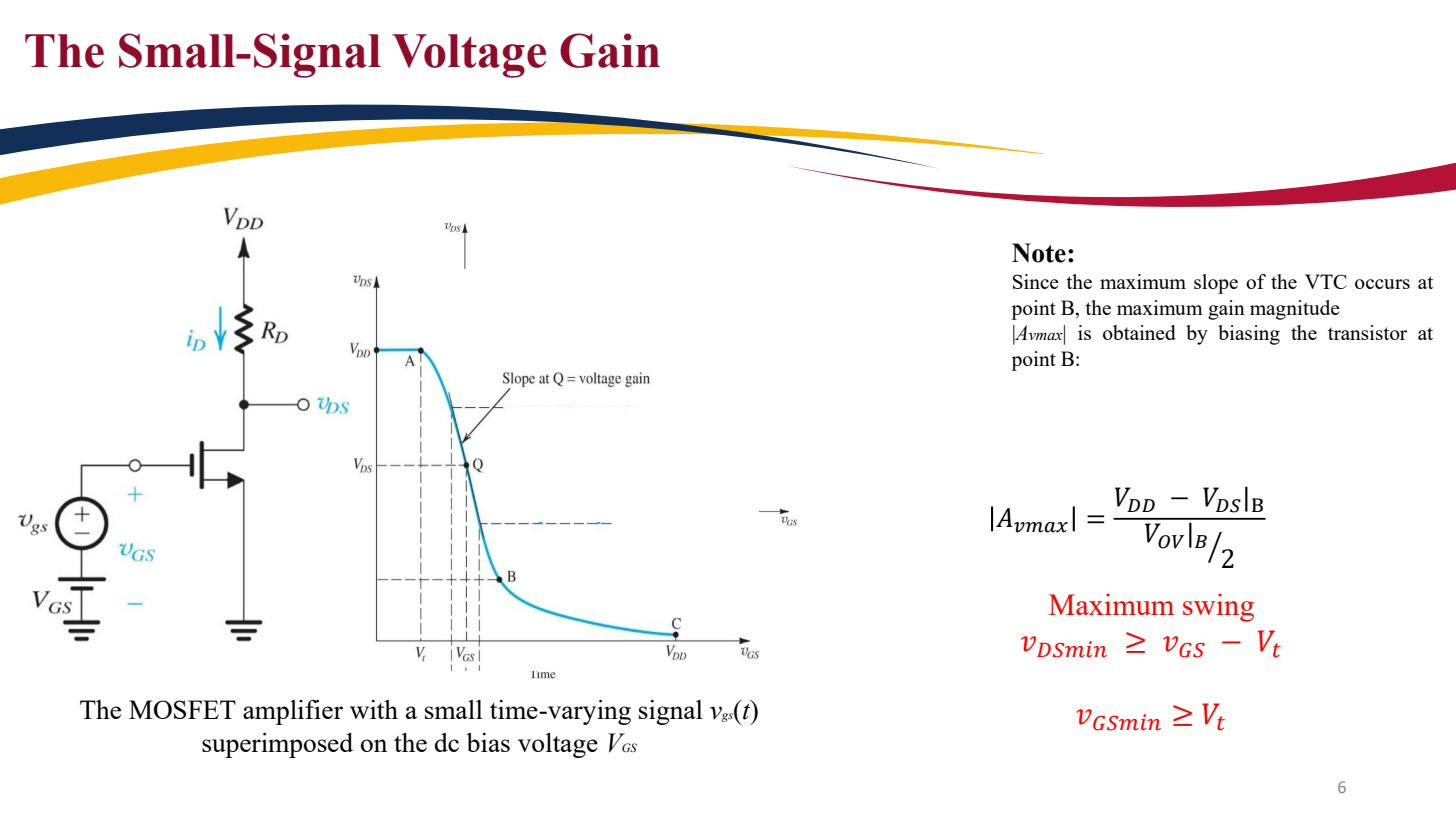 Maximum achievable gain : large gain wants low at the bias point and small .
Common-source with source degeneration
Adding an un-bypassed resistor in the source introduces Negative feedback: a rise in raises the source voltage by , which eats into the effective . The gain drops to
When this collapses to , a gain set purely by a resistor ratio, independent of the process-dependent transistor parameters. That’s the point of Source degeneration. To get the AC gain back while keeping for DC bias stability, a Bypass capacitor is placed across . The full board-level circuit is the Discrete-circuit MOSFET amplifier.