Source degeneration is adding an un-bypassed resistor in the source path of a Common-source amplifier. It introduces local Negative feedback that trades away gain for predictability, linearity, and bandwidth, usually a good trade.
The feedback mechanism
Signal increases . That raises the drain current . But also flows through , so the source voltage rises by . Gate-source voltage is gate minus source, so a rising source eats into the effective . The device’s own response (more current) pushes back against the input that caused it. Negative feedback, applied locally at one transistor.
Gain with degeneration
Working through the MOSFET small-signal model, the effective gate-source voltage is the input minus , and . Solving:
where is the MOSFET transconductance, the drain resistor, and the source resistor. The bare common-source gain is divided by the feedback factor . Larger ⇒ more feedback ⇒ less gain.
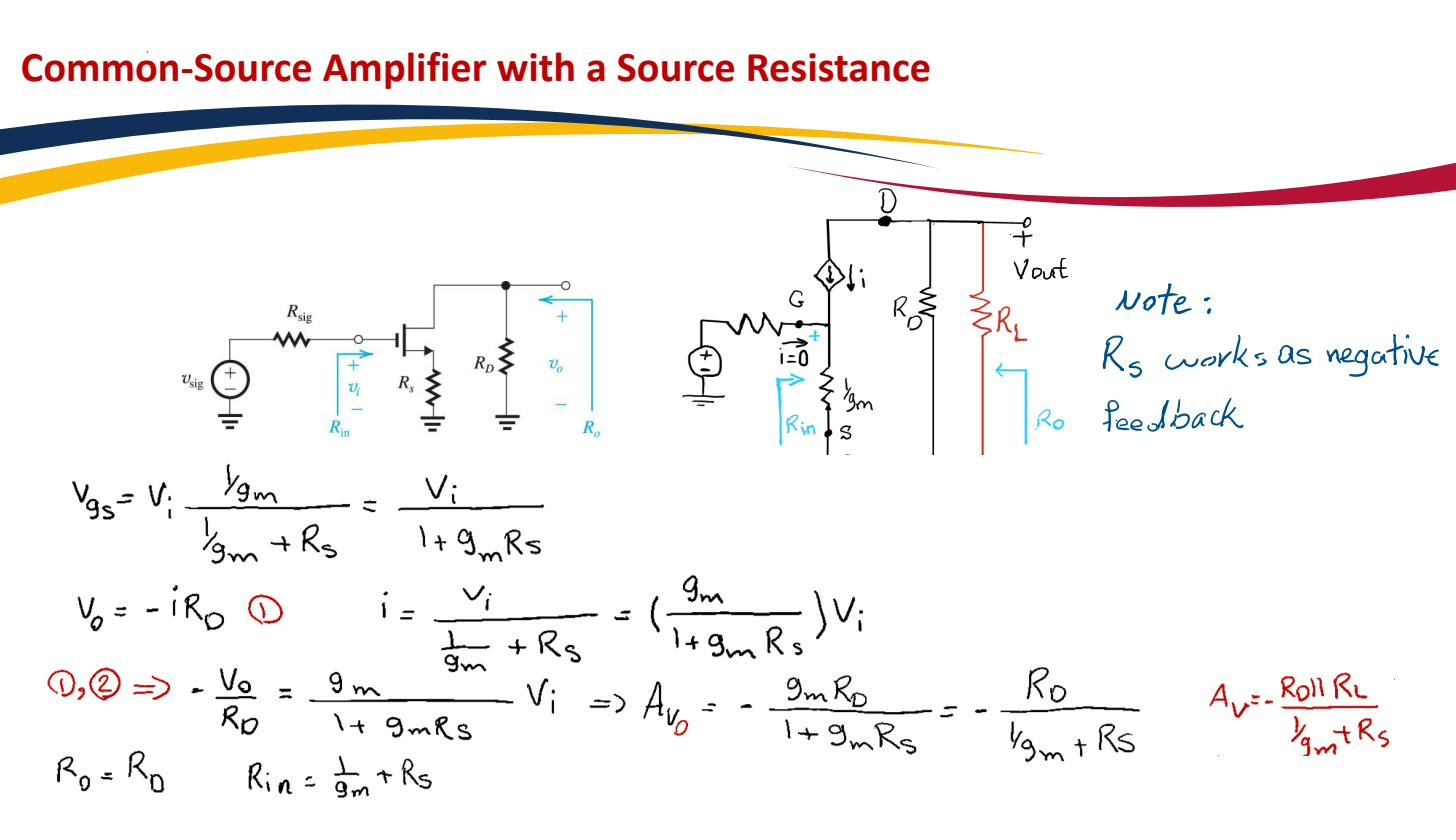 adds negative feedback; gain ÷ but more predictable and linear.
Why give up gain on purpose
The payoff is in the strong-feedback limit. When :
The gain now depends only on a resistor ratio, not on , not on , not on , none of the process-dependent, temperature-sensitive transistor parameters. Two “identical” transistors that would give wildly different bare gains now give the same predictable . That insensitivity is the whole point. Degeneration also linearises the stage (the feedback compresses the nonlinear square-law curve) and improves bandwidth. The cost, lower raw gain, is exactly the “excess gain” a bare common-source had no good use for anyway.
This is the MOSFET counterpart of Emitter degeneration in a BJT (an un-bypassed emitter resistor doing the same job). When you want the DC bias benefit of but not the AC gain loss, put a Bypass capacitor across : it shorts for AC (full gain restored) while leaving it for DC (MOSFET biasing stability intact). It also raises the stage’s input resistance.