Emitter degeneration is adding an un-bypassed resistor in the emitter of a Common-emitter amplifier. It introduces Negative feedback, trading away gain for predictability, linearity, higher input resistance, and better bandwidth. The BJT analogue of Source degeneration in a MOSFET.
The feedback mechanism
Without the emitter is at AC ground and the full input appears as . Add : now a rise in collector current also raises the emitter voltage by . That rise subtracts from the input, so the effective base–emitter signal is reduced; the output opposes the change that caused it. That’s series–series negative feedback. The collector current is now set largely by , not by the touchy device parameters.
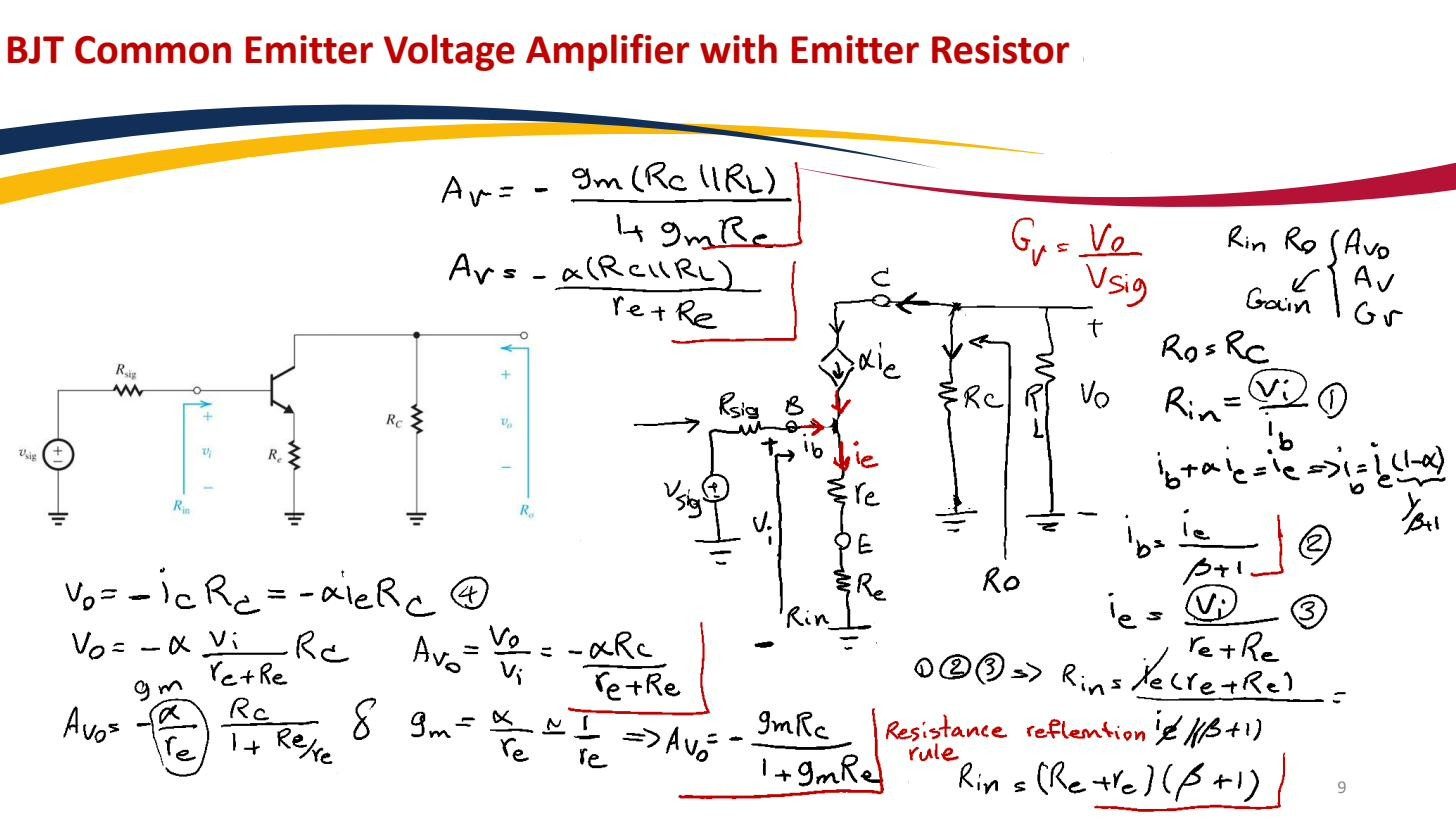 provides negative feedback: gain is reduced by the factor , but the amplifier becomes much more predictable and linear.
Gain
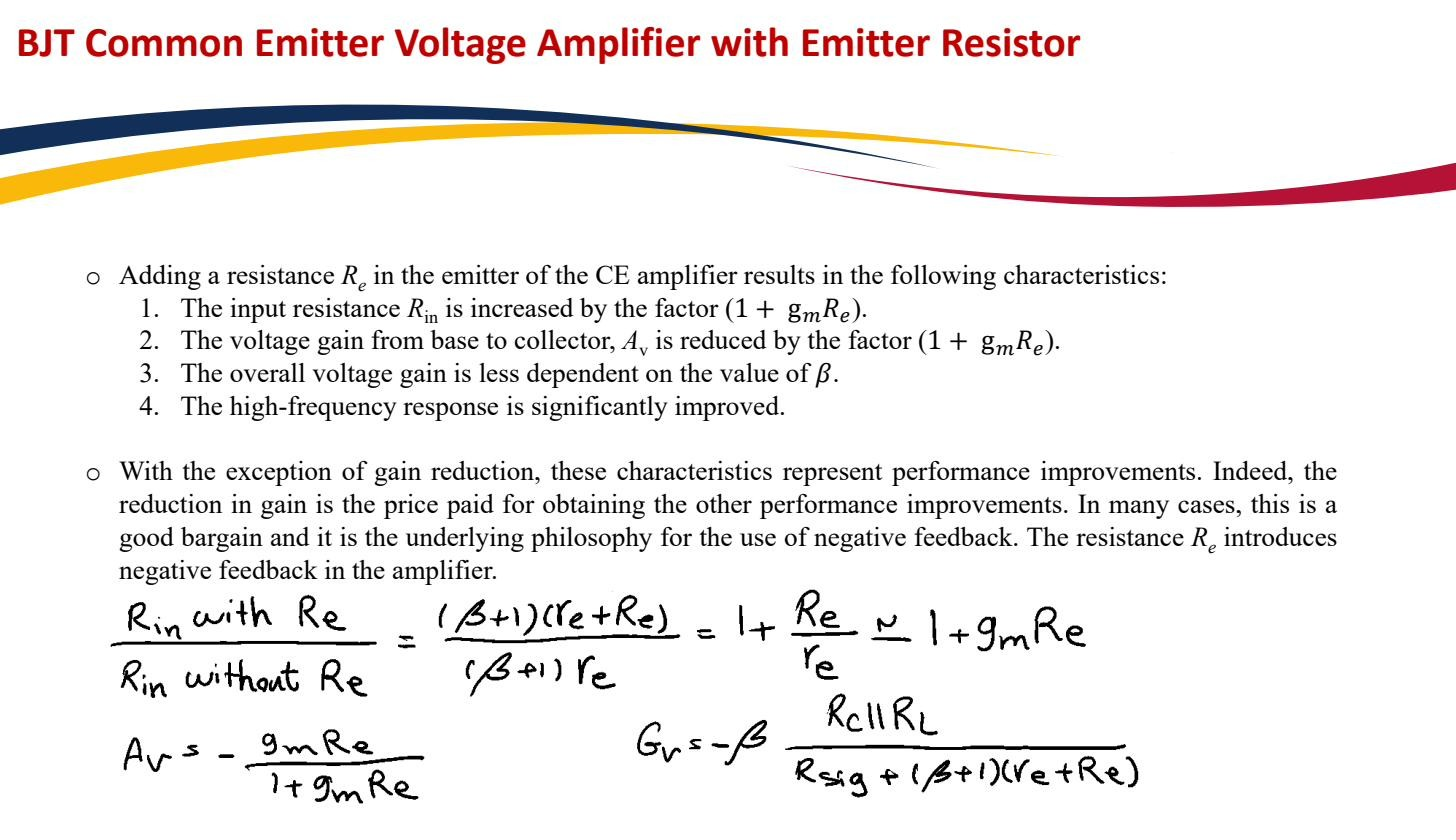
Working through the BJT T-model from the emitter loop, the collector current is set by across , and :
Equivalently, in terms of the un-degenerated gain , degeneration divides it by :
(These agree: since .) When the gain collapses to , set purely by a resistor ratio, independent of the process- and temperature-dependent , , . That insensitivity is the whole point.
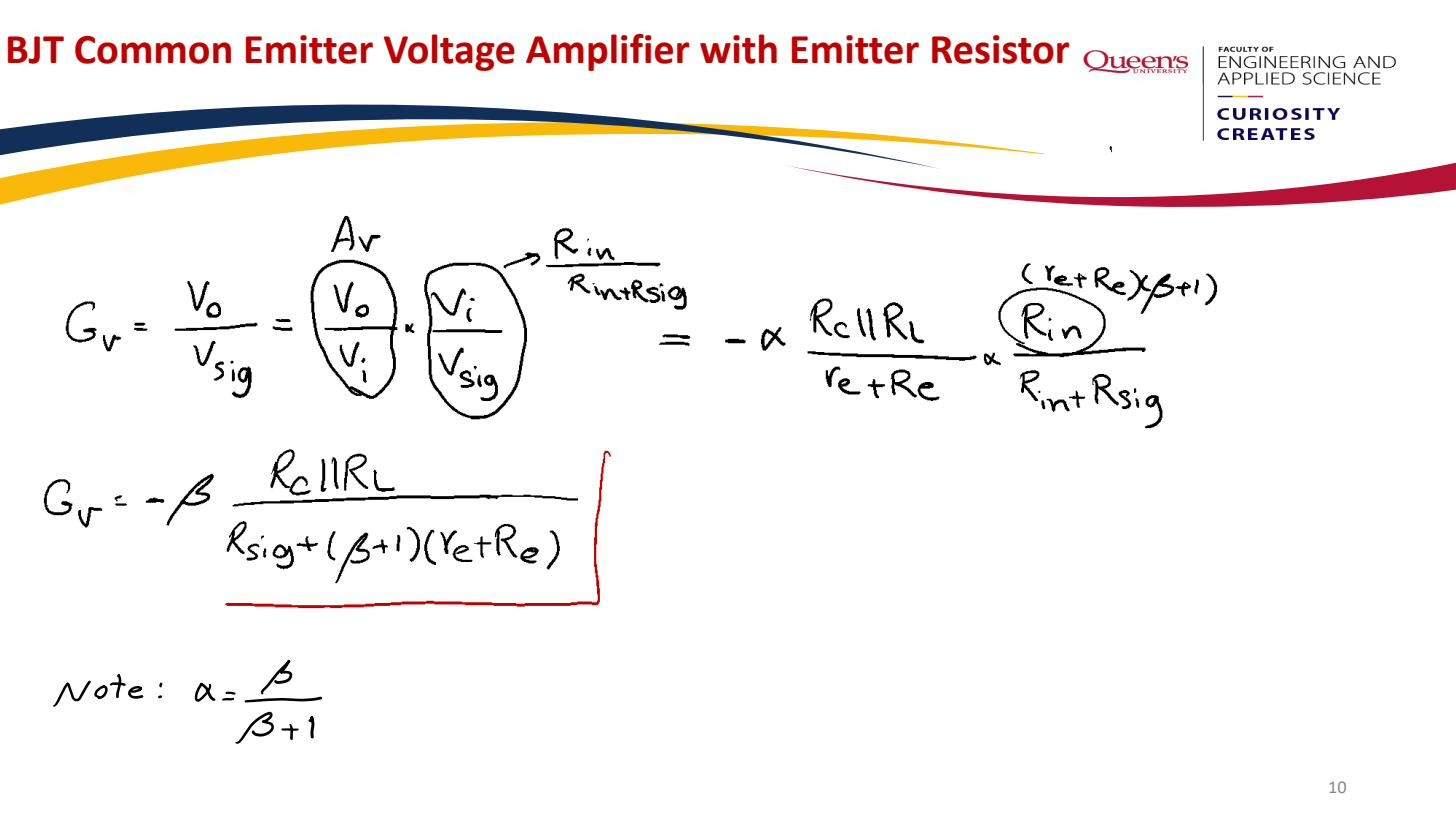 Detailed analysis of CE with an emitter resistor: the feedback action and the input-impedance increase from .
Input resistance and the rest of the trade-off
The un-bypassed raises the input resistance via the Resistance reflection rule: a resistor in the emitter is seen from the base as times larger.
The output resistance looking into the collector stays . The four effects of adding :
- increases by the factor (to ), so less loading of the source.
- decreases by the same factor. The price paid.
- Gain depends much less on : it’s now , two resistors you control, not a sloppy device parameter.
- Frequency response improves. Negative feedback widens the bandwidth (lower Miller effect sensitivity, flatter response).
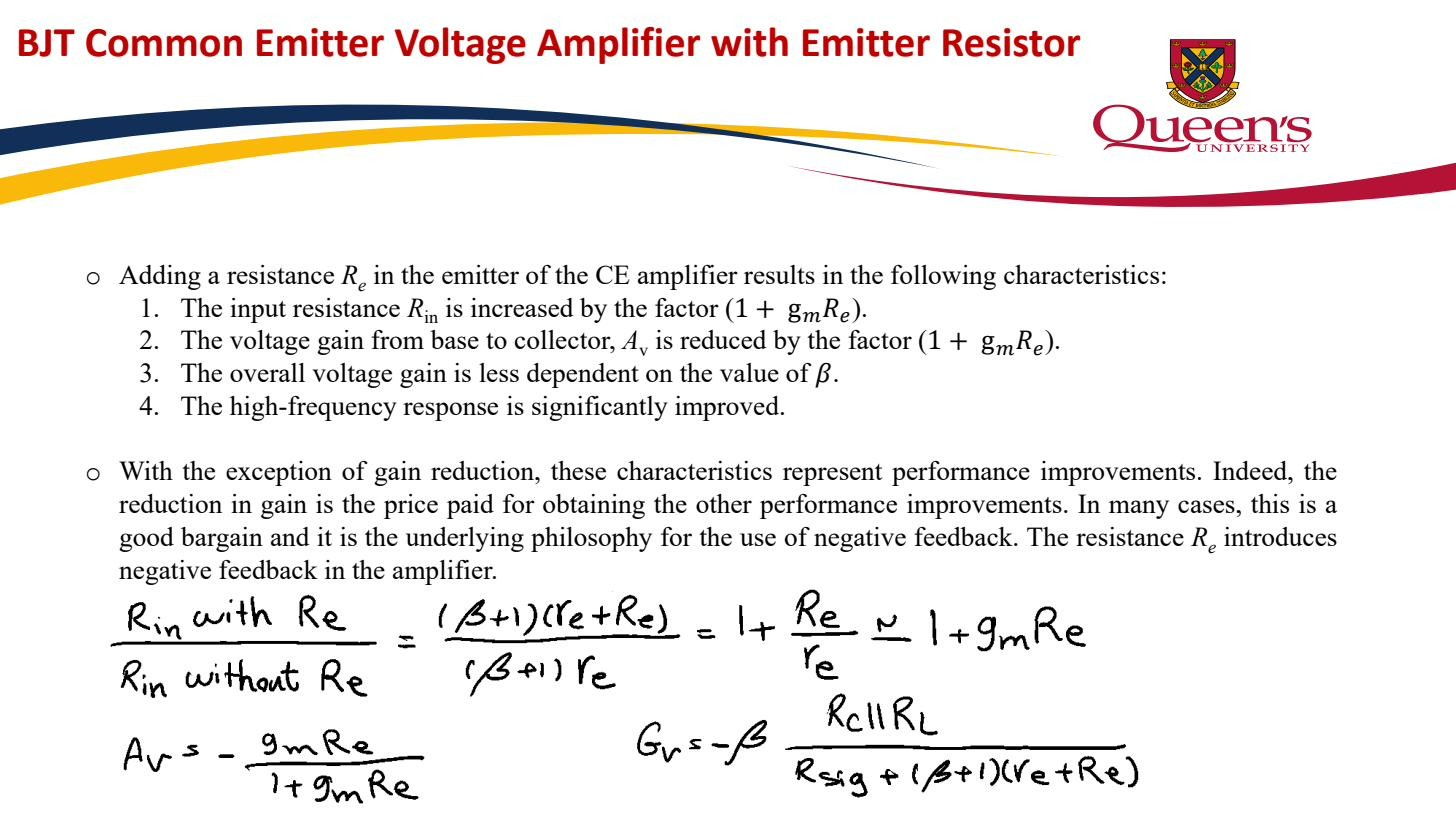 Effects of : up, down by the same factor, less β-dependence, better frequency response.
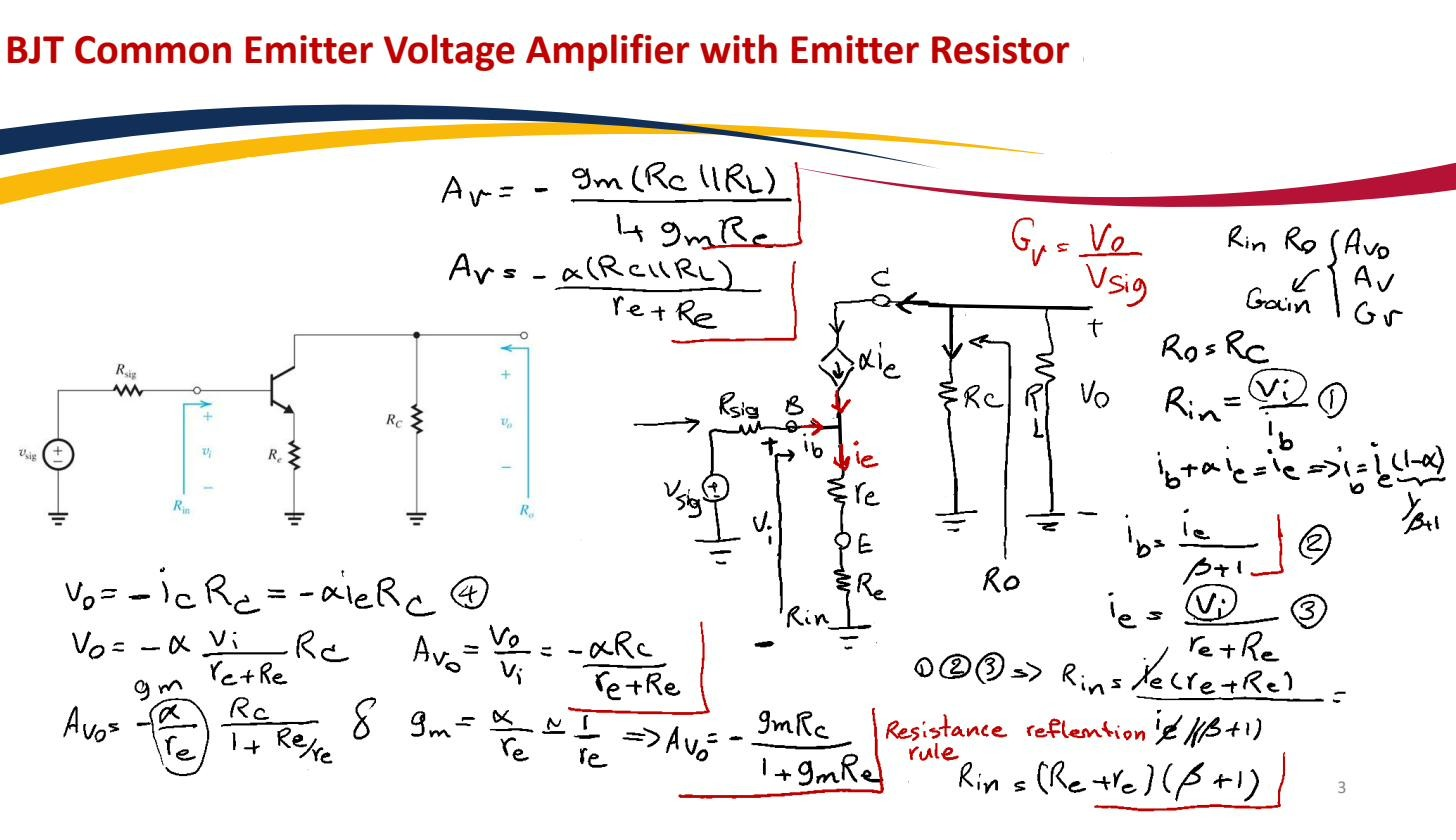 T-model analysis: , , .
 Negative feedback trades gain for performance.
To keep for DC bias stability while restoring the AC gain, a Bypass capacitor is placed across so it shorts at signal frequencies but is still present for DC.