The diode equation (also called the Shockley equation) is the exponential current–voltage relation of a forward-biased PN junction:
is the current through the Diode in the forward (anode→cathode) direction, is the voltage across it (anode minus cathode), is the Reverse saturation current, and is the Thermal voltage. This is the form: the full Shockley equation carries an ideality factor as , with for an ideal junction and rising toward when recombination dominates. This course takes throughout.
Reading the equation
The term is the contribution of the reverse saturation. In reverse bias is negative, , and : a tiny constant reverse leakage. In forward bias, once climbs a few above zero, the exponential is enormous compared with 1, so the drops out and we use the simplified form for all forward-bias analysis.
is a device parameter set by the cross-sectional area, doping levels, and minority-carrier diffusion lengths. For a typical small-signal silicon diode it sits somewhere between A and A, extraordinarily small. mV at room temperature, where is Boltzmann’s constant, the absolute temperature, and the electron charge.
Inverting the equation to solve for the voltage given a current:
This inverse form is what Iterative diode analysis uses to refine a voltage estimate, and it makes the steepness of the curve concrete.
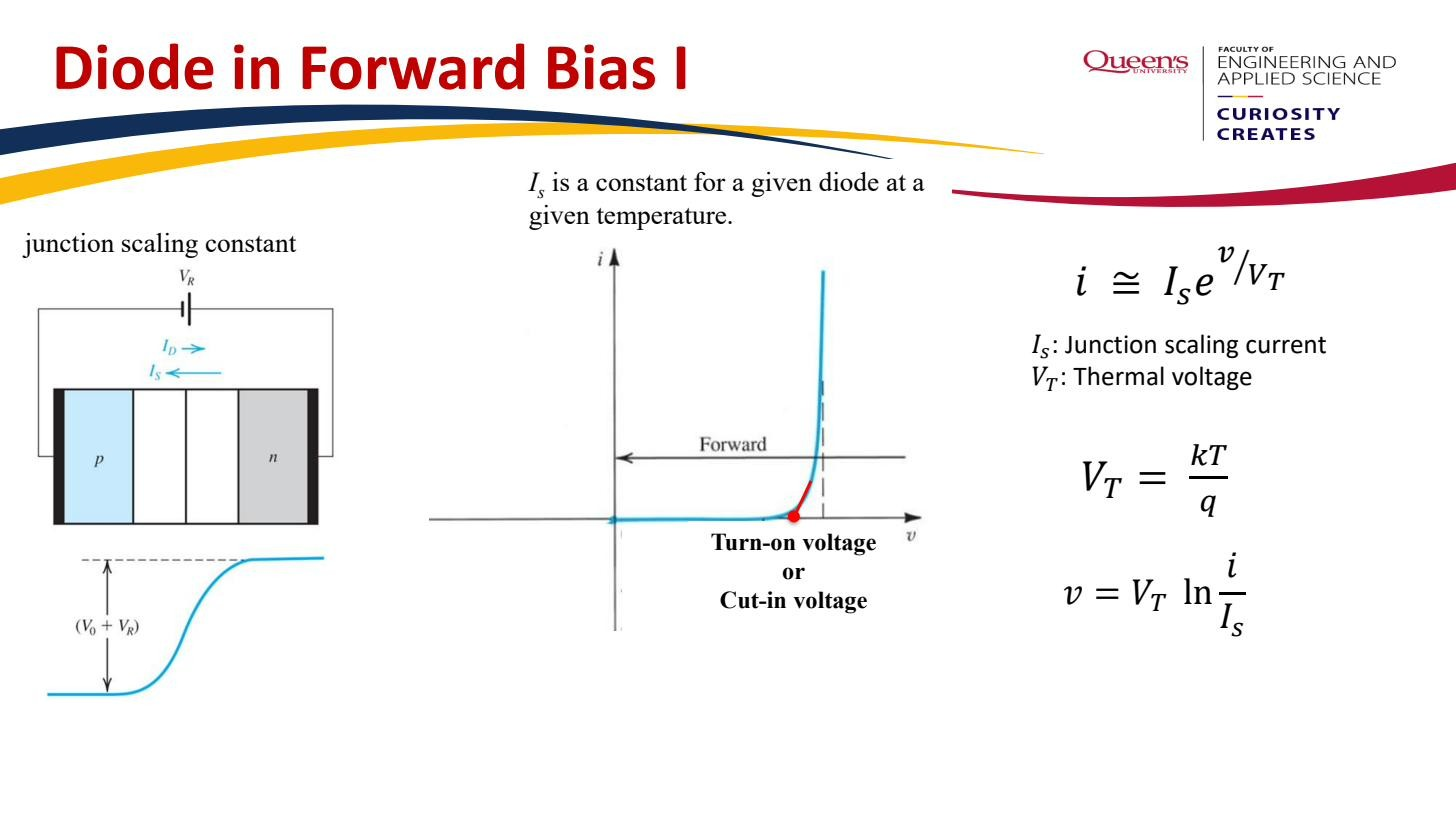 The diode equation in forward bias; inverting gives .
Why the curve is so steep, and why this gives a 0.7 V “constant” drop
The exponential is brutally steep. Increase by one (25 mV) and the current is multiplied by . Increase by 60 mV and it goes up by about 10. Check that second claim: a factor-of-10 change needs
So every decade of current costs only ~60 mV of extra voltage. Run that the other way: changing the current by six orders of magnitude (say 1 µA to 1 A) moves by only about mV. That is why a forward-biased silicon diode sits between roughly 0.6 V and 0.8 V across a gigantic range of currents: the voltage is almost pinned. This near-constancy justifies the Constant-voltage-drop model and is the reason forward diodes make decent voltage references.
The same equation underlies the Exponential diode model for precise hand analysis.