A voltage reference produces a stable, known voltage that barely moves when the supply voltage or the load changes. Two simple diode-based references: a string of forward-biased diodes (each contributing its near-constant ~0.7 V drop) and a Zener diode in breakdown. Both work because the diode’s voltage is almost insensitive to current, so its small slope-resistance (Diode small-signal resistance , or Zener dynamic resistance ) makes the output stiff against disturbances.
Forward-diode reference
Stack forward-biased diodes in series and feed them through a resistor from the supply. Each diode drops ~0.7 V, so the reference is V. Three diodes give about 2.1 V. It’s stable because each diode’s voltage changes only per unit current, and is tiny. When the supply wobbles, almost the whole wobble falls across the series resistor, not across the diodes.
Worked example: three-diode 2.1 V reference
Three diodes in series, , series resistor k. The three diodes drop V.
Bias current: by KVL the current is set by what’s left after the diode stack.
Each diode’s small-signal resistance:
Three in series present to a change at the supply.
Effect of the ±1 V supply variation: the reference and the series resistor form a divider for the change. A 1 V change at the supply produces a change in the reference of
That is about . So a swing on the 10 V supply moves the 2.1 V reference by less than half a percent. The string of diodes has regulated the voltage. The smaller is (i.e. the higher the bias current, up to power limits), the stiffer the reference.
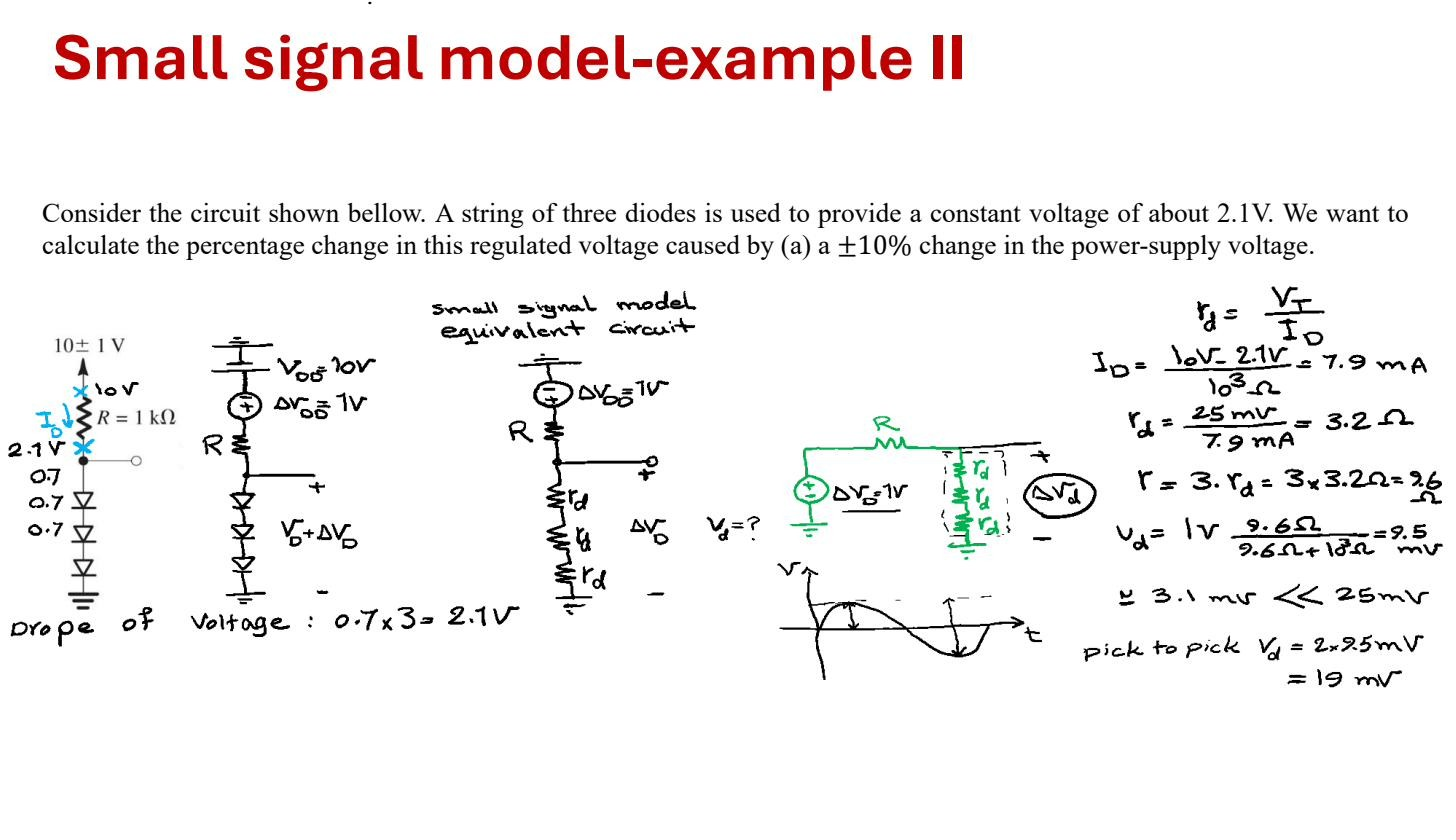 Three series diodes as a 2.1 V reference; small makes it insensitive to supply variation.
A Zener voltage regulator does the same job with one device instead of a stack, at an arbitrary rather than a multiple of 0.7 V; the math is identical with in place of . Either way, a low slope-resistance turns a current-disturbance into a negligible voltage-disturbance.