Forward bias is the connection that lets a PN junction conduct: the p-side is tied to the positive terminal of the supply and the n-side to the negative terminal. The applied voltage opposes the junction’s built-in barrier, current grows exponentially, and the junction acts like a closed (conducting) switch.
What the applied voltage does
In equilibrium a carrier crossing the junction must climb the built-in barrier (silicon). Connect p to and n to , and the external voltage pushes holes toward the junction from the p-side and electrons toward it from the n-side, directly against the built-in field. The net barrier the carriers see is lowered:
Lowering an energy barrier has an exponential effect on how many carriers can surmount it, because the fraction of carriers with enough thermal energy follows a Boltzmann distribution , where is the Thermal voltage. Drop the barrier by even a few tenths of a volt and the number of carriers able to diffuse across, and hence the current, shoots up by orders of magnitude. This exponential current-versus-voltage relationship is the Diode equation , the defining behaviour of a diode.
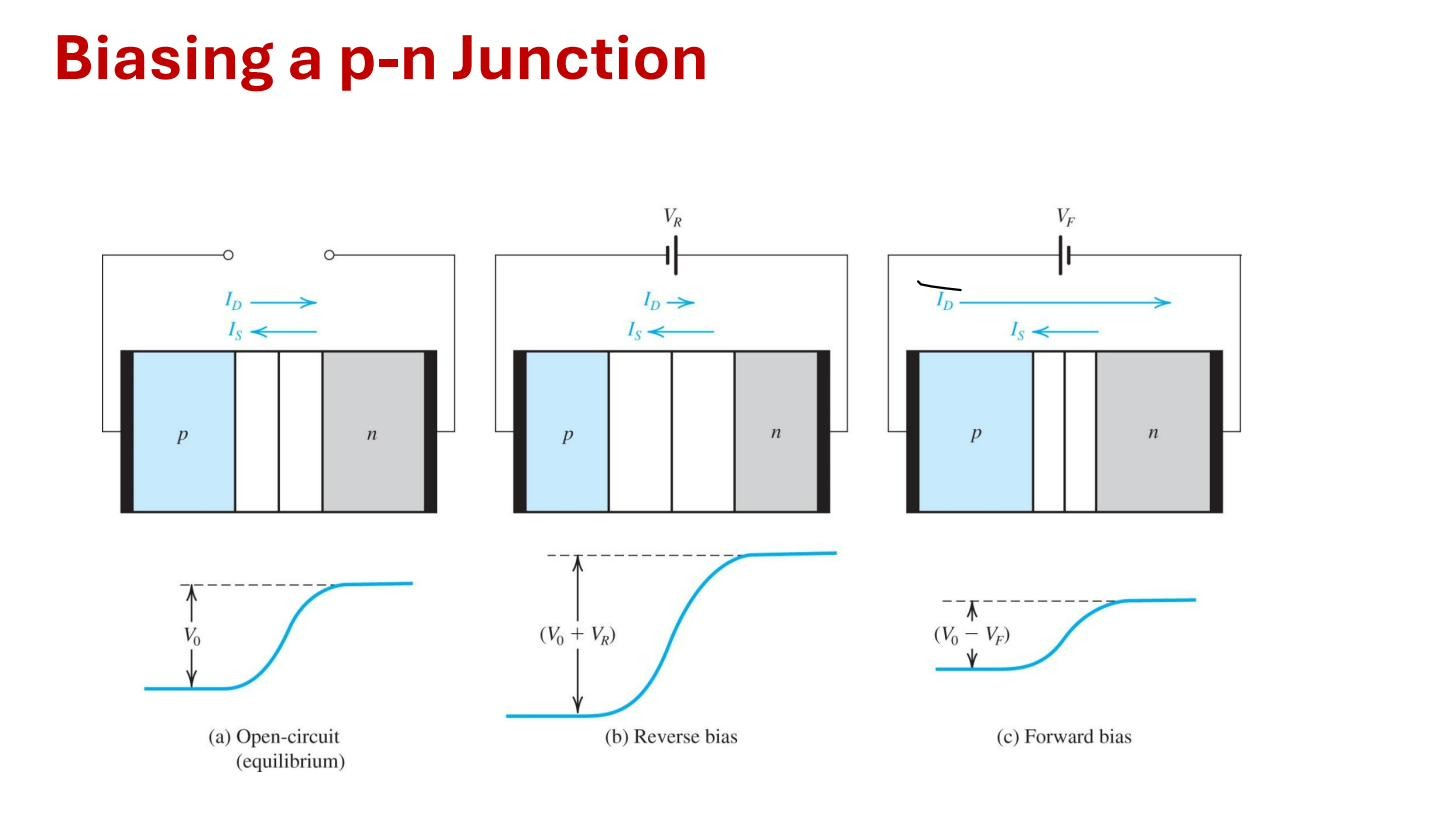 Forward bias lowers the barrier (large diffusion current); reverse bias raises it (blocked).
Practical consequences
The depletion region narrows. Because the net junction potential drops to , the Depletion region width (which scales with the square root of that potential) shrinks. The “wall” between the two sides gets thinner as well as lower.
Current is carried by diffusing majority carriers. Holes from the p-side and electrons from the n-side flood across the lowered barrier (the diffusion half of Drift and diffusion current). Large current, in contrast to the negligible minority-carrier Reverse saturation current under Reverse bias.
You must limit the current with a series resistor. Because grows exponentially with , the voltage across a conducting silicon junction barely moves off even as the current changes by orders of magnitude. There is no internal mechanism limiting that current. Connect a forward-biased diode straight across a source and the current runs away until the device overheats and destroys itself. So you always put a series resistor in the loop; it absorbs the difference and sets the operating current to . For a source and a desired : .