A light-emitting diode (LED) is a PN junction made from a direct-bandgap semiconductor that emits light when forward biased. Electrically it behaves like an ordinary Diode; the difference is that the energy released when carriers recombine comes out as photons instead of heat.
Why it emits light
In Forward bias the junction’s barrier is lowered and a large current flows: electrons are injected into the p-side and holes into the n-side, and near the junction they recombine. An electron drops from the conduction band into an empty valence-band state (a hole) and the two annihilate. That drop releases an energy roughly equal to the Bandgap . In a direct-bandgap material that energy is released as a single photon of energy
is Planck’s constant, and the photon’s frequency and wavelength, the speed of light, the material’s bandgap energy. In an indirect-gap material like silicon the energy mostly turns into lattice vibrations (heat) instead, which is why LEDs are not made from silicon. See Direct and indirect bandgap.
Colour is set by the bandgap
Rearranging gives : a larger bandgap means a higher-energy, shorter-wavelength photon. So the material’s Bandgap directly fixes the colour. Wide-gap materials (GaN and its alloys) emit blue and ultraviolet; narrower-gap materials (GaAs and its alloys) emit red and infrared. White LEDs are typically a blue LED plus a phosphor that down-converts some blue to yellow.
Higher forward voltage than a silicon diode
The forward drop of a diode is tied to its bandgap, and LED materials have larger bandgaps than silicon, so an LED’s forward voltage is higher than the ~0.7 V of a silicon diode: roughly 1.8 V for a red LED and about 3.2 V for a blue or white one. In a circuit you still treat it with the Constant-voltage-drop model, using the appropriate higher , and you must include a series current-limiting resistor exactly as for any forward-biased diode. The LED’s – curve is just as steeply exponential.
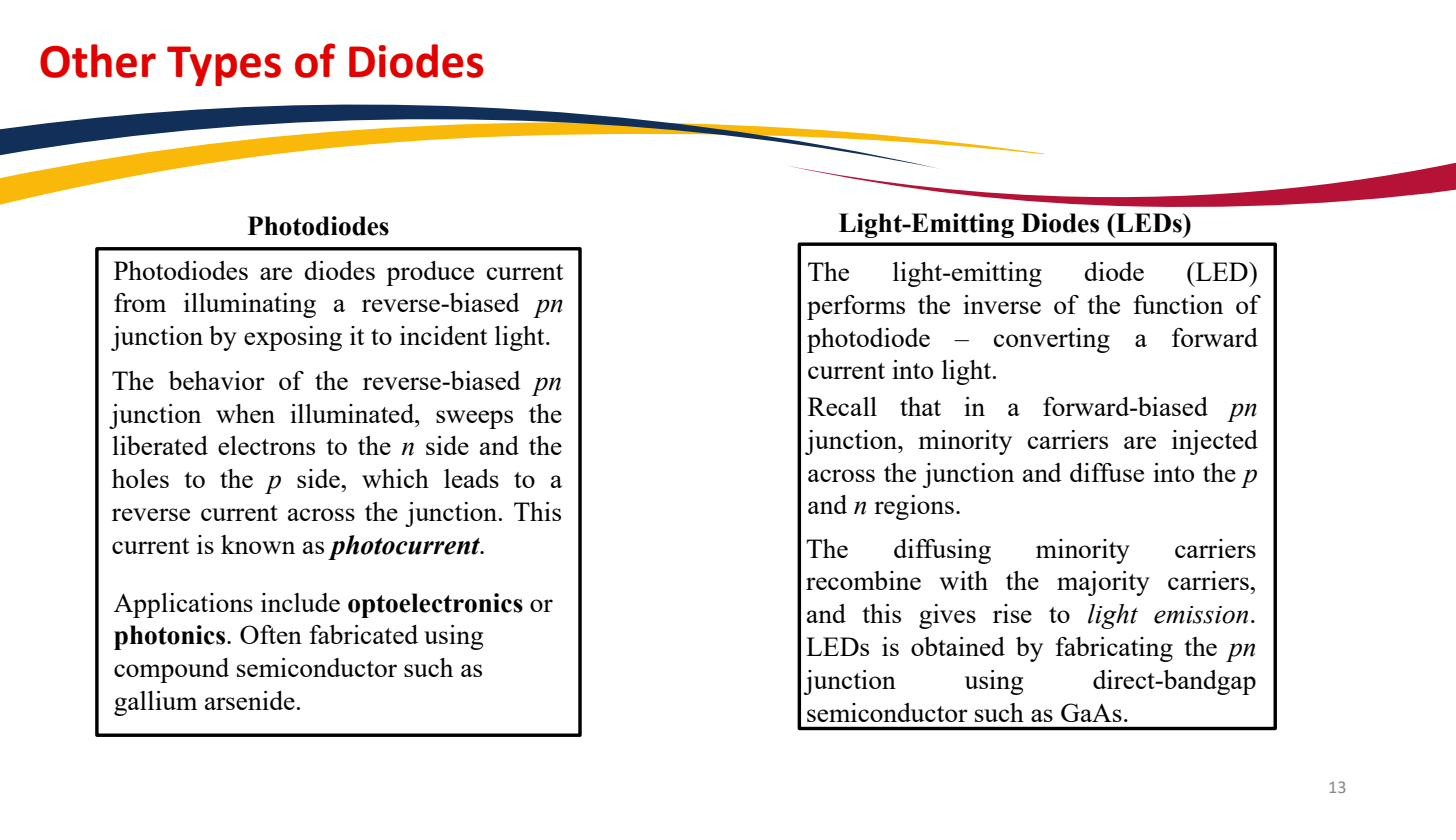 Photodiodes generate current under illumination; LEDs emit photons when forward-biased.
The Photodiode is the inverse: same junction run in reverse, absorbing photons to make current instead of consuming current to make photons.