A photodiode is a reverse-biased PN junction that produces a current proportional to the light falling on it. The exact reverse of a Light-emitting diode: instead of consuming current to make photons, it absorbs photons to make current.
How it works
The diode is held in Reverse bias, so the Depletion region is wide and contains a strong built-in electric field, while the dark current is just the tiny Reverse saturation current. When a photon of energy at least (the Bandgap) is absorbed inside the depletion region, it kicks an electron from the valence band into the conduction band, creating an electron–hole pair. The field sweeps the two apart before they can recombine, the electron toward the n-side, the hole toward the p-side. That separated charge flowing out the terminals is the photocurrent.
More intense light generates more electron–hole pairs per second, so the photocurrent is (over a wide range) proportional to the incident optical power. So the device acts as a linear light-to-current transducer. The reverse bias is what makes it work: it widens the depletion region (more photons absorbed where the field can collect them) and speeds up the carrier sweep-out, giving a fast, sensitive response.
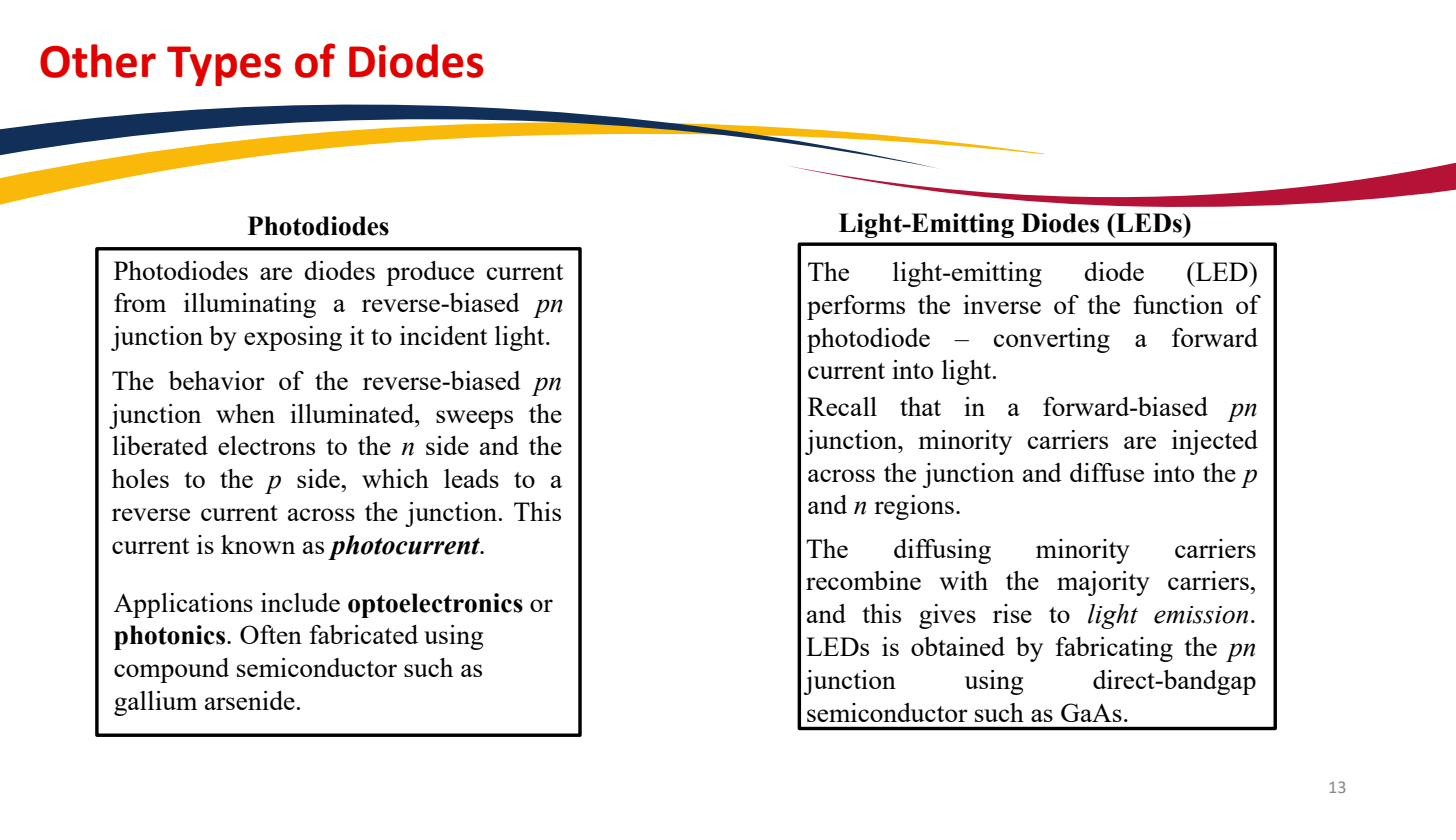 Photodiodes generate current under illumination; LEDs emit photons when forward-biased.
Where it is used
Anywhere light has to become an electrical signal: light meters, the receivers at the end of fibre-optic links, optical encoders, remote-control sensors. Solar cells too, operated with no external bias and harvesting power from the photocurrent rather than measuring it. A solar cell is a large-area photodiode optimised to deliver power rather than measure intensity. Same underlying physics as the Light-emitting diode: both hinge on the energy exchanged when an electron–hole pair is created (photon absorbed) or destroyed (photon emitted) at the junction.