The Early effect (base-width modulation) is the slight rise in BJT collector current as the collector–emitter voltage increases, at fixed . It’s the BJT analogue of the MOSFET’s Channel-length modulation, and the reason an active-mode BJT has a finite output resistance instead of behaving as a perfect current source.
Physical cause
In active mode the collector–base junction is reverse-biased. Raising (with held constant) increases that reverse bias, which widens the CBJ depletion region. The depletion region eats into the base, so the effective electrical base width (the neutral region the injected carriers must diffuse across) gets narrower. A narrower base means the carrier concentration gradient is steeper and the transit shorter, so a larger fraction of injected carriers make it across before recombining. Result: rises slightly as rises. Since the base width controls the saturation current, itself effectively depends on through .
The modified current law
Adding a first-order correction to [[BJT collector current|]]:
where is the Early voltage, a device parameter typically 50–100 V for a discrete transistor. A larger means the curves are flatter (less base-width modulation), good for high-gain amplifiers.
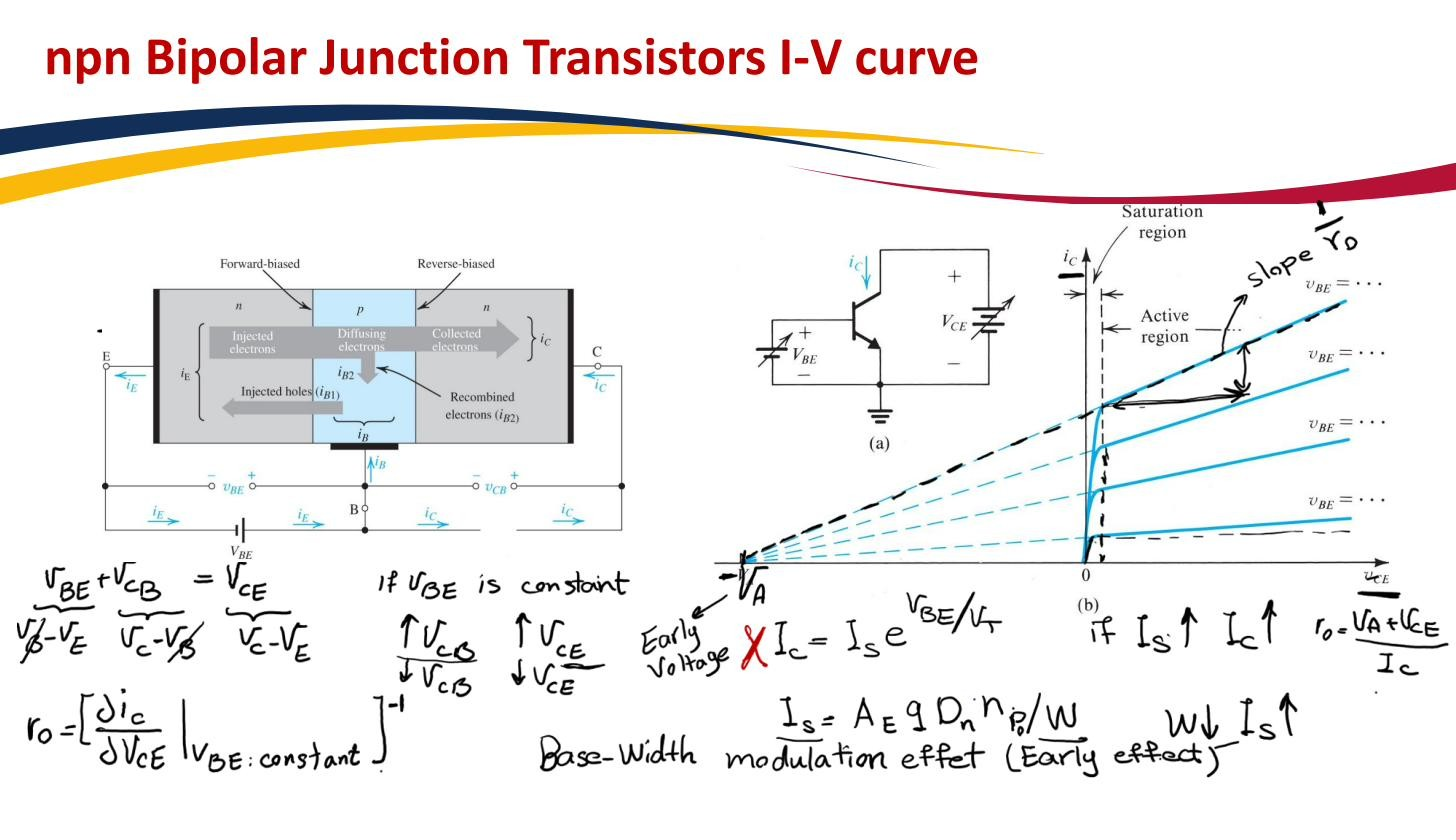 npn vs family at constant : in the active region the slope is non-zero (); extrapolating the lines backward, they all intersect the axis at the same point .
Output resistance
The non-zero slope of the – curve in the active region defines a small-signal output resistance. Differentiating the corrected law with respect to at the bias point,
so
Same form as the MOSFET’s . Geometric reading of the figure: every active-region line, extended backward, hits the axis at , the same construction used for the MOSFET in Channel-length modulation. At with , : large, but not infinite, and it sets the ceiling on the gain of a Common-emitter amplifier ().
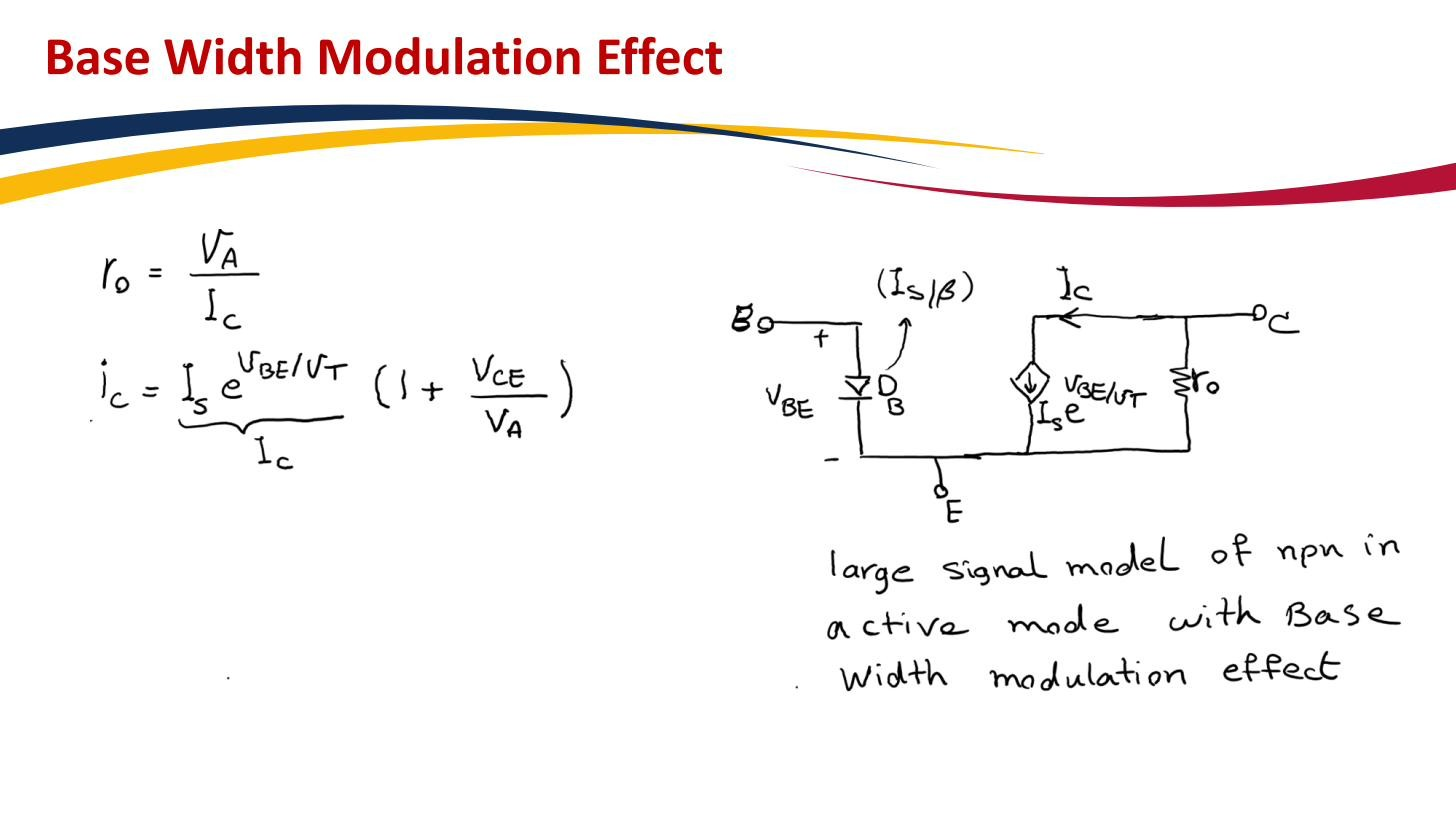 Active-mode large-signal model with the Early effect included: the collector current carries the correction and an output resistance is added in parallel with the current source between collector and emitter.
For introductory DC hand analysis the Early effect is dropped (set ) to give the simplified BJT large-signal model; it is restored only in small-signal gain and output-resistance calculations where it actually limits performance.