The standard discrete-amplifier biasing scheme. A resistive Voltage divider from the supply sets a fixed reference at the gate (MOSFET) or base (BJT), and a source/emitter resistor adds Negative feedback to stabilise the operating point. The practical realisation of the principle in MOSFET biasing.
The topology
Two divider resistors (supply to gate) and (gate to ground) set the gate reference
and a source resistor closes the feedback loop. KVL around the gate–source loop gives , so when the drain current is , set by stable resistors, not the wandering Threshold voltage or MOSFET transconductance parameter. Counting the divider pair, , and the drain resistor , this is also called the four-resistor bias.
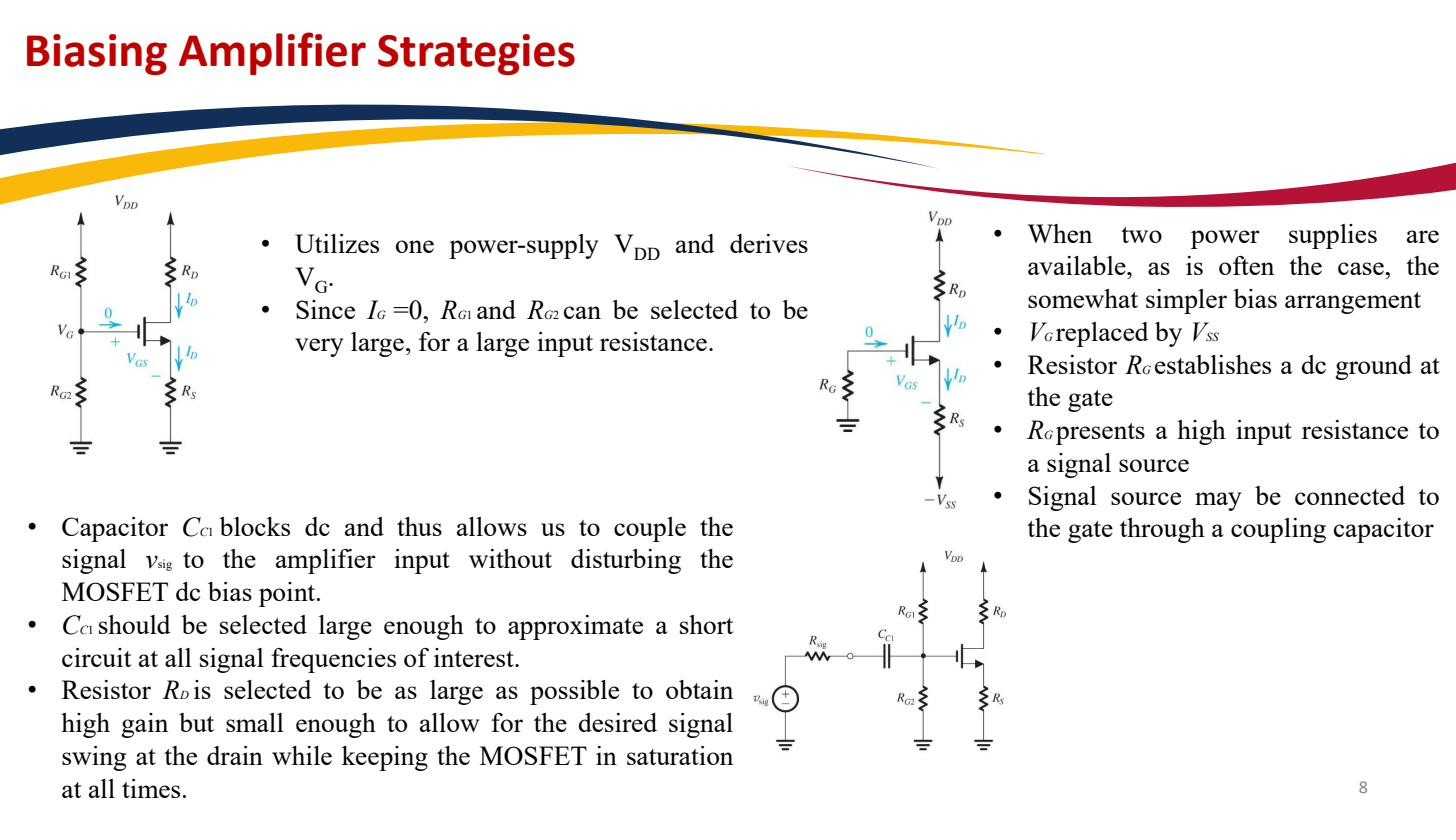 Left: single-supply divider + source . Right: dual-supply version with to ground.
Single-supply vs dual-supply
- Single-supply: one rail . The divider generates ; in the source provides feedback. The win for the MOSFET: because the gate draws no current (Gate oxide), the divider resistors can be made very large (megohms) without disturbing , keeping the stage’s input resistance high.
- Dual-supply (, ): the source is returned through to , and a single resistor from gate to ground sets the gate at AC ground (and DC ~0) while still presenting a high input impedance through an input Coupling capacitor. Fewer divider resistors, and the negative supply gives more headroom.
Shared with the BJT — with one caveat
The same four-resistor topology biases a BJT (see BJT DC analysis), and the negative-feedback idea is identical. The difference: a BJT base does draw current. So for a BJT the divider must be designed “stiff”, with the current through the divider much larger than the base current. Otherwise the base current loads the divider and shifts with the transistor’s (which itself spreads widely). For a MOSFET that constraint vanishes because the gate current is zero, which is why MOSFET dividers can use much larger resistors. Same circuit shape, but the MOSFET version is easier to get right.