The emitter follower (common-collector amplifier) is the BJT configuration with input at the base, output at the emitter, and collector at AC ground (usually tied to ). Voltage gain just below 1, input resistance very high, output resistance very low. It’s the standard analog Buffer amplifier, the BJT analogue of the Source follower.
Why the output “follows” the input
In active mode the base–emitter drop is the roughly-constant 0.7 V of a forward PN junction. So the emitter voltage is
Whatever the base does, the emitter does the same thing offset by ≈0.7 V. The signal (the AC part) passes through unchanged: , so
Slightly less than 1 because the intrinsic [[Emitter resistance|]] forms a small divider with . There is no voltage gain. The value of the stage is entirely in its impedance transformation.
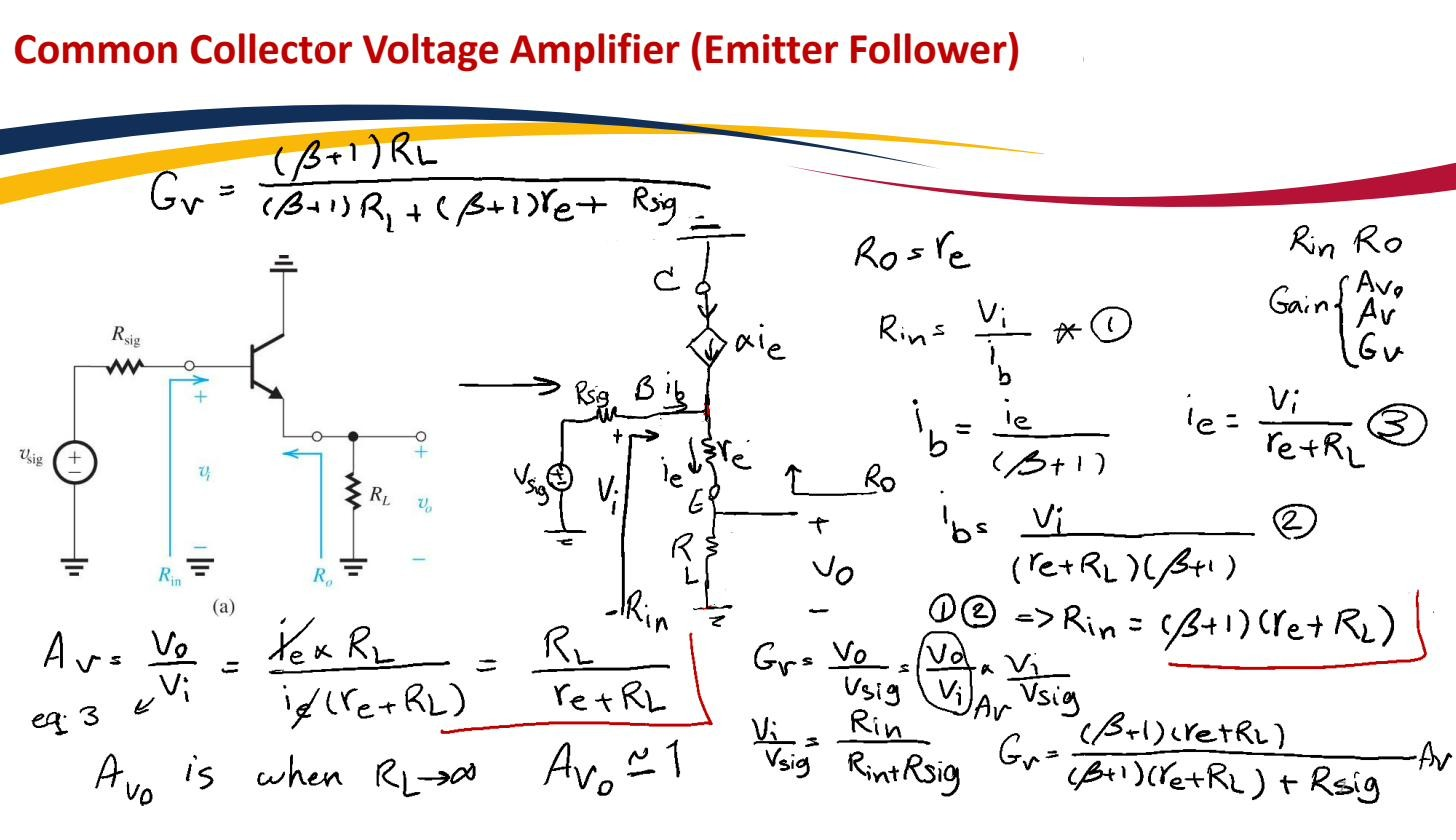 Common-collector / emitter follower: output at the emitter follows the input at the base; gain ≈ 1, very high input resistance, low output resistance. Used as a buffer.
The impedance transformation
This is the whole point. By the Resistance reflection rule:
- Input resistance (high): the emitter load is reflected up to the base by : often hundreds of kΩ. The follower barely loads the source driving it.
- Output resistance (low): the source resistance at the base is reflected down to the emitter by , in series with the intrinsic : typically only tens of ohms.
So a high-impedance signal source (which can’t itself drive a heavy load) connects to the follower’s base. The follower presents that source with an easy high-impedance load, and re-presents the same voltage at the emitter from a very low impedance, able to drive a heavy load. Voltage in ≈ voltage out, but the load is decoupled from the source. That’s the job of a Buffer amplifier, and it’s why the emitter follower is the default output stage of analog circuits and op-amps.
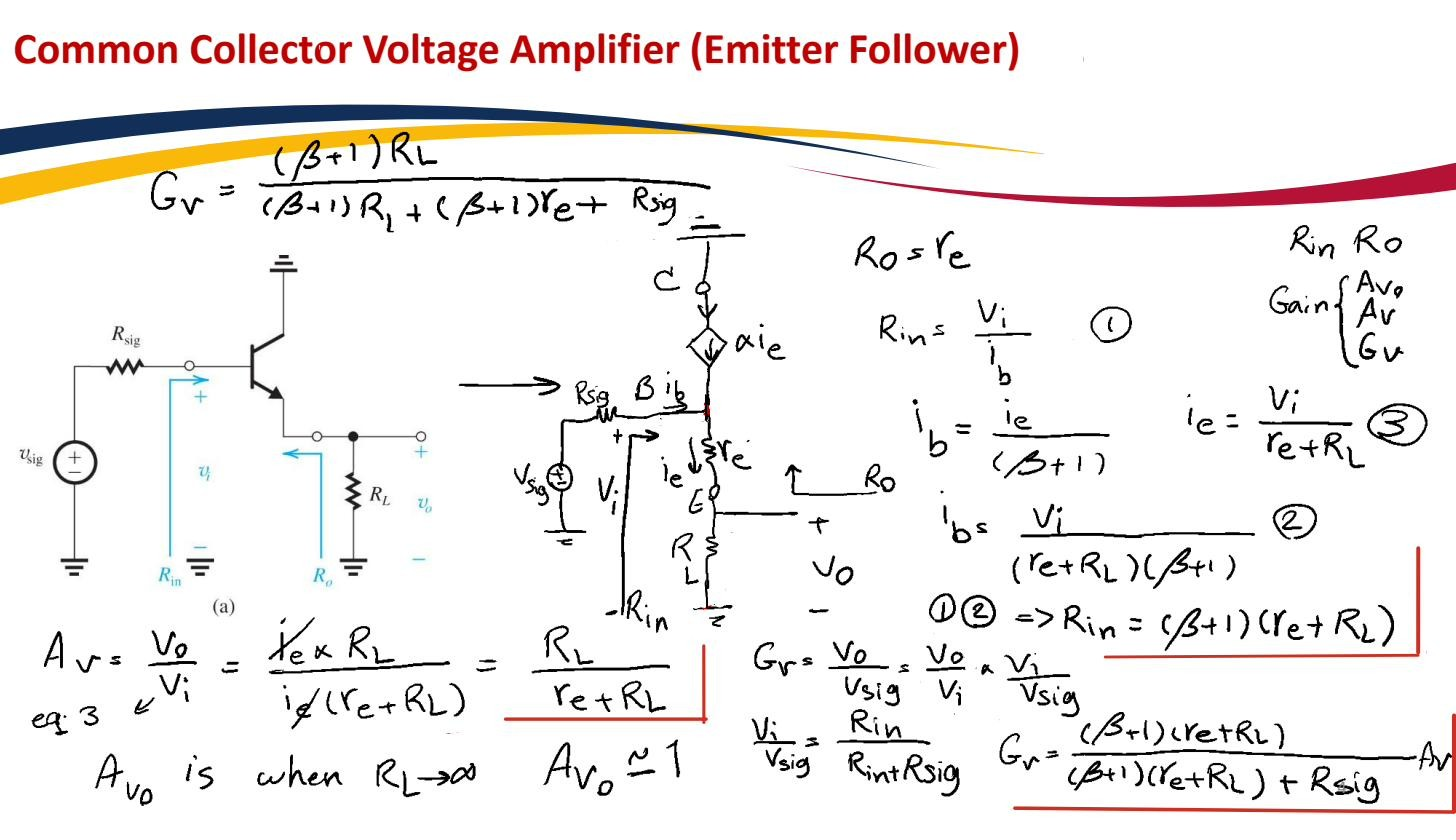 Detailed analysis of the emitter follower: near-unity gain with a large impedance transformation, the standard output buffer for analog circuits.
The three single-transistor BJT stages divide the labour: the Common-emitter amplifier provides voltage gain (inverting), the Common-base amplifier provides a low-input-impedance current buffer with wide bandwidth, and the emitter follower provides a near-unity-gain impedance buffer. They mirror the three MOSFET stages exactly.