A voltage follower (unity-gain buffer) is the degenerate non-inverting configuration with and , i.e. the output wired straight back to the inverting input. Closed-loop gain is exactly : the output follows the input. It doesn’t amplify; it transforms impedance.
Why the gain is one
The non-inverting gain is . The feedback network here is a plain wire from to , which is the limit (a perfect short for the feedback) and (nothing to ground):
You can see it directly too. The virtual short forces . The non-inverting input is the signal, . The inverting input is wired to the output, so . Therefore . The op-amp does whatever it must to keep its inverting input (which is its own output) equal to the input, so the output copies the input.
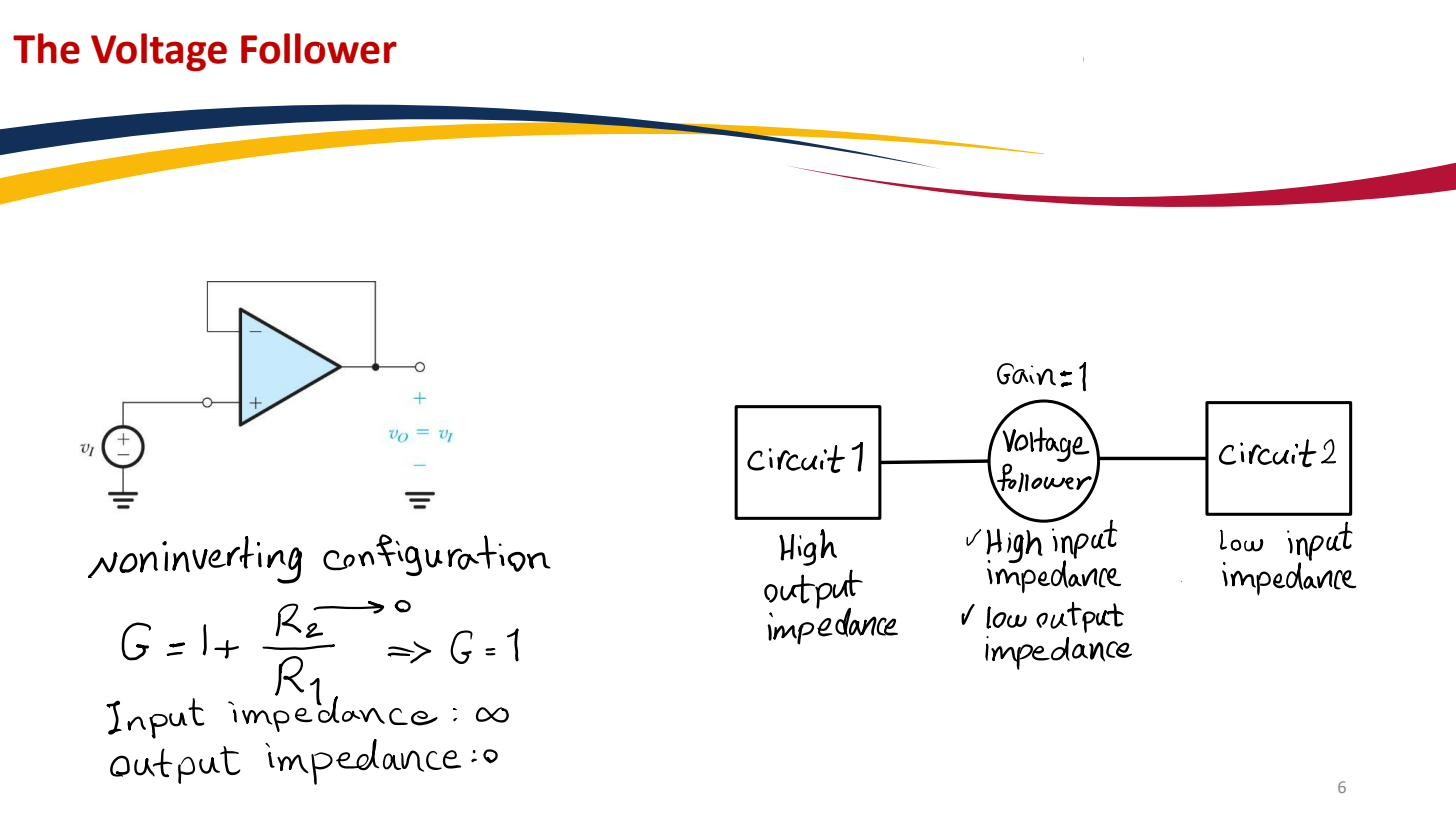 Output tied to the inverting input. , ∞ input impedance, 0 output impedance: a buffer.
What it is for
A gain of one sounds pointless until you look at the impedances. The signal drives the non-inverting input directly, which draws no current (golden rule 1 of the Ideal op-amp model), so the input resistance is the op-amp’s own, ideally infinite. The output is the op-amp’s output, ideally zero resistance, able to drive any load without sagging. So the follower:
- draws nothing from whatever it’s connected to (it doesn’t load the source), and
- delivers a stiff voltage to whatever follows it (the load can’t pull it down).
That makes it the cleanest practical Buffer amplifier and the closest real circuit to an ideal voltage source, exactly the role we wanted the side of a Thévenin equivalent to play. The classic use: a high-output-impedance source (a sensor, a long cable, the tap of a Voltage divider, the output of another op-amp stage) feeding a low-input-impedance load. Connect them directly and the load forms a divider with the source impedance and the signal collapses. Insert a follower between them and the source sees infinite load (no loading), while the load sees zero source impedance (no attenuation). Same voltage, broken impedance chain. It’s the MOSFET Source follower / BJT Emitter follower taken to its ideal limit.