One of the two basic op-amp Negative feedback topologies. The input signal drives the inverting input through a resistor , a feedback resistor runs from the output back to that same inverting node, and the non-inverting input is grounded. Closed-loop gain is the negative resistor ratio , set entirely by external components.
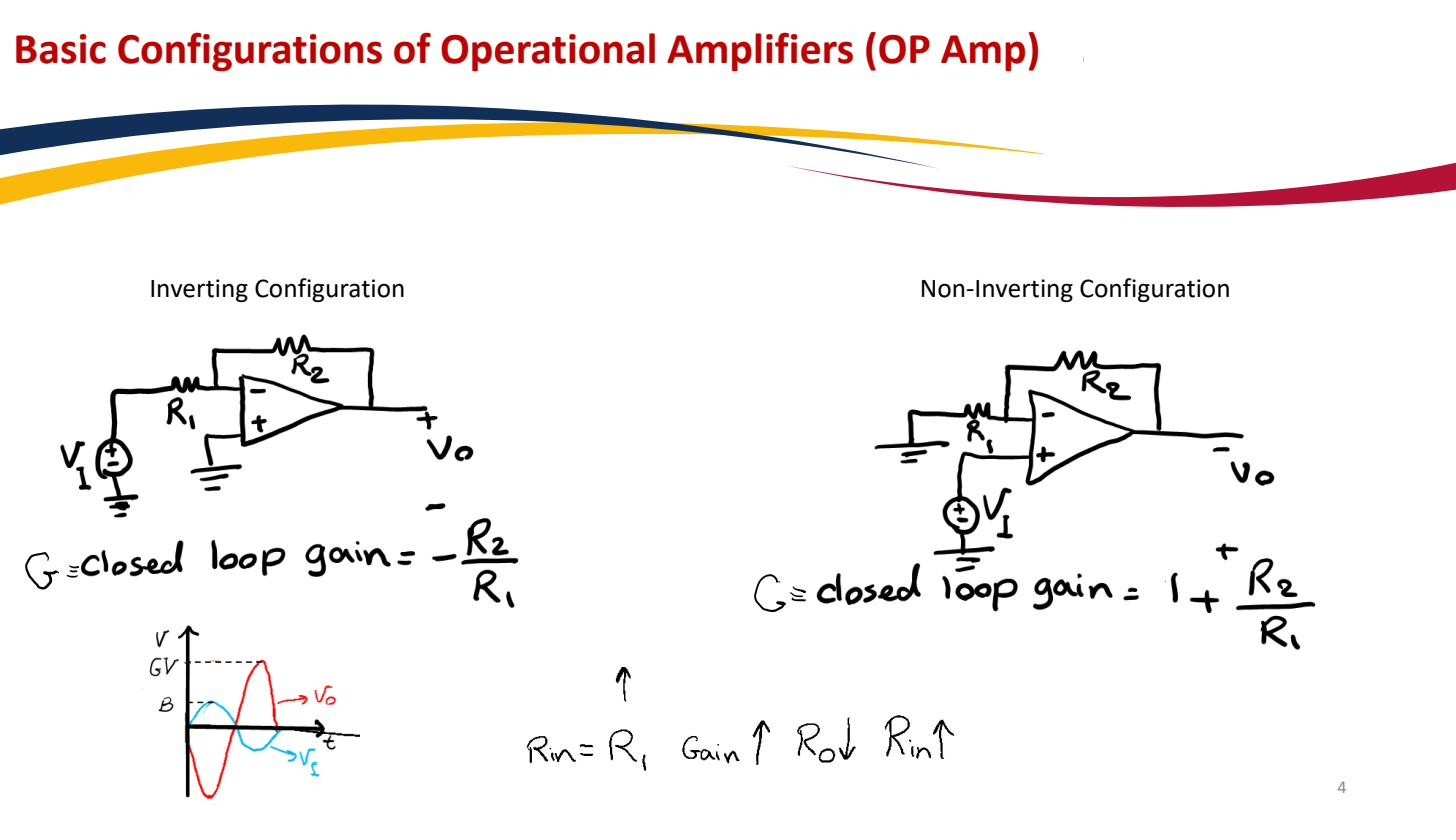 The two basic feedback configurations: inverting (signal into at ) and non-inverting.
Deriving the gain
Three steps, using the two golden rules of the Ideal op-amp model plus KCL.
Step 1 — golden rule 2 (virtual ground). Negative feedback forces . The non-inverting input is wired to ground, so , and therefore . The inverting node sits at ground potential even though it is not connected to ground, a virtual ground.
Step 2 — golden rule 1 + KCL. No current flows into the inverting input (). So at the inverting node, all the current arriving from through must continue on through toward the output, it has nowhere else to go. The current into the node from the source is ; the current leaving toward the output through is . Setting them equal with :
Step 3 — solve for the gain. Rearranging,
The gain depends only on the resistor ratio : not on the op-amp’s Open-loop gain , not on temperature, not on the device at all (to the accuracy discussed in Closed-loop gain). That insensitivity is the whole point of feedback. The minus sign says the output is out of phase with the input: a positive input swing produces a negative output swing. With and the gain is .
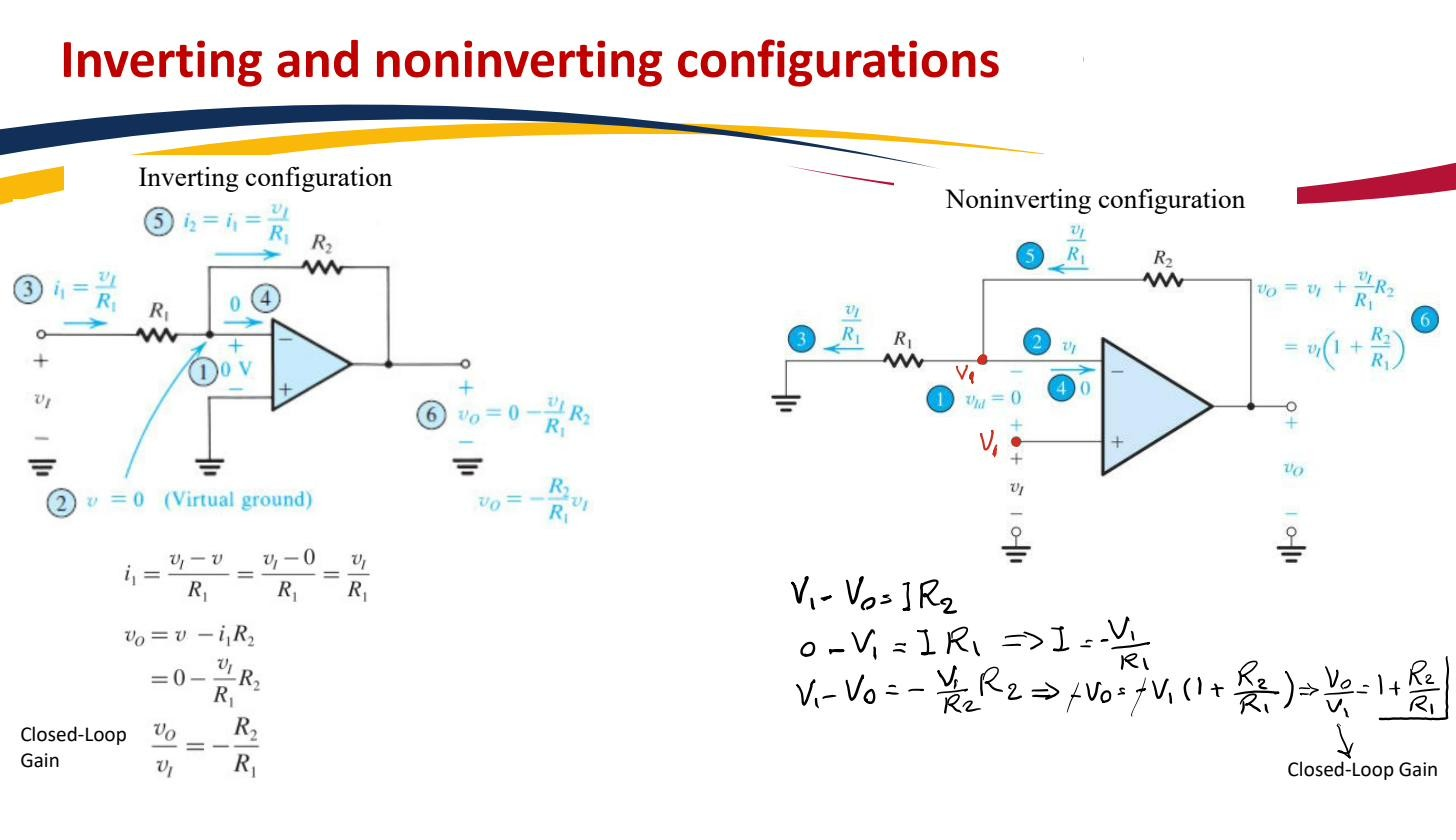 Inverting gain ; non-inverting , both depend only on resistor ratios.
Input resistance — the drawback
What resistance does the source see? Looking in from , the current is and (virtual ground), so the source sees exactly to ground:
This is finite, and it’s the inverting configuration’s main weakness. A high-impedance source (a sensor, a piezo element) connected through forms a Voltage divider with the source’s own output resistance and loses signal. You also can’t make large without making large, which forces huge to keep the gain. When a source must not be loaded, use the Non-inverting amplifier (op-amp) (infinite input resistance) or buffer it with a Voltage follower (op-amp). The same virtual ground that costs you here is what makes the Summing amplifier work.