The closed-loop gain is the gain of an op-amp circuit with feedback connected: the gain you actually get and design for, as opposed to the bare-chip Open-loop gain . In the ideal limit it is a pure ratio of external resistors, for the Inverting amplifier (op-amp) and for the Non-inverting amplifier (op-amp). It does not depend on the op-amp, on temperature, or on the active device. That independence is the whole reason Negative feedback is used.
Effect of finite open-loop gain
The ideal derivations set to get . What if is large but finite? Redo the inverting amplifier without that shortcut. The output still obeys . With (grounded), this means , not exactly zero but a tiny nonzero error voltage. Write KCL at the inverting node with this corrected . Current in from the source equals current out through the feedback resistor:
Substitute :
Multiply through and collect terms. The right side is ; the left is . Gathering :
Solve for and tidy (multiply numerator and denominator by ):
The result is the ideal gain multiplied by a correction factor that approaches as . The finite- error is small precisely because is enormous.
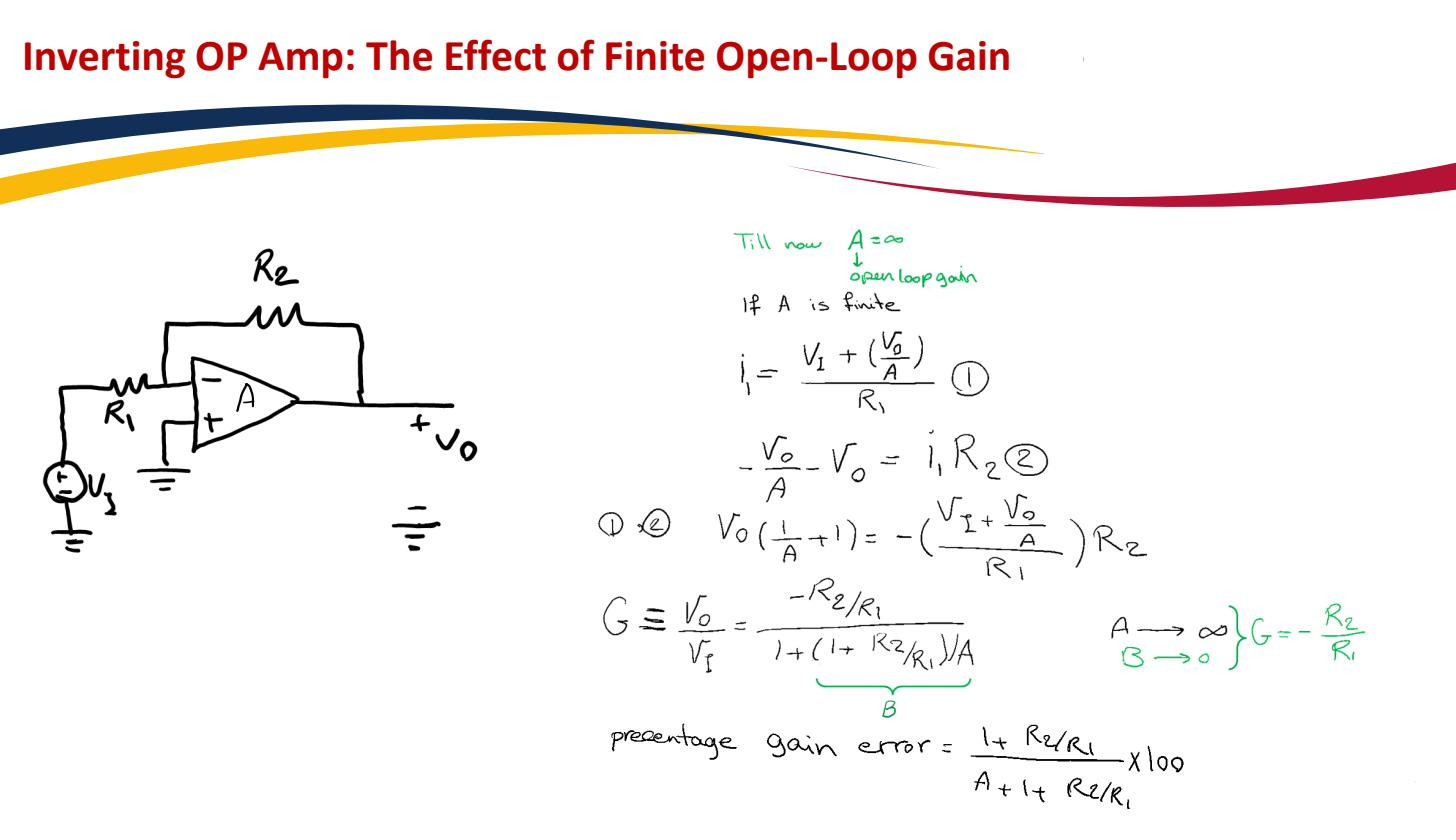 Finite- correction factor as .
Worked number. A 741 has . Build a inverter, so . The correction factor is
A gain error. You almost never need the corrected formula in design; the op-amp’s huge is what makes the ideal model trustworthy.
Loop gain — the general lesson
Reframe the result. Write the closed-loop gain as the ideal gain times , where is the loop gain, the total gain going once around the feedback loop (the op-amp’s times the feedback fraction). For the inverter, , so :
When the loop gain is large (open-loop gain closed-loop gain), and the closed-loop gain locks onto the feedback network, completely indifferent to . That is the engineering meaning of “large loop gain”: you deliberately throw away open-loop performance to buy closed-loop precision. The op-amp itself is mediocre; the loop makes it good. Finite and frequency-dependent also limits closed-loop bandwidth to roughly , one of the Real op-amp imperfections.