An operational amplifier is an integrated circuit containing many transistors, sold as a single component, that behaves as a differential amplifier with very high gain. Every amplifier before this was one MOSFET or BJT whose gain depended sensitively on bias point, , , and temperature. The op-amp is different: somebody else designed the internals, and the characteristics are so close to ideal that we treat them as exact. The consequence is that the gain of a circuit built around an op-amp depends almost entirely on external resistor ratios, not on the op-amp itself. That comes from Negative feedback, which lets you do analog signal processing without designing a single transistor.
Terminals
The op-amp has three signal terminals and two power-supply terminals.
- Inverting input (also written ): conventionally drawn with a minus sign.
- Non-inverting input (also written ): drawn with a plus sign.
- Output .
- Positive supply rail and negative supply rail . The point midway between the two supplies, where they meet, is the circuit ground. Every signal voltage in the circuit is measured with respect to this node.
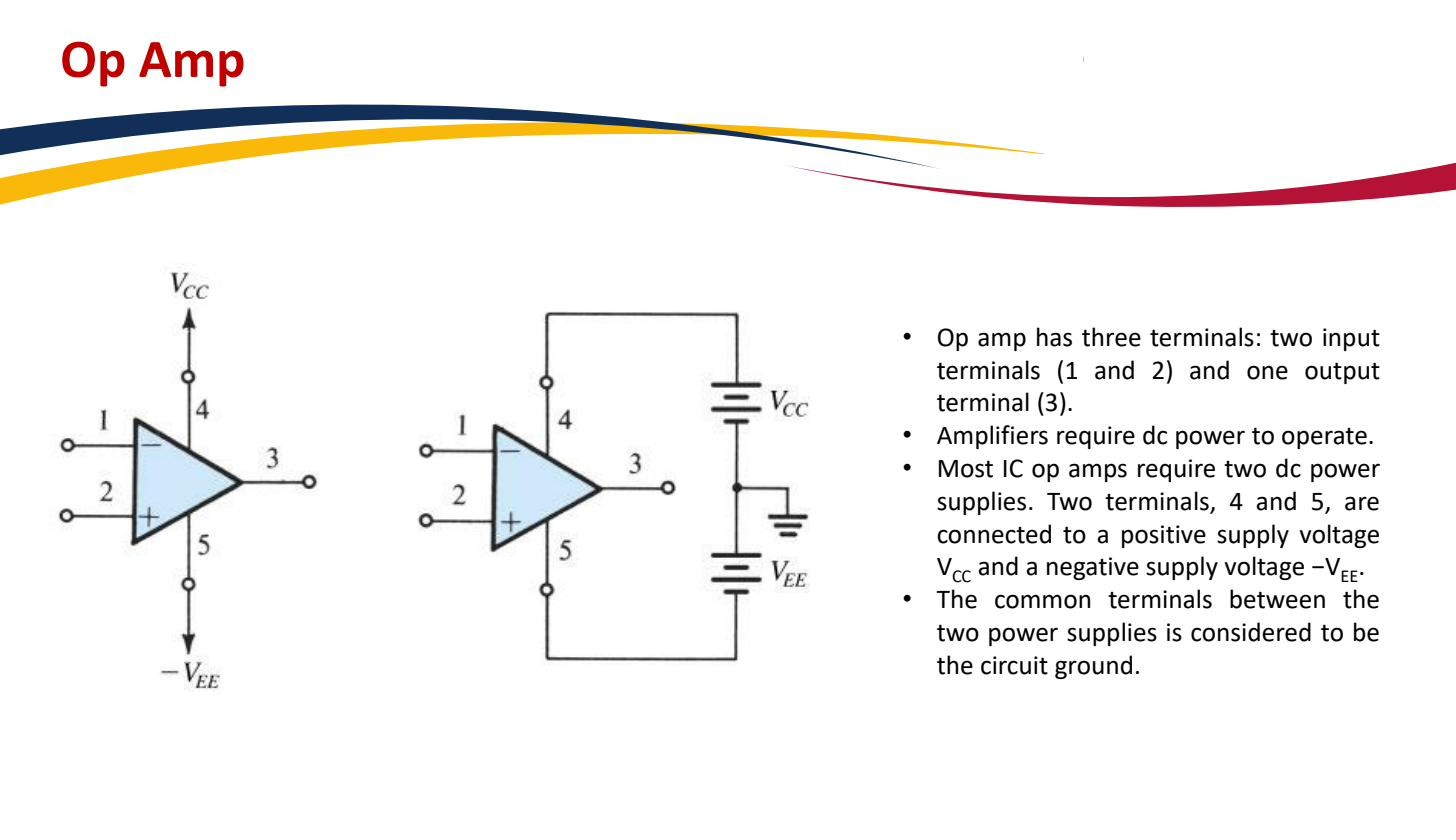 Three signal terminals plus two supply rails; the supply midpoint is the circuit ground.
Two things about the supply terminals trip people up. First, although and appear on the schematic symbol, they’re almost always omitted from circuit diagrams to keep them readable, but the op-amp does nothing without them. The chip needs power; the schematic just hides the wires. Second, the output voltage can never exceed nor fall below ; it is physically pinned between the rails. With a typical lab supply of and , the usable output swing is only about , since a volt or two of headroom is lost inside the chip. This is Op-amp output saturation.
What it actually does
The op-amp takes the difference of its two inputs and multiplies by a huge number:
where is the Open-loop gain, typically to for a real device. is the non-inverting input voltage, the inverting input voltage, both measured to ground. The op-amp responds only to the difference between its inputs; in principle it ignores any signal common to both (see Differential and common-mode signals).
That gain is far too large to use directly. A gain of means a input difference slams the output to , so the faintest noise saturates the output to a rail. The op-amp is useless open-loop. It becomes a controllable amplifier only when wrapped in Negative feedback: feed a fraction of the output back to the inverting input so the device drives its own input difference toward zero. There are two ways to do this, the Inverting amplifier (op-amp) and the Non-inverting amplifier (op-amp), and their gains, derived from the Ideal op-amp model, depend only on resistor ratios.