An instrumentation amplifier is the standard three-op-amp circuit for accurately amplifying a tiny differential signal that rides on a large common-mode signal. Two non-inverting input buffers feed a Difference amplifier. The result has infinite input resistance, a Common-mode rejection ratio above , and a differential gain set by a single resistor.
Why the plain difference amplifier is not enough
The single-op-amp Difference amplifier has two fatal flaws for instrumentation: its input resistance is finite (the sources see and ), so a high-impedance sensor is loaded and attenuated; and its CMRR depends on matching four external resistors to a fraction of a percent. Real measurements (a thermocouple, an ECG electrode pair, a strain-gauge bridge) present a few millivolts of differential signal sitting on several volts of common-mode interference from a high source impedance. Both flaws are intolerable there.
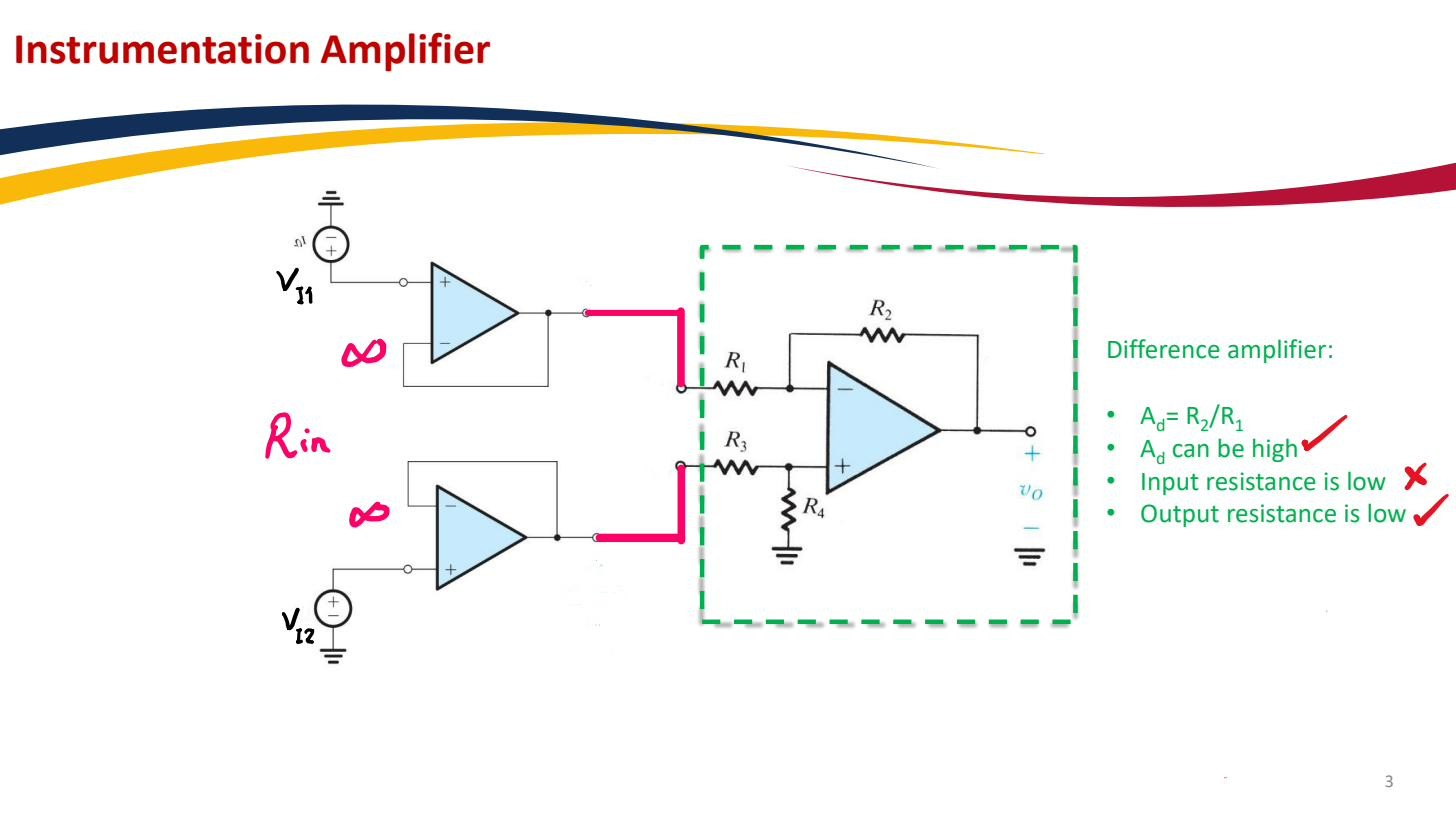 Why the single-op-amp difference amp is unsuitable: finite , CMRR set by resistor matching.
The two input stages
Op-amps A1 and A2 are wired almost like non-inverting amplifiers, with one twist: instead of each inverting-side resistor going to its own ground, the two are tied together through a single gain-setting resistor , with an outer resistor from each op-amp output to the ends of .
By golden rule 2 (virtual short), A1 forces its inverting node to and A2 forces its inverting node to . Those two nodes are the two ends of , so the voltage across is exactly , and the current through it is
Golden rule 1 says no current enters the op-amp inputs, so this same current flows through both outer resistors. Walk from A1’s output to A2’s output through the chain : the output of A1 is
and symmetrically . Subtract:
So the first stage has a differential gain of , set by the single resistor , which is why real in-amp ICs bring out to two pins. The decisive point: a common-mode input () puts zero volts across , so no current flows, so each output equals its own input. Common-mode passes through at unity gain while the differential signal is amplified by .
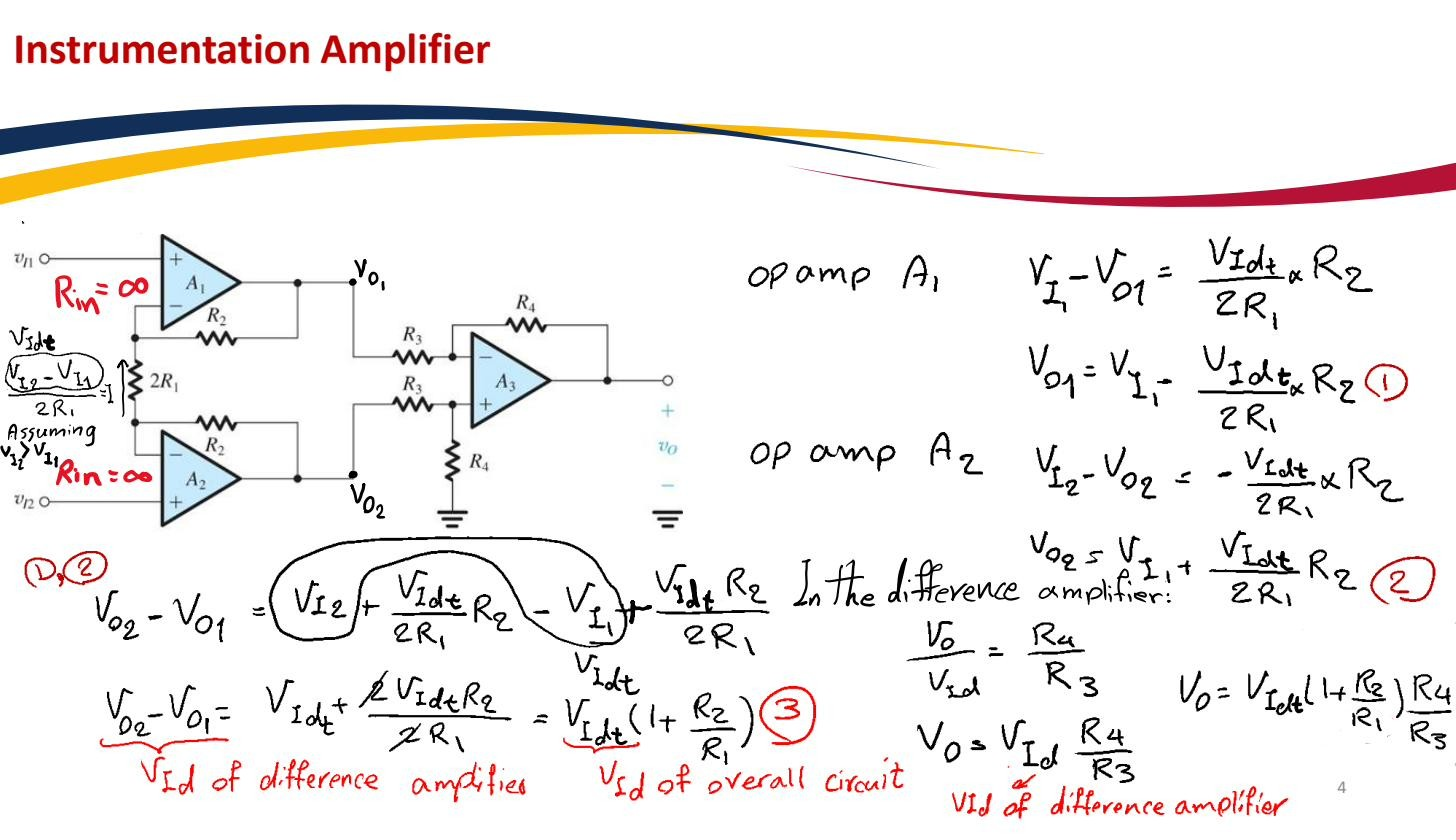 Two non-inverting input stages + a difference amp; sets the first-stage differential gain.
Why this fixes everything
Two problems, both solved by the input stage. Input resistance is now infinite at both inputs: each signal drives a non-inverting op-amp input directly, drawing no current. And the first stage has already boosted the differential signal relative to the common-mode signal before any resistor matching is relied upon. The third op-amp A3, a conventional difference amplifier, then adds its own differential gain and rejects the (now relatively tiny) common-mode. Overall:
Because the common-mode component was never amplified, A3’s resistor mismatches act only on that small leftover common-mode signal, so realistic resistor tolerances still deliver CMRR in excess of . Infinite input resistance, single-resistor gain, large CMRR: what biopotential, strain-gauge and thermocouple front ends need.