A DC power supply is the chain of circuit blocks that turns the AC from a wall socket into the steady DC rail an electronic circuit runs on. The classic linear supply is four stages in series: a transformer, a Rectifier, a smoothing capacitor, and a regulator. Each stage fixes one problem the previous stage’s output still has.
The chain, block by block
Transformer. The wall delivers a large AC voltage (e.g. 120 V RMS). A transformer steps it down to a smaller AC voltage close to what the circuit needs, and isolates the circuit from the mains. It does not change the kind of voltage. The output is still AC, still zero-average.
Rectifier. A diode arrangement (Half-wave rectifier, Center-tapped full-wave rectifier, or Bridge rectifier) makes the waveform unipolar, always one polarity. After this stage the voltage no longer averages to zero, but it is still a train of half-sinusoid humps, not anything you would call DC.
Smoothing capacitor. A large capacitor across the load charges to the peak and holds the voltage there between the rectifier’s conduction bursts. The output is now close to a constant with only a small Ripple voltage sawtooth on top. This is “unregulated DC”: roughly constant, but it still droops with load current and tracks slow changes in the mains voltage, and the ripple is still present.
Regulator. The final stage forces the output to a precise, fixed value regardless of the remaining ripple, load changes, and supply drift. In a simple supply this is a Zener voltage regulator; a better supply uses an active series regulator (a transistor controlled by feedback). After this block the output is clean, stable DC.
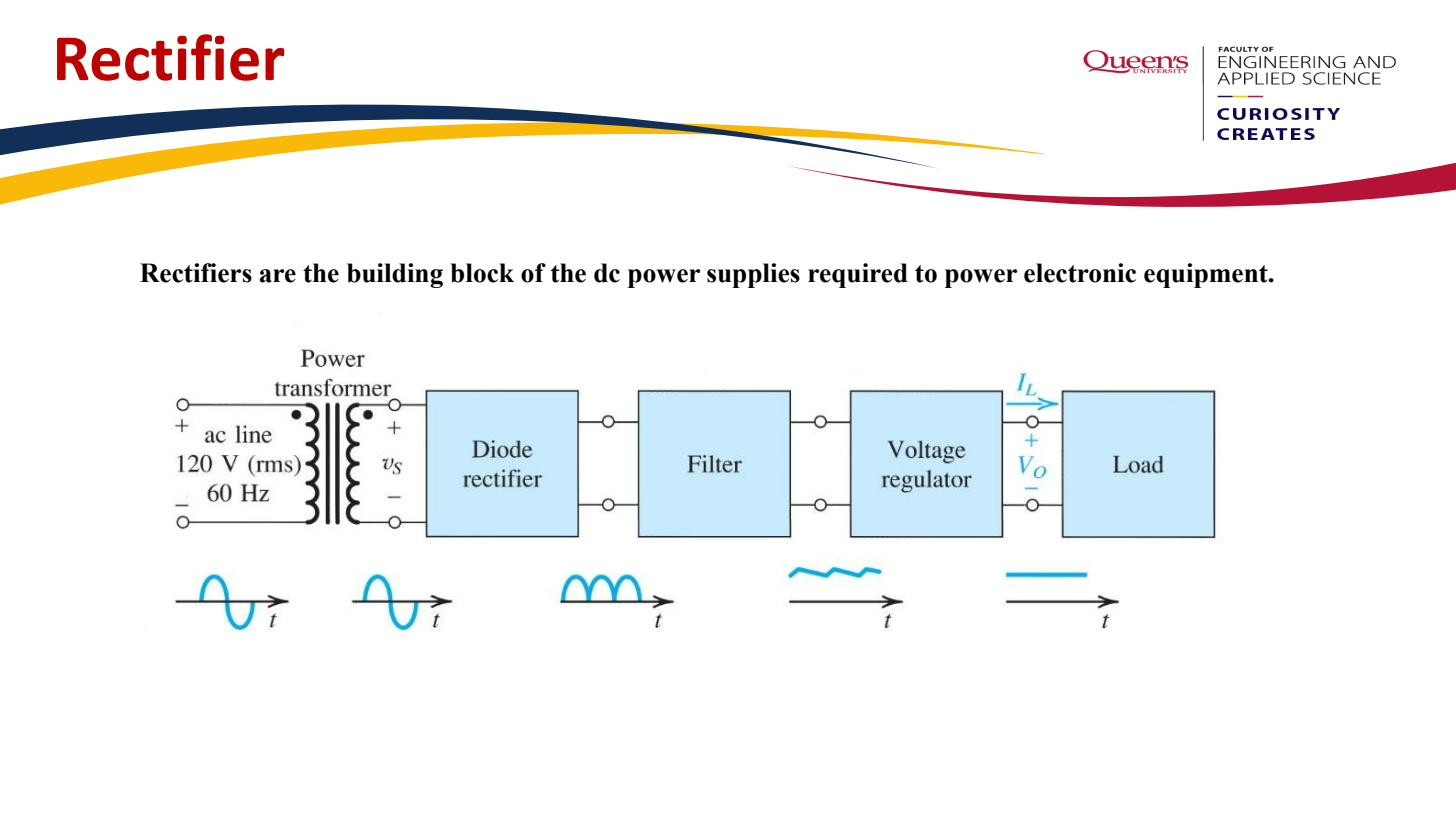 Rectifiers are the building block of the DC power supplies that power electronic equipment.
Why all four stages
You cannot skip stages. The transformer alone gives AC. Add a rectifier and you have unipolar pulses, useless for powering a circuit. Add the capacitor and you have rough DC that still wobbles with the line and the load. Only the regulator delivers the constant voltage a circuit actually needs. Each block exists because the one before it leaves a defect: non-isolation/wrong amplitude, then bipolarity, then ripple, then instability. A supply that stops at the smoothing capacitor (no regulator) is an unregulated supply: cheap, and adequate only when the load can tolerate the ripple and drift.