Ripple voltage is the peak-to-peak variation left on the output of a Peak rectifier, the small sawtooth wobble that remains after the smoothing capacitor has averaged the rectified waveform. It’s the residual AC riding on the DC, and minimising it is the main job of the smoothing stage.
Where the formula comes from
Between conduction bursts the diode is off and the load draws its current entirely from the capacitor. A capacitor discharged by a roughly constant current droops linearly: , so . Over a discharge interval the voltage falls by
is the DC load current, the smoothing capacitance, and the time the capacitor is left to discharge: one full period for a half-wave rectifier, or half a period for a full-wave (the next peak comes twice as often). With line frequency , the period is , so:
The factor of 2 is the full-wave advantage: peaks arrive twice as often, the capacitor discharges for only half as long, so the ripple is half (or, for a given ripple target, you need only half the capacitance).
Reading the formula and typical values
Ripple shrinks with larger , higher , or smaller load current . You cannot change the line frequency (50/60 Hz), and is set by the load, so the design knob is the capacitor. A typical small linear DC supply uses a few thousand microfarads to keep the ripple down to a few hundred millivolts.
Quick example. A full-wave supply delivering A at 60 Hz with F:
Halve the capacitor and the ripple doubles; double the load current and it doubles too. The trade-off isn’t free: smaller ripple means a shorter, sharper diode conduction burst and therefore a larger peak diode current, which is why Conduction angle and ripple get designed together. The remaining ripple is what a downstream Zener voltage regulator or active regulator must reject.
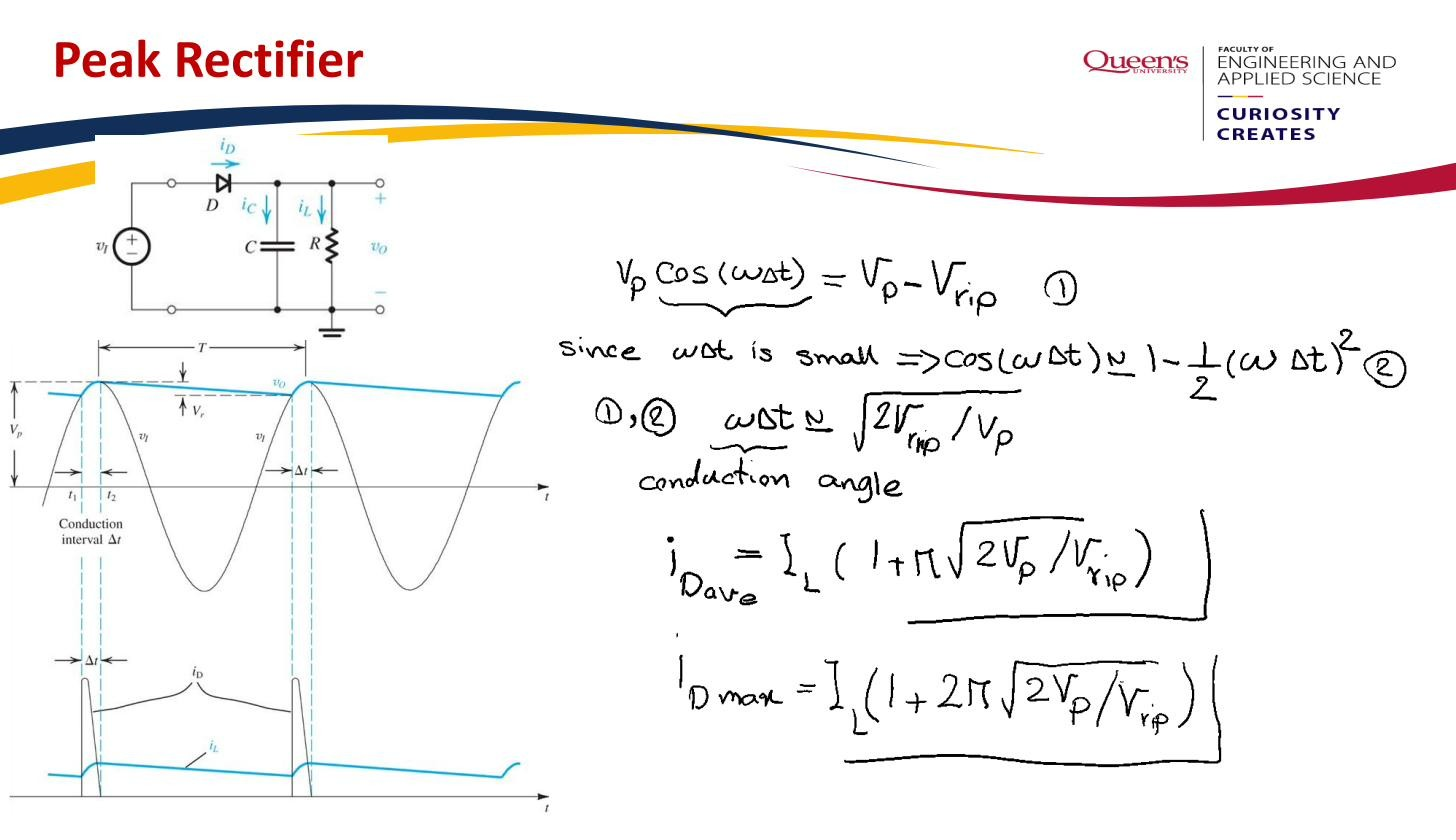 Conduction angle ; average/peak diode currents far exceed because charge is replenished in a short burst.