The sinusoid is the signal everything in signals-and-systems is built on. The general continuous-time sinusoid is
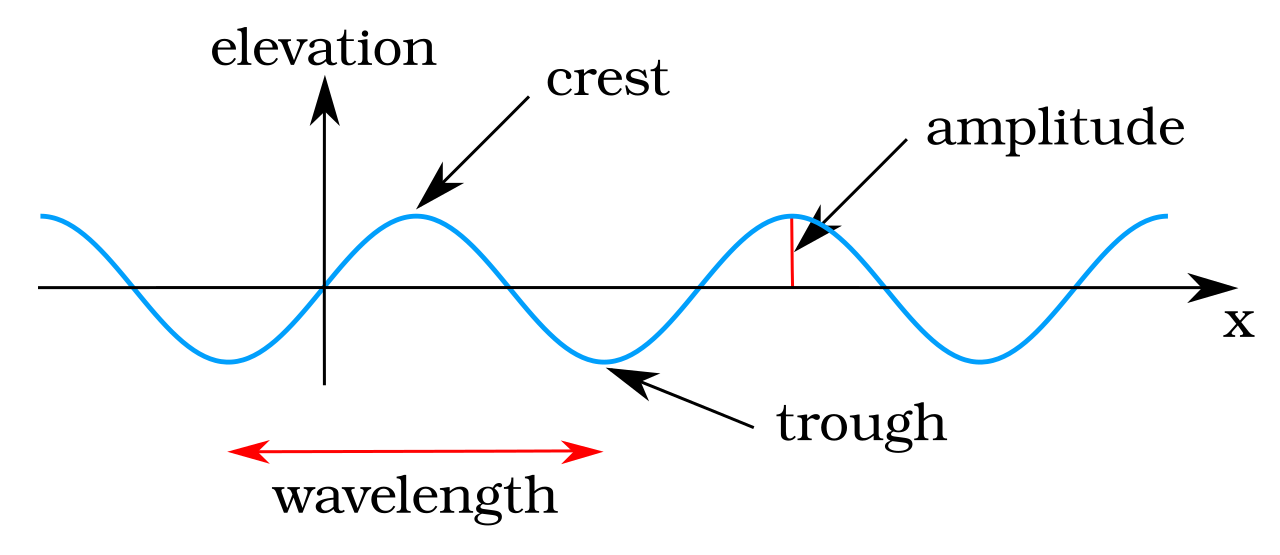 Image: Sine wave with amplitude and period annotations, CC BY-SA 3.0

Three numbers define it:
- Amplitude , the peak value. Doubling doubles the whole signal vertically.
- Fundamental period , the time in seconds it takes to repeat.
- Phase shift in radians. A positive slides the cosine left by seconds; a negative slides it right.
Three equivalent ways to write the same signal
The speed of oscillation can be described three ways:
is the cyclic frequency in hertz (cycles per second). is the radian frequency (or angular frequency) in radians per second. They differ by a factor of because one full cycle is radians of cosine argument.
Using these:
Same signal, three notations. You should be able to slide between them without thinking, since different chapters and different formula sheets pick different forms.
This course pays special attention to the middle one (-form, with inside the argument). In Fourier-transform formulas, is always grouped with inside an argument and never appears as a coefficient out front; this makes the formulas symmetric.
Why sinusoids dominate
Fourier showed that every reasonable periodic signal can be written as a sum of sinusoids at integer multiples of a fundamental frequency. The Fourier transform extends this to aperiodic signals: every reasonable signal is built up from sinusoids of all frequencies. So sinusoids are the basis we keep coming back to.
Sinusoids are also the eigenfunctions of LTI systems: a sinusoid in, a sinusoid out, at the same frequency. That’s what makes Fourier-domain analysis work.
Average power
When we square a sinusoid and average over many periods, the result is half the square of the amplitude:
This is independent of frequency and phase. It shows up in nearly every signal-power calculation, and is derived properly in Signal power. Worth memorizing.
Complex form
A real sinusoid decomposes into a sum of two complex exponentials via Euler’s formula:
Equivalently, and , so a real sinusoid is also the real (or imaginary) part of a single complex exponential. The two views — sum-of-two and real-part-of-one — are interchangeable.
Many derivations replace a real cosine by this sum, do algebra with the complex exponentials (which multiply, differentiate, and integrate cleanly), then collapse back to a real cosine at the end.
In electronics
In circuits and microelectronics the sinusoid usually appears as a voltage or current, written in sine form as , where is the peak amplitude, the angular frequency, and the phase. Sine vs cosine is purely a phase-reference choice ( shifted by ). It’s the test signal for everything in analog electronics: because any signal is a sum of sinusoids (its Fourier series) and biased circuits are linear in the small-signal regime, knowing a circuit’s response to one sinusoid at each frequency tells you its response to any signal.