Amplitude is the height of a waveform, its peak excursion away from zero. One of the three numbers that fully specify a single sinusoid, the other two being frequency and phase.
Write a sinusoidal voltage as
where is the amplitude in volts, is the angular frequency in rad/s, is time in seconds, and is the phase in radians. As runs forward, swings between and , so swings between and . The constant is exactly how far the waveform reaches from the zero line at its highest point.
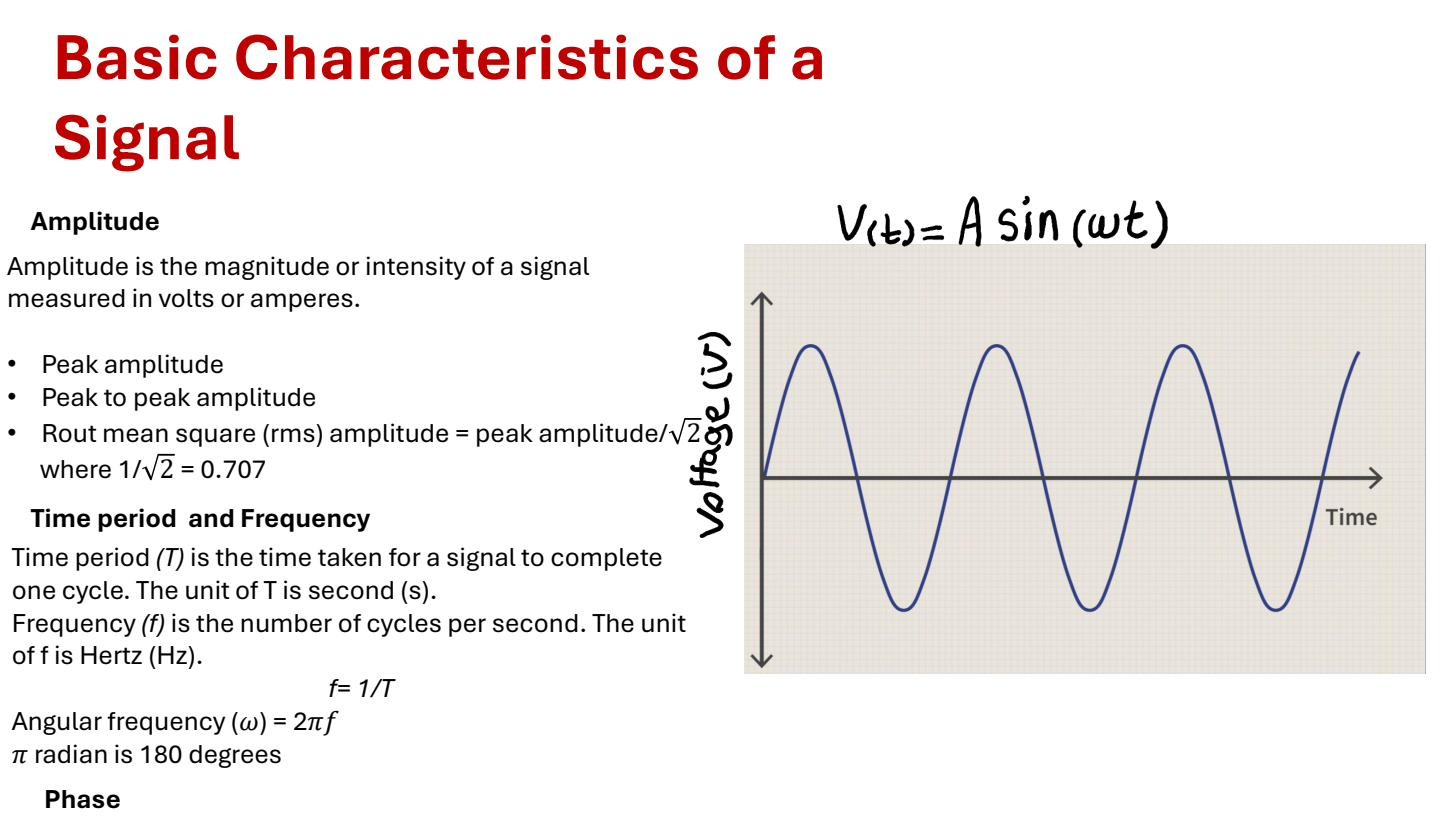 The three basic descriptors of a sinusoid : amplitude (peak, peak-to-peak, RMS ), period and frequency , phase .
Three ways to quote amplitude
The same waveform gets described by three different “amplitude” numbers, and confusing them is a classic source of factor-of-2 and factor-of- errors.
- Peak amplitude (also written ): distance from zero to the maximum. The in the equation above.
- Peak-to-peak : distance from the most negative point to the most positive point. For a symmetric sinusoid the waveform reaches and , so . Scopes usually display peak-to-peak because it’s the easiest thing to read off a screen: you measure the total vertical span of the trace.
- RMS value : the Root mean square of the waveform. For a sinusoid, . This is the amplitude that matters for power and heating.
For a peak sine wave: , , . All three describe the same signal.
Why amplitude matters physically
A signal is the electrical stand-in for some real-world quantity, and amplitude is usually how the strength of that quantity gets encoded. For an audio signal, amplitude maps to loudness: a louder sound produces a microphone voltage with larger peak swing. For a radio wave, amplitude relates to transmitted power. The power a sinusoid delivers into a resistor goes as the square of its amplitude, which is why RMS is the right measure for power (see Signal power). Doubling the amplitude across a fixed resistor quadruples the power it dissipates.
Amplitude is also what an amplifier exists to change. The whole point of a voltage amplifier is to take a small-amplitude input and produce a larger-amplitude copy at the output, ideally without distorting its shape (without altering its frequency content or phase relationships).