A complex sinusoid generalizes the real sinusoid and the real exponential at once:
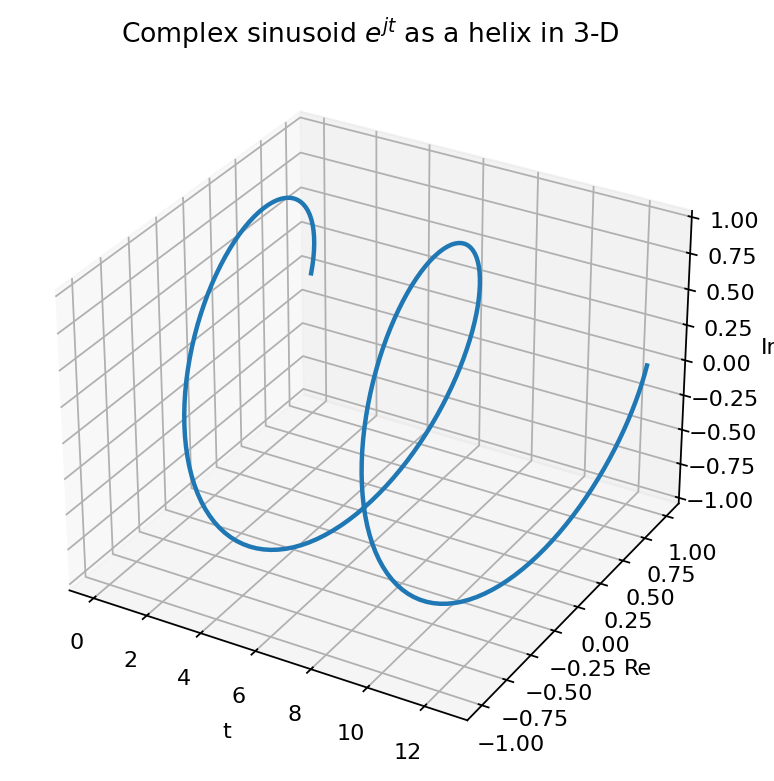 The complex exponential traces a unit-radius helix in (Re, Im, t) space.
where the second equality uses Euler’s formula. The pair fully describes a complex sinusoid: is the radian frequency of oscillation, and controls whether the envelope decays, stays constant, or grows.
- : oscillation inside a decaying envelope, the bumper-after-the-speed-bump signal, or the ring of a struck tuning fork. This is the shape of an underdamped second-order system’s transient (in the second-order sense, “underdamped” means damping ratio , which puts the poles off the real axis and produces exactly this kind of damped oscillation).
- : pure undamped oscillation, , tracing a circle in the complex plane.
- : oscillation inside a growing envelope, usually meaning instability.
The point in the s-plane
The pair is exactly a point in the complex s-plane: real part , imaginary part . The complex sinusoid is what the Laplace transform returns when you ask “what time-domain signal has a pole at ?” Pole locations and complex sinusoids are two views of the same object.
A pole in the left half-plane → decaying sinusoid. On the imaginary axis → pure oscillation. In the right half-plane → growing sinusoid. Memorize this pole-location-to-signal-shape mapping.
Why we use them even for real signals
Complex exponentials multiply, differentiate, and integrate cleanly:
Real sinusoids are messier: products of cosines give sums of cosines via half-angle identities. The usual trick is to replace a real cosine by a sum of two complex exponentials (via Euler’s formula), do the algebra, then collapse back to a real cosine.
Complex sinusoids are also the eigenfunctions of LTI systems: feed one in, get the same complex sinusoid out, scaled by a complex constant . That fact is what frequency-domain analysis is built on.
A note on versus
Electrical engineering writes the imaginary unit as , while mathematicians and physicists use . The EE convention exists because already means current. Same object, different notation.