The Fourier series represents a periodic signal of period as a sum of complex sinusoids at integer multiples of the fundamental frequency :
Synthesis (signal from coefficients):
Analysis (coefficients from signal):
where means “integrate over any one period.”
These two equations are the heart of the chapter. They are not on the formula sheet; you have to know them by heart. Everything else (properties, pairs, conversions) is on the sheet.
Reading the formulas
The -th coefficient describes the strength of the harmonic at frequency . So is the fundamental, is the second harmonic, etc. Negative values correspond to complex sinusoids spinning the opposite direction; they pair with positive to make real-valued sinusoids when is real (Conjugate symmetry of Fourier coefficients).
The coefficient is special: it’s the DC component (average value over one period), since . So .
Why it works
The derivation depends on the orthogonality of complex sinusoids at integer-multiple frequencies. Multiply the synthesis equation by and integrate over one period: by orthogonality, only the term survives, and you get the analysis formula.
Trigonometric form
For real signals, an equivalent form uses real cosines and sines:
The complex and trigonometric coefficients are related by
with . The factor of 2 is the most common source of error in converting between forms. Trigonometric form of Fourier series has the conversion details.
Standard pairs
The formula sheet lists Fourier-series pairs for common building blocks. The most useful:
- , representation period .
- , period .
- , period .
- , a constant has only a DC coefficient.
- , an impulse train has equal coefficients at every harmonic that’s a multiple of .
- , a periodic train of rectangles becomes a sinc-sampled spectrum.
- , a periodic train of triangles.
The pattern: any periodic train made by convolving a pulse with has coefficients times a sinc-like function of , masked by the Kronecker delta (zeroing indices not multiples of ).
Standard properties
All on the formula sheet, but worth knowing what each says:
- Linearity: .
- Time-shift: . The magnitude is unchanged; the phase rotates linearly in .
- Frequency-shift: . The dual of time-shift; foundation of amplitude modulation.
- Time differentiation: . Differentiation becomes algebraic multiplication.
- Multiplication–convolution duality: (discrete convolution). Periodic-convolution-in-time corresponds to multiplication-in- (with a factor of ).
- Change of period: representing over instead of adds zero coefficients between the existing harmonics.
Parseval’s theorem
The average power in the time domain equals the sum of squared magnitudes in the frequency domain. Useful for sanity-checking calculations and for estimating signal power from a few dominant coefficients. See Parseval’s theorem.
Convergence
For any periodic signal that is absolutely integrable over a period, has finitely many maxima/minima per period, and has finitely many discontinuities of bounded jump size per period (the Dirichlet conditions), the synthesis equation converges to at every point of continuity and to the midpoint of the left and right limits at jump points.
Two different limits to keep apart. The full infinite series converges pointwise at every point: to where is continuous, to the midpoint of the left/right limits at jumps. The truncated partial sum (the sum of just the first harmonics) behaves differently near jumps: it overshoots and undershoots the signal by about 9% of the jump size, and the overshoot doesn’t shrink as , it just gets narrower (the Gibbs phenomenon). So the series and its finite truncations agree everywhere away from jumps but diverge in behavior near them: pointwise convergence holds, uniform convergence fails.
Where this leads
The Fourier series handles only periodic signals. For aperiodic signals, take and let the discrete sum become a continuous integral. That gives the Fourier transform, one of the central computations in the next chapter.
Why this matters for circuits
This is the result that justifies frequency-domain thinking in electronics. Any repeating signal, no matter how jagged, is a sum of sinusoids; an aperiodic one is an integral over a continuum of them via the Fourier transform. Since a biased amplifier or filter is linear in the small-signal regime, its effect on a complicated signal is completely determined by what it does to a single sinusoid at each frequency. That is why a circuit’s frequency response, its bandwidth, and the action of a filter are sufficient descriptions of how it processes every possible input.
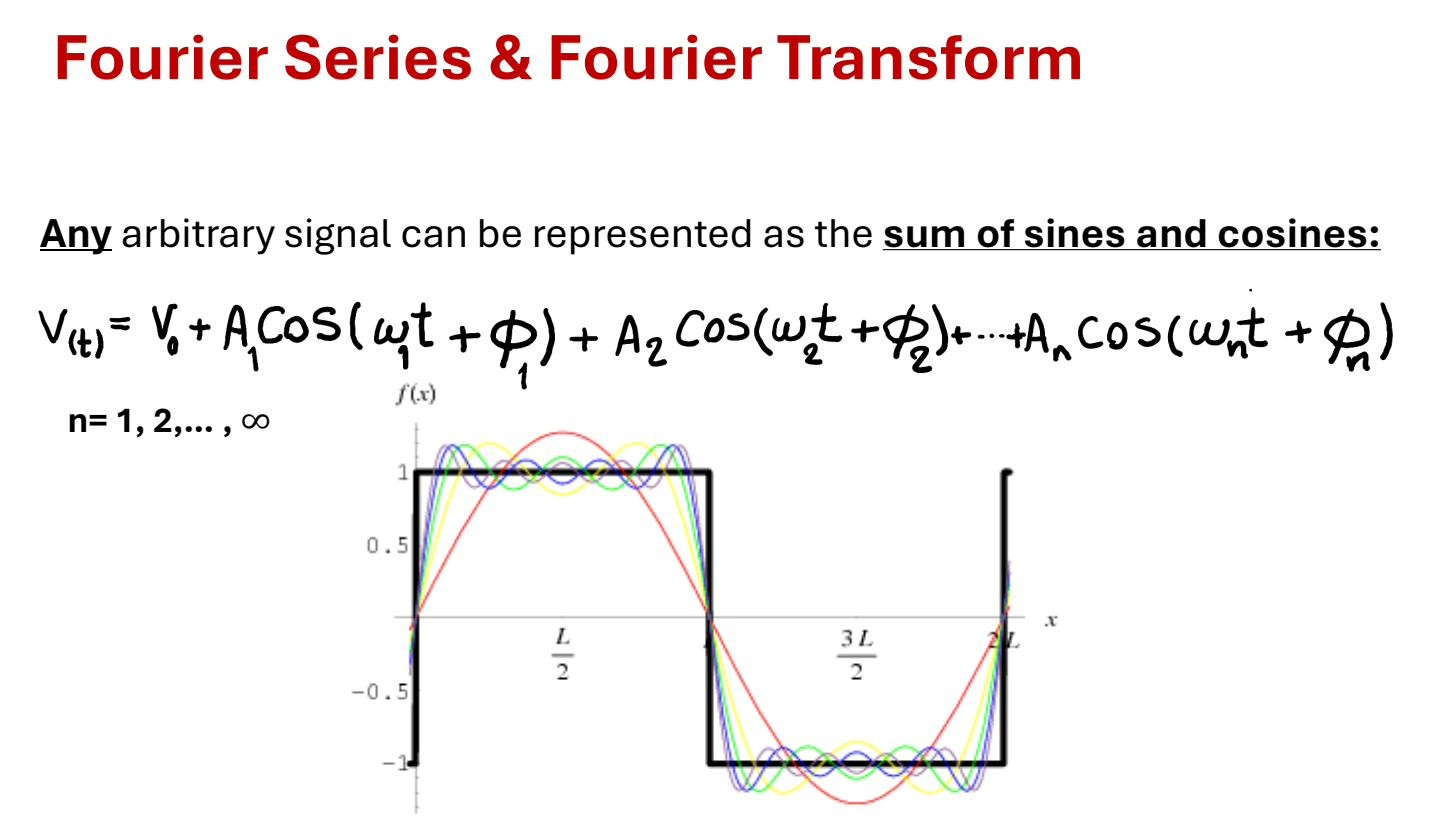 Any signal decomposes into a sum of sinusoids (Fourier series); aperiodic signals use the Fourier transform.