Sampling records a continuous-time signal at evenly-spaced moments to produce a discrete sequence. Pick a sampling period in seconds, and define the samples by
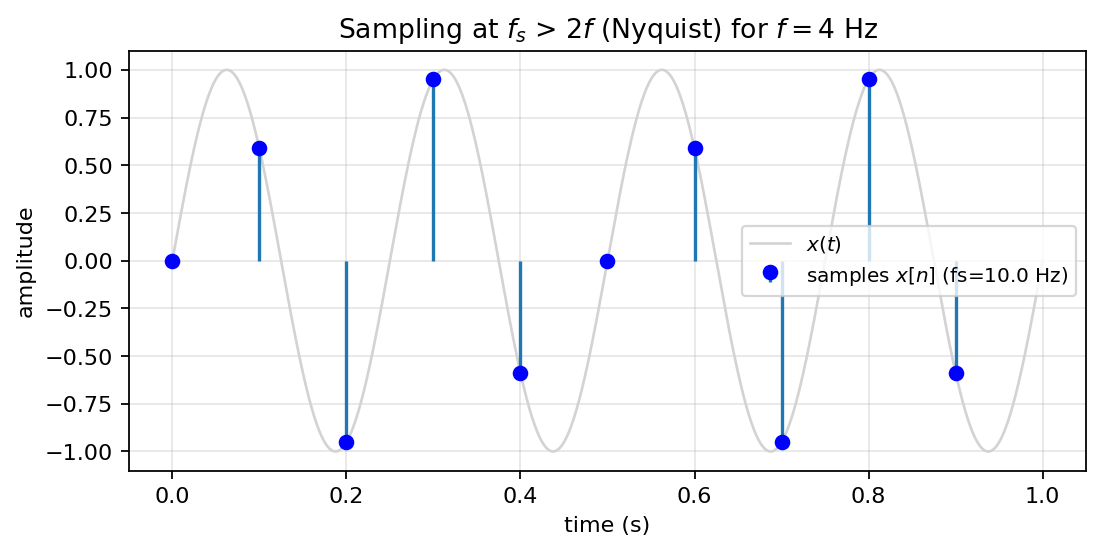 A 4 Hz sinusoid sampled at 10 Hz, above Nyquist, so the samples uniquely determine the signal.
The list of samples is a discrete-time signal. The sampling rate (or sampling frequency) is , in hertz: samples per second.
Impulse sampling
The cleanest model, and the one that connects to the Fourier transform, is impulse sampling. Instead of producing a list of numbers, multiply by a periodic impulse train of period :
(The last equality uses the equivalence property of the impulse.)
The result is a continuous-time signal, still on the real line, but zero except at the sample instants, where it carries impulses with strengths equal to the sample values.
This is a mathematical fiction (no real sampler produces zero-width impulses), but it’s useful: it preserves all the sample information and has a clean Fourier transform.
The spectrum of a sampled signal
Take the Fourier transform of using the convolution theorem:
(Convolution with a train of impulses just shifts and sums copies.)
So the spectrum of the sampled signal is the original spectrum replicated at multiples of , with each copy scaled by . The copy is the original; copies at are images.
This one formula drives everything in sampling theory:
- If the copies don’t overlap → original signal can be recovered. Sampling theorem guarantees this when is more than twice the highest frequency in the signal.
- If they overlap → aliasing mixes high-frequency content into low frequencies, and information is irreversibly lost.
The Nyquist condition
For a bandlimited signal with maximum frequency (so for ), the copies in don’t overlap when
The critical rate is the Nyquist rate.
From samples back to continuous signal
If , the original can be recovered by lowpass-filtering with cutoff between and . The corresponding time-domain operation is sinc interpolation:
In practice, real systems use approximations: zero-order hold, first-order hold, FIR filters that approximate the sinc with finitely many taps.
In the analog-to-digital pipeline
Sampling is the first step in converting an analog signal to digital:
Anti-aliasing filtering usually precedes sampling, to enforce bandlimiting (no real signal is perfectly bandlimited).