Sinc interpolation (also called Whittaker–Shannon interpolation) is the exact reconstruction of a sampled bandlimited signal from its samples. Given samples taken at rate above the Nyquist rate, the original continuous signal is
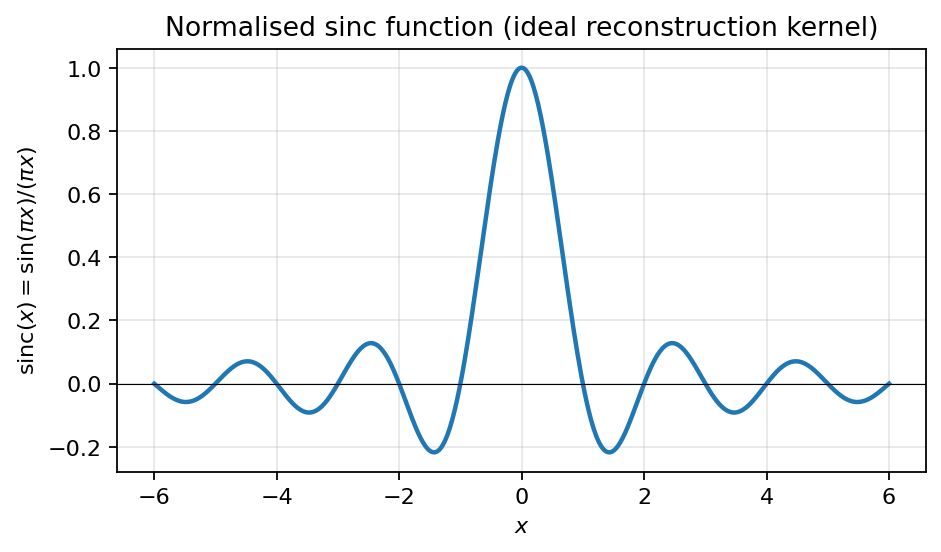 Normalised sinc function , the ideal interpolation kernel for band-limited reconstruction.
Each sample contributes a sinc-shaped pulse centered at , with height equal to the sample value. Summing all the sincs gives back the original signal exactly.
Derivation
The spectrum of the impulse-sampled signal is , copies of spaced apart. Sampling above Nyquist () keeps the copies from overlapping.
To recover , multiply by a frequency-domain rectangle : this gates through the copy, scales it by to cancel the factor that sampling introduced, and zeros out all other copies. The result is .
In time, multiplying by a frequency rect becomes convolving with the sinc inverse transform. Using the normalized-sinc convention and the pair read in reverse (with , so the frequency-domain rectangle has width ):
So . Since , the convolution becomes a sum of shifted sincs, the formula above.
Interpolation property
The sinc function equals at and equals at every other sample instant (the sinc has zeros at every nonzero integer argument). So at the sample instants, only one term in the sum contributes, and it contributes exactly .
Between sample instants, the sinc tails from all the samples combine to give the original signal’s value at that intermediate time. The samples pin down the function at the integer sample times, and the sincs interpolate between them.
Why it’s not practical
The sinc function has infinite support, with tails extending to . To compute at a single intermediate time, you’d need every sample from every time. Real systems can’t do this; they have finite memory.
Practical reconstruction uses approximations:
- Zero-order hold: each sample is held constant until the next. Square-wave reconstruction, easy to implement but high-frequency content distorted.
- First-order hold: linear interpolation between adjacent samples. Smoother than ZOH.
- FIR filters approximating sinc: a finite-length impulse response that approximates the ideal sinc with windowed truncation. Used in audio DACs, image upscaling, and most modern reconstruction systems.
The cost of approximation: small aliasing artifacts in the reconstructed signal. The fewer taps, the more artifacts; the more taps, the better the reconstruction (and the more computation).
The signal chain
Sinc interpolation (or its practical approximation) is the last step in the digital-to-analog conversion chain:
A real DAC implements an approximation of sinc interpolation, followed by an analog reconstruction filter (also called a smoothing filter) that suppresses any remaining out-of-band content.