Aliasing is what happens when a signal is sampled too slowly: high-frequency content “folds back” and shows up at lower frequencies, where it is indistinguishable from genuine low-frequency content in the original signal. Irreversible loss of information.
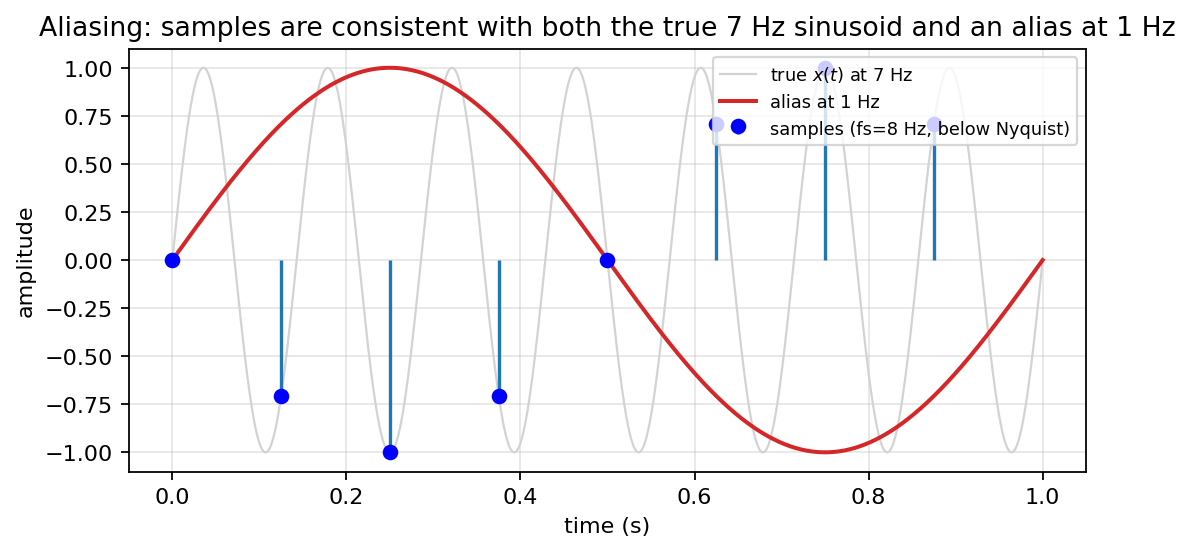 Undersampling: a 7 Hz sinusoid sampled at 8 Hz is indistinguishable from a 1 Hz alias.
The mechanism
Sampling a continuous-time signal at rate produces a discrete-time signal whose spectrum is
a sum of shifted copies of the original spectrum, spaced apart.
If is bandlimited to and the sampling rate satisfies , the copies don’t overlap. But if , they overlap, and the spectra add in the overlap region. The spectrum near is now a sum of contributions from neighboring replicas, and the shape of any one bump no longer matches the original .
Alias frequency
A true frequency in the original signal shows up in the sampled signal at the aliased frequency (which lies in ).
Example. Sample a 700 Hz tone at . The tone aliases to . From the samples alone you cannot tell whether the 300 Hz content came from a genuine 300 Hz tone or an aliased 700 Hz tone. The information is gone.
More generally, any frequency aliases to for some integer that puts the result in . Picture the sampled spectrum as “folded” repeatedly around .
The wagon-wheel effect
In old films a car’s wheel spinning at some rate is filmed at 24 frames per second. If the wheel spins fast enough, the camera’s sampling rate is too low, and the wheel appears to rotate slowly backward: an aliased frequency. The wheel and the camera form a sampled system, and the visual oddity is aliasing.
Why it’s irreversible
Once spectra overlap, no operation on the samples can undo the overlap and recover the original signal. The aliased high frequencies have been added to the low frequencies, and the sum is a single number per frequency, with no way to factor it.
Compare to quantization noise, which is bounded and additive but recoverable in principle to some accuracy by oversampling. Aliasing is qualitatively worse: it destroys structure, doesn’t just add noise.
How to prevent it
Use an anti-aliasing filter: a lowpass filter applied to the continuous-time signal before sampling, with cutoff below . This forcibly bandlimits the signal to the region where replicas don’t overlap.
The anti-aliasing filter does lose information, since the content above is removed, but that content would have been corrupted by aliasing anyway. The filter doesn’t make things worse; it makes them honest.
Sampling correctly
To avoid aliasing entirely, sample at a rate , where is the highest frequency present in the signal. This is the Nyquist sampling theorem. For digital audio sampled at 44.1 kHz, the implicit assumption is that the signal has been bandlimited to below 22.05 kHz, roughly the upper limit of human hearing, so the loss is inaudible.