The electric field at a point in space is the force per unit positive test charge placed at that point:
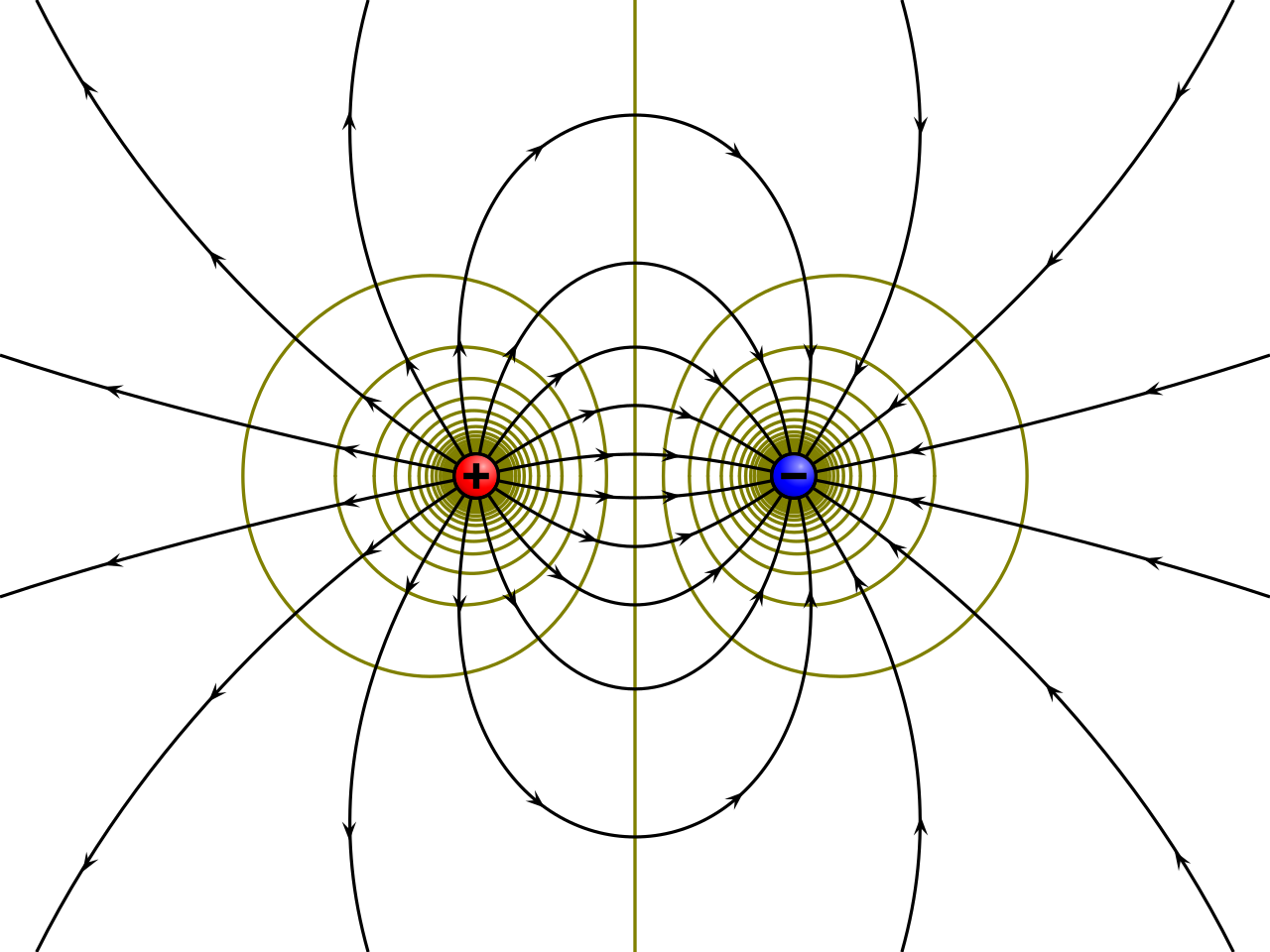 Image: Electric dipole field lines, CC BY-SA 3.0 — field lines (red) and equipotential lines (blue) of an electric dipole.

A charge placed in the field experiences a force . Taking the limit is the standard idealization: the test charge has to be small enough that it doesn’t disturb the field it’s measuring.
The electric field is a Vector field: at every point in space it assigns a vector (magnitude and direction). It’s the carrier of electrostatic interaction — charges create , and other charges respond to the local . This decouples the question “what does charge feel from charge ” into two steps: sets up a field, and feels the local field where it sits.
Field of a point charge
For an isolated charge in a medium with permittivity , the field at distance is
pointing radially outward for , inward for . This is Coulomb’s law written in field form.
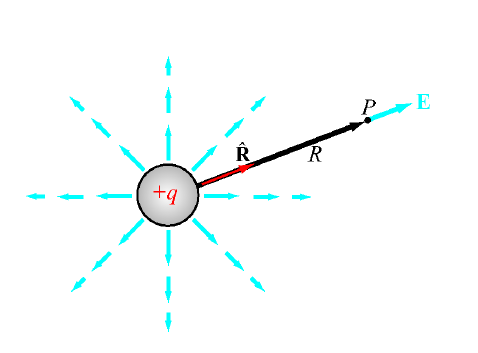 Radial electric field lines from a positive point charge.
In free space, F/m. In a Dielectric medium, where is the relative permittivity.
Electric flux density
In a medium, it’s convenient to define a second vector field, the electric flux density :
has the advantage of being directly tied to free charge via Gauss’s law: . The complication of the medium (its ) gets absorbed into the relationship , leaving ‘s sources as just the free charges.
Superposition
The field obeys the Superposition principle: the field due to multiple charges is the vector sum of the fields of each charge taken individually. For point charges,
where is the Position vector of charge and is the observation point.
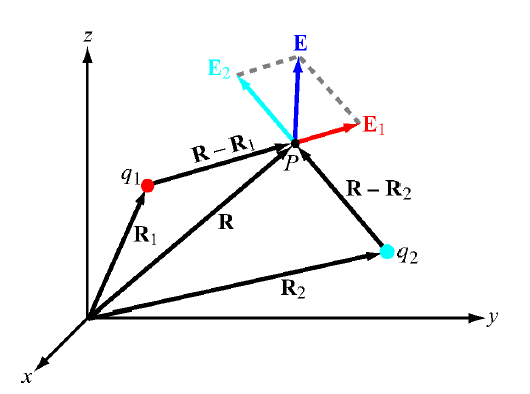 Two-charge superposition: at is the vector sum of and .
For continuous distributions, the sum becomes an integral over the charge density. See Charge density.
Field from distributed charge
If charge is spread out, the field at observation point is
where ranges over the source region. Same form for surface () and line () distributions.
In practice you’d rather use Gauss’s law when symmetry permits, falling back to direct integration only when symmetry is absent.
Relationship to potential
The electric field is the negative Gradient of the Electric potential:
This is the “easy way” to find when is known. Equivalently, is recovered from by line integration: .
The sign convention: points in the direction of decreasing potential. A positive charge released in an field rolls “downhill” toward lower potential.
In electrostatics vs time-varying fields
In electrostatics, : the electric field is irrotational, and a scalar potential exists. In time-varying problems, Faraday’s law gives in general, so the line integral of around a closed loop is no longer zero. The scalar potential alone is insufficient; you need both a scalar and a vector potential.