At the interface between two media with different permittivities or conductivities, the Electric field and Electric flux density obey specific jump conditions. These follow from Maxwell’s equations applied to thin “pillbox” and “loop” volumes straddling the boundary.

Tangential is continuous
Tangential components of the electric field match across the boundary. This follows from (electrostatic case): apply to a small rectangular loop crossing the boundary, shrink the perpendicular sides to zero, and only the two tangential segments contribute. They must cancel for the integral to vanish.
This holds for time-varying fields too, as long as the boundary itself isn’t moving. The line integral acquires a magnetic-flux term, but for an infinitesimal loop the enclosed flux is also infinitesimal.
Normal jumps by the free surface charge
The vector form is unambiguous:
where is the unit normal pointing from medium 2 into medium 1. In scalar form, taking as the component along :
(Other texts pick instead, which flips the sign on the left. The vector form removes the ambiguity.)
This follows from : apply to a small pillbox spanning the boundary, shrink the sides perpendicular to the boundary to zero, and only the two faces parallel to the boundary contribute.
If the boundary is charge-free (): , so — the normal component of jumps in the inverse ratio of the permittivities.
Conductor-dielectric boundary
Inside a perfect conductor in electrostatic equilibrium, . So at the surface:
- Tangential in the dielectric must equal zero too (continuity): . The external field is perpendicular to the conductor surface.
- Normal in the dielectric equals the surface charge: , so .
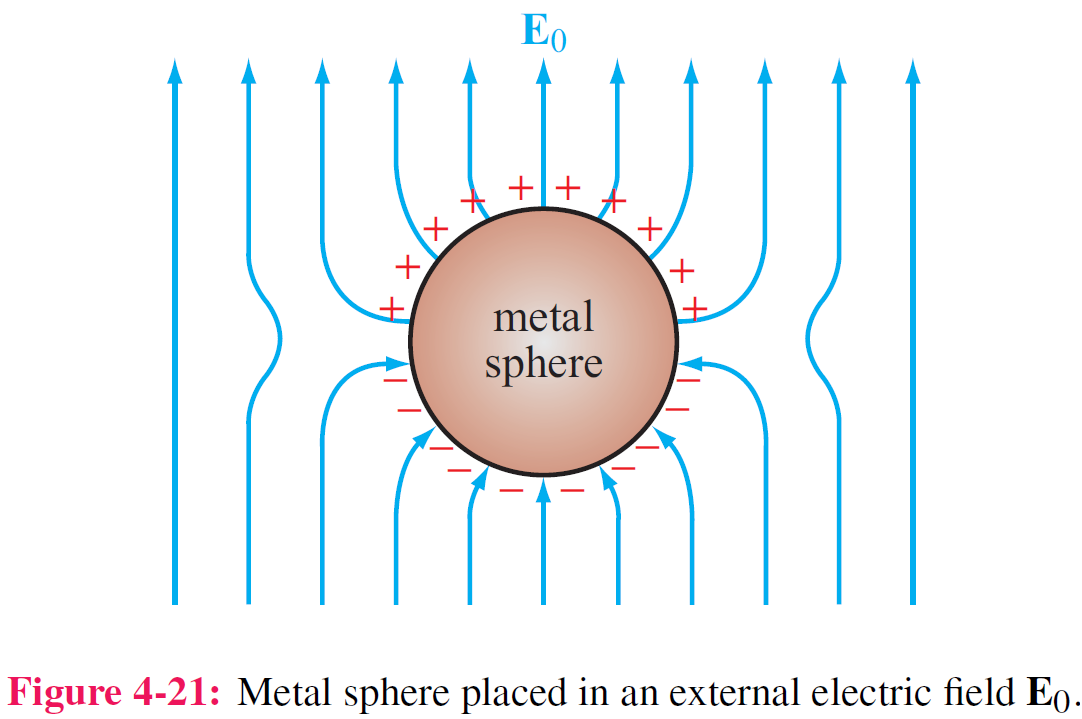
The first condition (field perpendicular to conductors) is what makes capacitor problems tractable — field lines run perpendicularly between the plates.
Refraction of field lines
When the interface is charge-free and both sides are dielectrics, the field “refracts” at the boundary like light. If are angles from the normal in regions 1 and 2:
Using and :
Field lines bend toward the normal when entering a higher- medium. Direct geometric analog of Snell’s law in optics (where the refractive index is ).
Current boundary conditions
In conducting media with current flow, the analogous conditions on apply:
- Tangential continuous → .
- Normal continuous in steady state (charge conservation): .
If only steady-state currents flow, the normal must obey
so any mismatch between and shows up as a surface charge
accumulating at the interface.
Worked example
The -plane separates two dielectrics: (below) from (above). In medium 1, V/m. Find , assuming the boundary is charge-free.
The normal to the boundary is , so:
- V/m, .
Apply the boundary conditions:
- Tangential continuous: .
- Normal: , so .
Result: V/m.
Notice the field is not simply rescaled. The tangential component is preserved while the normal component is divided by , and the vector direction changes too.