Polarization of a Dielectric medium is the dipole moment per unit volume induced by an applied Electric field:
where is the electric susceptibility of the material (dimensionless).
Units of : C/m², same as a surface charge density, because bound dipole charges produce a kind of effective surface charge at the boundaries of the polarized region.
The microscopic picture
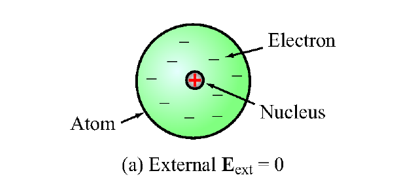
In a dielectric with no applied field, atoms are charge-neutral with the electron cloud centered on the nucleus, so no dipole moment.
Apply an external . Electrons (negative) shift slightly against the field; nuclei (positive) shift slightly along it. Each atom develops a small dipole moment in the direction of .
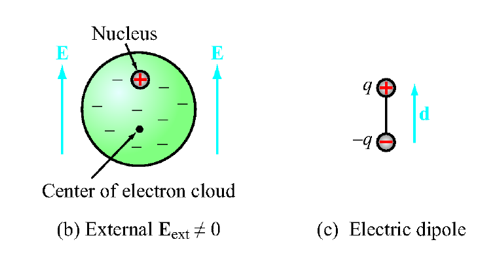
The medium is now polarized: its volume-averaged dipole moment per unit volume is .
The induced dipoles set up their own field, opposing (negative end of each dipole faces the source). This is why the field inside a dielectric is smaller than the field that would exist if the same free charges were in free space.
How it connects to and
The fundamental relation:
In free space and . In a linear dielectric, , so
with Permittivity and . So is the field “seen” by free charges only; the polarization is folded into the permittivity once you trust the medium to respond linearly.
Linear, isotropic, homogeneous
Electromagnetics (like most introductory EM courses) assumes:
- Linear: . Nonlinear corrections appear only at very high fields (nonlinear optics).
- Isotropic: is parallel to . Anisotropic crystals would have with a tensor susceptibility.
- Homogeneous: doesn’t depend on position.
Under these conditions is a single scalar constant.
Bound vs free charge
Two distinct kinds of charge live in a dielectric:
- Free charge : charges that can move (e.g., conduction electrons in a doped semiconductor, or charges deliberately placed on a capacitor plate).
- Bound charge : the displaced charges within the dielectric atoms, immobile but contributing to the local field.
Bound charge density is derivable from : . Where has nonzero divergence, bound charges accumulate.
is engineered to be sourced only by free charge: . The bound charges are quietly inside the constitutive relation. This is the practical reason to work with rather than in dielectric problems.
Dielectric breakdown
A dielectric polarizes linearly up to a critical field — the dielectric strength. Beyond that, the field is strong enough to ionize bound electrons, freeing them; an ionization cascade flows, and the material conducts.
Typical strengths:
- Air: ~3 MV/m
- Glass: 25–40 MV/m
- Mica: ~200 MV/m
Breakdown is irreversible damage in solid dielectrics; in gases (air, SF6) it self-heals when the field is removed.
The breakdown voltage of a capacitor is where is the dielectric thickness. This sets a hard ceiling on operating voltage for a given physical design.