The electric potential at a point is the work per unit positive test charge required to move that charge from a reference point (usually infinity) to the given point, against the Electric field:
Equivalently, the potential difference between two points is
Units: volts (V), defined so that one joule of work moves one coulomb of charge through one volt: .
Why a potential exists
The line integral is path-independent in electrostatics. This is the property that makes a single-valued function of position. Equivalently:
the closed-loop integral of is zero. By Stokes’ theorem this is the same as
A field with zero curl is a Conservative vector field; it is the gradient of a scalar. We define the scalar so that
The minus sign is a convention: points “downhill” from high to low potential, the same way a ball rolls.
In time-varying problems, from Faraday’s law, so the scalar potential alone isn’t enough and a vector potential is also needed. That’s why is a clean concept in electrostatics but more subtle in dynamics.
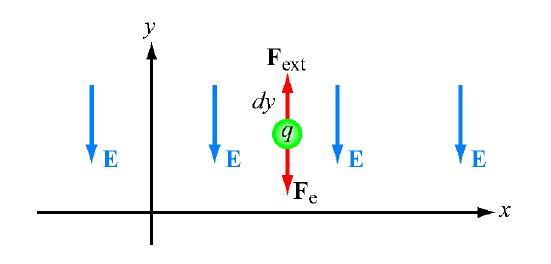 Work done by an external force moves a positive charge against , raising its potential.
Potential of a point charge
A charge at the origin. From Coulomb’s law , with reference at infinity ():
So potential falls off as (slower than ‘s ).
For a charge at , observation point at :
Superposition
For multiple charges:
This is a scalar sum, not a vector sum, a big practical advantage over computing directly. Compute , then take to get if needed.
For continuous distributions:
Same form for , .
Equipotential surfaces
Surfaces of constant . Since and gradients are perpendicular to level surfaces, is everywhere perpendicular to equipotential surfaces.
A perfect conductor in electrostatic equilibrium has inside, so is constant throughout: a conductor is an equipotential body. Its surface is an equipotential surface, and the external just outside is perpendicular to it.
Worked example: ring of charge
A circular ring of radius in the -plane, line charge density . Find at on the axis.
Every infinitesimal element is at distance from the field point, the same for all .
To get the on-axis , take the gradient (only contributes by symmetry):
Direct integration of Coulomb’s law for would have required vector components and cancellations by symmetry. The potential approach is much cleaner.
Poisson and Laplace equations
Combining with and :
In a charge-free region, this reduces to
These PDEs determine in a region from the boundary data (the potential on the boundary, or the field at the boundary). Once is known, everywhere.