Coulomb’s law gives the force between two stationary point charges and separated by a Distance vector :
where is the unit vector from to . Like-sign charges repel (force along ), opposite-sign attract. The force decays as , an Inverse-square field, the same fall-off as gravity.
In free space the constant in the denominator is , with F/m. In a Dielectric medium replace with , where is the medium’s relative permittivity.
Field form
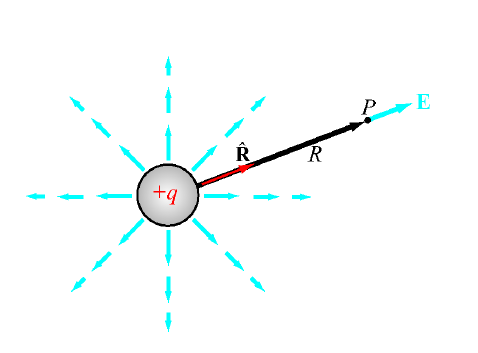
Dividing by the charge being acted on gives the Electric field of a single source charge at distance :
This is the “field-first” statement: sets up in all of space; a test charge placed at any point feels .
Multiple charges: superposition
The field obeys superposition. For two charges at positions , the field at observation point is
The vector form packages the behavior (direction and inverse-square magnitude) into a single expression that handles the geometry automatically.
Worked example
Two point charges C at and C at in free space. Find at .
Position and distance vectors:
- . Magnitude .
- . Magnitude .
Substituting:
This evaluates numerically; the point is the structure: vector form makes multi-charge problems mechanical.
Why Coulomb’s law looks the way it does
The fall-off is a geometric consequence of “field lines spread out.” If the total electric flux emanating from a point charge is uniformly distributed over a sphere of radius , the flux density per unit area is , exactly . This is the seed of Gauss’s law, which generalizes Coulomb’s law to arbitrary charge distributions.
In a region with dielectric polarization, the factor reduces the field: bound charges in the medium partially cancel the source charge’s field. Same Coulomb’s law applies, with in place of .
From Gauss’s law to Coulomb’s law
Coulomb’s law and Gauss’s law are mathematically equivalent for a point charge plus spherical symmetry. The Gauss → Coulomb direction:
For a point charge in free space, spherical symmetry forces : purely radial, depending only on . Apply Gauss’s law to a sphere of radius centered on the charge:
Solving for :
which is exactly Coulomb’s law. The two formulations are different ways of writing the same physics: Coulomb’s law states the field of a single charge directly; Gauss’s law states the flux through any closed surface. Choose Coulomb when you have a few point charges and want the field at a specific point; choose Gauss when you have symmetry and want to avoid integration.
In context
Coulomb’s law is the static, point-charge starting point. From it everything else in electrostatics follows: Electric potential (integrate along a path), Gauss’s law (the differential / integral restatement), Capacitance (geometry of two conductors). In dynamics, Coulomb’s force is replaced by the Lorentz force when charges move and magnetic fields are present.