Passes frequencies above a cutoff, attenuates everything below. The simplest first-order highpass has transfer function
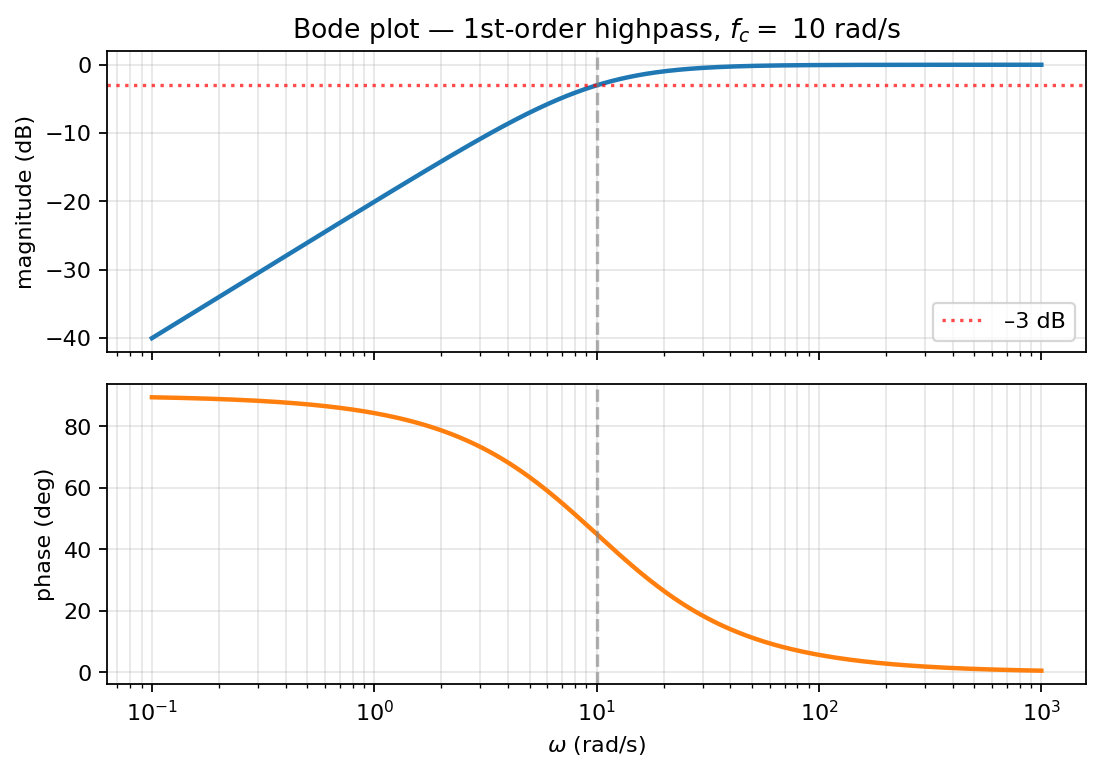 Bode plot of a first-order highpass with corner rad/s: +20 dB/decade rise to 0 dB, phase from +90° to 0°.
Behavior
- At DC (): . DC is completely blocked, so the filter is AC-coupled.
- As : . High frequencies pass unattenuated.
- At : , the half-power cutoff, a drop, same as for the lowpass.
Pole-zero structure
Same pole as the lowpass at , plus a zero at . The zero at the origin kills the DC component: the numerator goes to zero when .
The pattern: an extra zero at the origin transforms a lowpass into a highpass with the same cutoff.
LPF + HPF = 1
A clean identity falls out:
The highpass and lowpass at the same cutoff preserve the whole signal between them. Conservation of frequency content.
Bode plot
Asymptotic magnitude: starts at at , rising at at low frequencies due to the zero at origin, then flattening at past where the pole’s slope cancels the zero’s . So below , magnitude rises; above , magnitude is flat at .
Phase: starts at at very low frequencies (from the zero at origin), transitions through at , and asymptotes to at high frequencies. Decreasing from to over the transition.
Where it’s used
- Audio coupling: a highpass blocks DC offsets between amplifier stages. Common in microphone preamps and signal-conditioning circuits.
- AC-coupling capacitors: a series capacitor forms a highpass with the load resistance, blocking DC bias while passing the AC signal.
- Rumble filter: low-frequency rumble (e.g. footsteps in a recording studio) is removed by a highpass at ~30 Hz.
- DC removal in measurement systems: a highpass strips off DC drift while preserving the AC signal of interest.
Circuit realisation
The concrete first-order highpass in electronics is the RC highpass filter: a series capacitor feeding a shunt resistor, output across the resistor, with Cutoff frequency and a rise below it. This is the Coupling capacitor used between amplifier stages. It blocks the DC bias while passing the AC signal, and its cutoff sets the low-frequency end of the amplifier’s useful range.