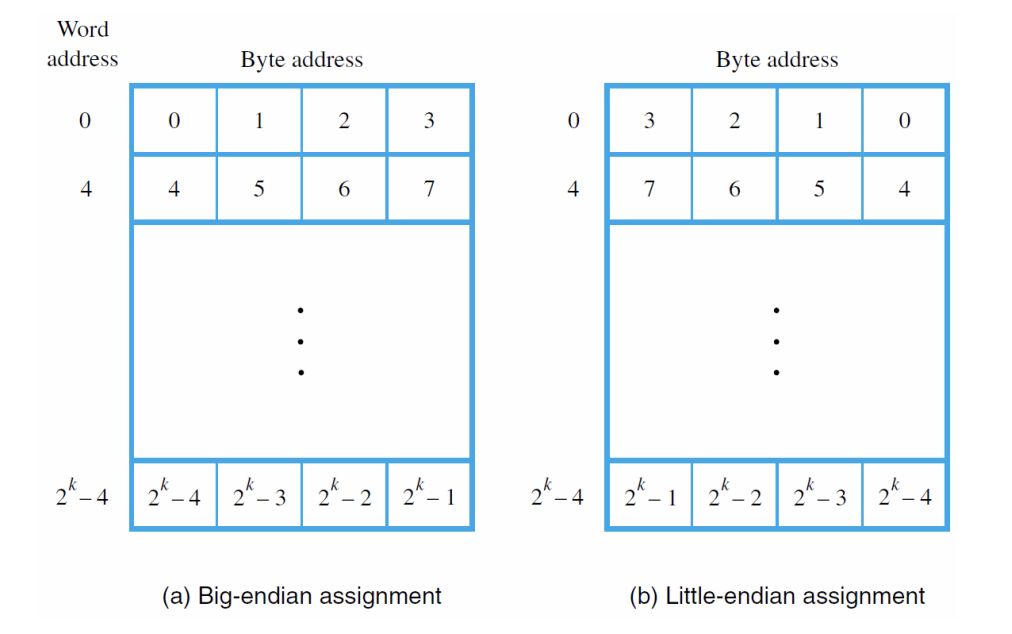
Endianness is the convention for which byte of a multi-byte value gets stored at the lowest address in byte-addressable memory. Two choices: big-endian and little-endian.
Big-endian
Most significant byte (MSB) goes at the lowest address. Bytes appear in memory in the same order you’d write the number on paper, left to right.
For the 32-bit value stored at address :
| Address | ||||
|---|---|---|---|---|
| Data |
Used by: traditional PowerPC, SPARC, network protocols (“network byte order” is big-endian).
Little-endian
Least significant byte (LSB) goes at the lowest address. Bytes appear reversed compared to how you’d write the number.
For :
| Address | ||||
|---|---|---|---|---|
| Data |
Used by: x86, x86-64, most ARM (configurable but usually little-endian by default), RISC-V.
Why it matters
When you only access a value through an instruction that knows its size (ldw for word, ldb for byte), endianness is invisible: the processor handles the byte-shuffling internally. Where it bites:
- Cross-platform data exchange. A binary file written by a big-endian machine and read by a little-endian machine sees byte-swapped values. Network protocols pin down byte order explicitly to avoid this.
- Casting between types. If you write a 32-bit value as four bytes and then try to read it back as a single 32-bit value on a different-endian machine, you get garbage. C unions and pointer casts exhibit this readily.
- Memory dumps in debugging. A hex dump of memory shows bytes in address order, not the “natural” left-to-right number order. On little-endian, shows up as
78 56 34 12, which can confuse if you’re not expecting it.
The eternal debate
Neither convention is inherently better on modern hardware. Big-endian feels natural to humans reading hex dumps. Little-endian’s historical advantage was on serial-byte ALUs that processed one byte per cycle starting from the LSB, convenient because the LSB sat at the lowest address. Modern parallel ALUs read or write a whole word in one cycle, so neither order has a meaningful arithmetic advantage today. The one residual little-endian convenience is aliased addressing: a byte, halfword, and word load from the same address all read the low bits of the value, which simplifies some pointer-casting tricks. But that’s a software ergonomics point, not a performance one.
Some processors (like ARM and PowerPC) are bi-endian: they can be configured to operate in either mode at boot.
The classic Jonathan Swift origin: Gulliver’s Travels mentions a war between people who break their boiled eggs at the big end vs. the little end. Computer scientists adopted the term in a 1980 paper about exactly this kind of “the choice doesn’t matter much, but you have to pick one and it’ll cause arguments forever.”