A clamper (also called a DC restorer or clamped capacitor) shifts an entire waveform up or down so that one of its peaks sits at a chosen DC level, usually 0 V, without changing its shape. It’s a series capacitor and a shunt diode. Unlike a Limiter circuit, which flattens the extremes of a waveform, a clamper leaves the waveform intact and slides it vertically.
How it works
The input drives a series capacitor ; a diode connects from the capacitor’s output side to ground (shunt), and the output is taken across the diode, not across the capacitor. What the capacitor charges up to is the whole trick.
On the first half-cycle that forward-biases the diode, the diode conducts and quickly charges the capacitor. It keeps charging until the diode just barely turns off, which happens when the capacitor has stored enough voltage that the diode no longer sees a forward bias at the input’s most-extreme point. After that the diode stays off for the rest of normal operation, and the capacitor holds its stored voltage like a battery in series with the input. The output is then the input plus that fixed DC offset:
is the constant capacitor voltage acquired during the brief initial charging, and it’s exactly the value that pins one peak of to the diode’s clamping level (≈ 0 V for an ideal diode, ≈ ± with the Constant-voltage-drop model). The shape of is untouched: every point shifts by the same constant , so the peak-to-peak amplitude is preserved and only the DC level moves.
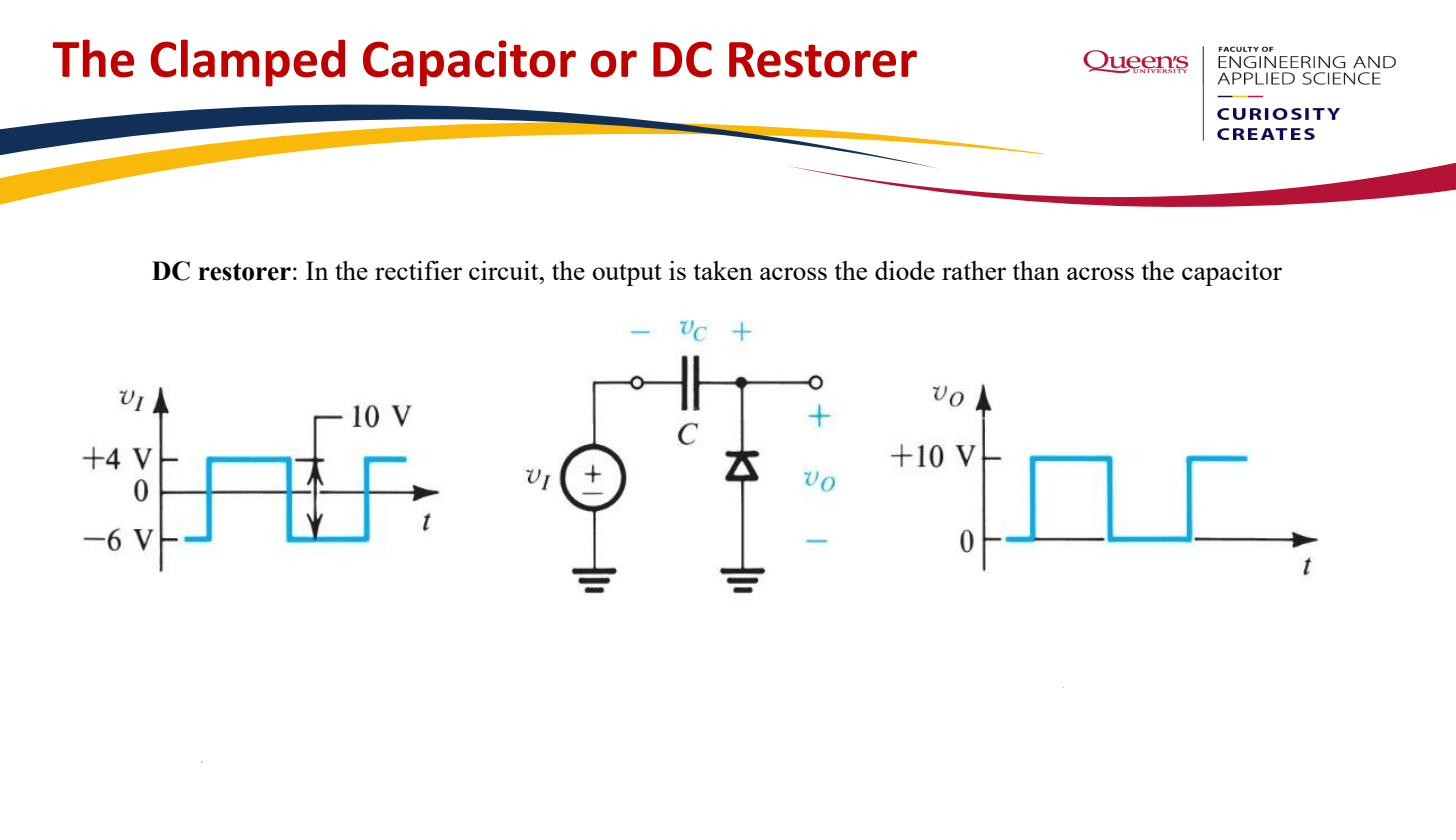 Output across the diode; the capacitor charges to the input peak then acts as a series battery.
Intuition and why “DC restorer”
The capacitor learns the input’s peak once and then behaves as a permanent battery added in series. Which peak gets pinned (positive or negative), and to what level, is set by the diode’s direction. The name “DC restorer” comes from video: a Coupling capacitor in a signal path strips the DC level (it only passes the changing part), and a clamper re-establishes a known DC reference at the receiving end so the absolute level (e.g. the black level of a video signal) is restored.
A clamper followed by a Peak rectifier is exactly a Voltage doubler: the clamper shifts the AC so its negative peak is at 0 V (making the positive peak reach ), and the peak rectifier then captures that doubled peak.