A transmission line is a two-conductor structure that guides electromagnetic energy from a source to a load. Unlike a lumped-element circuit connection, the line itself has electrical effects: voltages and currents propagate along it as waves, with finite travel time. The line is a distributed network with its own propagation behavior.
Common physical forms:
- Coaxial cable: inner conductor + outer shield, dielectric between.
- Two-wire line: parallel wires, dielectric between (or air).
- Microstrip / stripline: PCB traces over a ground plane.
- Twin-lead: parallel ribbon, used historically for TV antennas.
For TEM-mode lines (the focus of Electromagnetics), the electric and magnetic fields are entirely transverse to the line: no field components along the propagation direction. This requires two conductors. Higher-order modes (single-conductor waveguides) are covered in later courses.
When transmission line effects matter
A rule of thumb: when the line length is at least 1% of a wavelength , transmission line effects can’t be ignored:
At 60 Hz powerline frequency, km, and only intercontinental cables qualify. At 1 GHz, cm, so a PCB trace longer than 3 mm needs TL analysis. At 100 GHz, ~3 μm.
Two things go wrong if you ignore TL effects:
- Phase delay. Signals arrive at the load later than at the source: . For a 1 kHz signal on a 20 km line, the phase shift is large.
- Dispersion. Different frequency components travel at different speeds (in dispersive media), distorting pulses. High-speed digital signaling and long-haul fiber design hinges on this.
Phase delay
The total phase delay between input (at ) and output (at ) of a lossless line is
A pure sinusoid at frequency entering at exits at delayed by in phase, equivalently a time delay . For a 30 cm coax with , the delay is ns.
Phase delay answers “how late does the output sinusoid lag the input sinusoid?” For a non-dispersive line, this delay is the same for every frequency, so a pulse arrives delayed but undistorted. For a dispersive line, phase delay varies with frequency: different components arrive shifted by different amounts, and the pulse spreads.
Phase delay is distinct from propagation delay (the time-of-flight of a wave front, , identical to phase delay in the non-dispersive case) and from group delay (, the time-of-flight of a pulse envelope, equal to phase delay only in non-dispersive media). In a non-dispersive line, all three coincide. In a dispersive medium they differ: phase delay still describes the steady-state sinusoidal delay, but the energy and information in a pulse travel at the group velocity.
Dispersion
A line is dispersive when the Phase velocity depends on frequency. Equivalently, is not strictly linear in .
In an ideal lossless TEM line, is exactly linear in , and is constant. No dispersion. A pulse keeps its shape as it propagates: every Fourier component travels at the same speed.
Real lines deviate from the ideal in three ways:
- Conductor loss with frequency dependence: rises as from skin effect, making deviate from . This contributes mild dispersion at high frequencies.
- Dielectric loss: and the frequency-dependent dielectric permittivity introduce dispersion in lossy lines.
- Multi-mode / waveguide effects: above certain frequencies, higher-order modes (TE, TM) can co-propagate with the TEM mode, each with its own . Microstrip has small TE/TM contamination that increases with frequency (“quasi-TEM”).
Consequences of dispersion:
- Pulse spreading. A short pulse contains a wide band of frequencies. If they propagate at different speeds, the pulse smears in time. For a fiber-optic cable carrying 100 Gb/s, dispersion is the dominant limit on link distance.
- Group velocity becomes the relevant “signal speed” instead of . In normal dispersion (positive ), low frequencies travel faster than high, which is chirp. In anomalous dispersion (negative), the reverse.
- Phase velocity can exceed in dispersive media without violating relativity, because phase velocity isn’t the speed of information transport.
In Electromagnetics, the dispersion-free lossless line is the working model. Dispersion proper is treated in later wave-propagation and fiber-optics courses, where the dispersion relation and group velocity become the central tools.
Lumped-element model
A short segment of length of any TEM line can be modeled as a series RL plus a shunt GC, all per unit length:
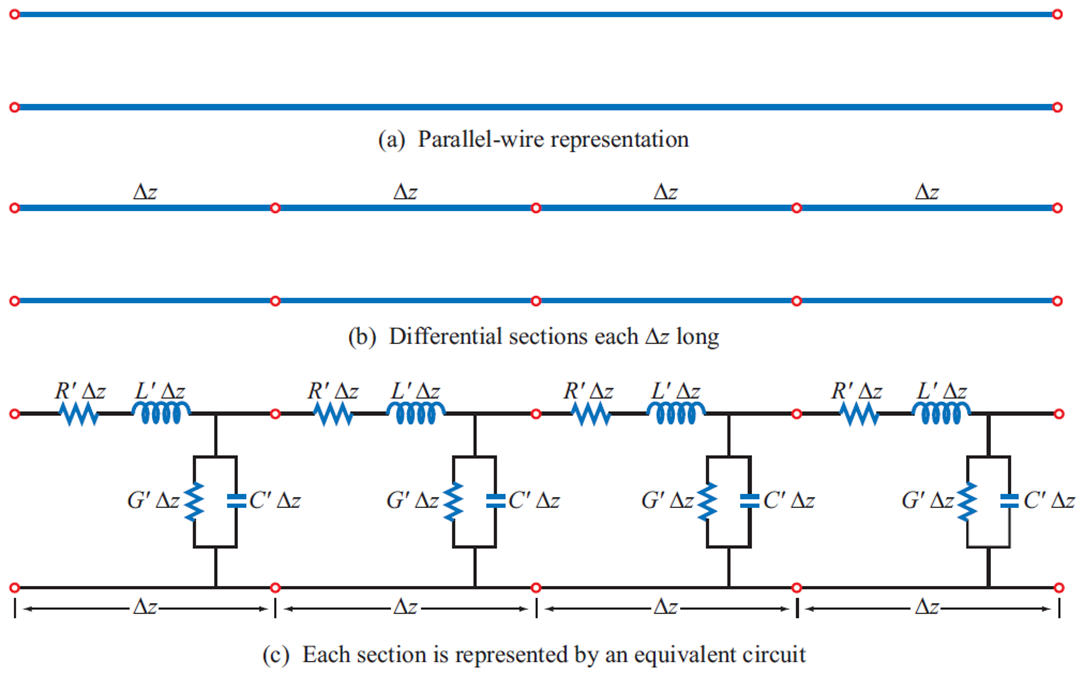
- (Ω/m): combined resistance of both conductors per unit length.
- (H/m): combined inductance of both conductors per unit length.
- (S/m): conductance through the dielectric per unit length.
- (F/m): capacitance between the conductors per unit length.
These four parameters depend on the line’s geometry and material. For a coaxial line with inner/outer radii and dielectric :
Two universal relations follow:
These hold for any TEM line. They reduce the four parameters to effectively two independent ones once geometry is fixed.
Telegrapher’s equations
Applying KVL and KCL to the segment and taking :
These are the Telegrapher’s equations, coupled PDEs for .
In phasor form (sinusoidal steady state), :
Decouple by differentiating again:
with propagation constant
These are 1D wave equations. Solutions: forward and backward propagating waves .
Characteristic impedance
The ratio of voltage to current for a single forward-propagating wave is the Characteristic impedance:
For a lossless line (): , real-valued. Common standard values: 50 Ω (RF coax), 75 Ω (TV cable), 100 Ω (twisted pair, Cat-5/6 Ethernet differential), 120 Ω (RS-485/CAN industrial pairs).
depends only on line geometry and dielectric, not on length and not on what’s connected. It’s the intrinsic impedance of the line for traveling waves.
Lossless line
The common idealization . Then:
Phase velocity:
For a non-magnetic dielectric, the wave moves at scaled down by . A coax with has .
Wavelength on the line:
shorter than free-space wavelength by . This is why a “quarter-wave” PCB stub is physically shorter than .
What lives on the line
Two waves coexist: forward and backward . Total voltage:
For lossless ():
The backward wave is what an impedance mismatch at the load produces (the Reflection coefficient sets its size). When the load matches the line (), and the line carries only a forward wave.