Spherical coordinates specify a point in 3D space by , using the engineering/physics convention:
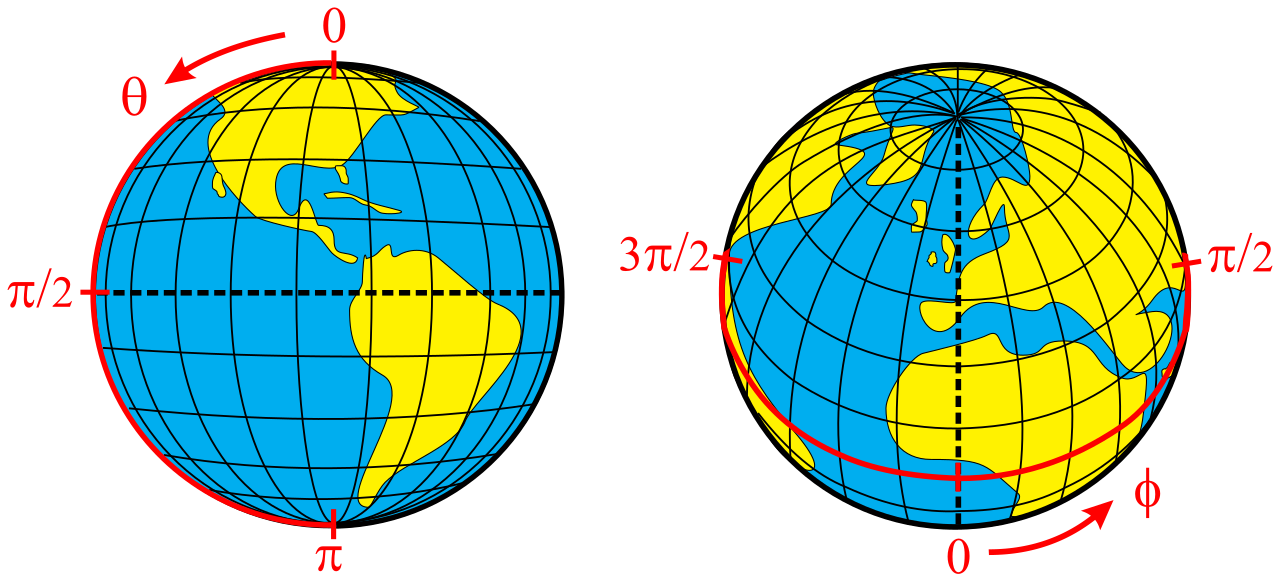 Image: Spherical coordinates on a globe, CC0 — spherical coordinates showing the radial distance, polar angle, and azimuth.

 Image: Spherical coordinate system, CC BY-SA 2.0 IT

- : distance from the origin,
- : polar angle from the -axis (),
- : azimuthal angle in the -plane from the -axis ().
Spherical coordinates are the natural choice when a problem has rotational symmetry about a point (like a point charge or a sphere).
A notation heads-up
The labels and get swapped in some sources: mathematicians often use for polar and for azimuthal. Vector Calculus and Complex Analysis (following Ulaby) uses polar, azimuthal for most of the material, but a few sphere-parameterization figures borrow the mathematicians’ convention. Check the labels on a given figure before substituting into a formula; the underlying geometry is the same.
Conversion to Cartesian
Visualize: sets the radius; sets how far from the north pole (-axis); rotates around the -axis.
Going the other way: , , .
Unit vectors
with
- radially outward from the origin,
- tangent to a meridian, in the direction of increasing (toward the south pole),
- tangent to a parallel, eastward (same as in Cylindrical coordinates).
All three are position-dependent. The mutual orthogonality holds at each point, but the absolute directions change as you move.
Differential elements
Differential length:
The factor on accounts for arc length on a meridian; the on accounts for the smaller circumference of parallels away from the equator.
Differential volume:
The Jacobian is the volume element factor.
Surface element on a sphere of radius :
Outward normal is . Total surface area: .
When spherical is right
- A point charge or point mass (Coulomb, Newtonian gravity).
- A spherical conductor, ball, dielectric sphere.
- Anywhere the symmetry is around an origin point.
Classic example: the electric field of a point charge is . Pure radial. The divergence theorem applied to a sphere of radius gives the enclosed flux in a few lines, recovering Gauss’s law. See Inverse-square field.
Distance between two points
For two points and , the Euclidean distance is
The bracketed expression is the dot product , the cosine of the angle between the two radial directions, computed via the spherical angular addition formula. So equivalently where is the central angle between and as seen from the origin. This is the spherical law of cosines.
Special cases:
- , , same parallel: substitute into the main formula and use to get . Geometrically: it’s a chord across a circle of latitude whose radius is (the parallel shrinks toward the poles). Along the equator this collapses to , the chord across the equatorial circle.
- , same meridian: , planar 2D distance.
- Origin to a point: (set ).
This formula appears in source/field integrations whenever the source charge or current distribution and the observation point are best located in spherical coordinates — e.g., radiation pattern integrals over a spherical antenna aperture.
Bridge
- (equator): reduces to cylindrical with .
- Cylindrical and spherical share the azimuthal angle .
- Cartesian: , (where is the cylindrical radial coordinate).