Cylindrical coordinates specify a point in 3D space by :
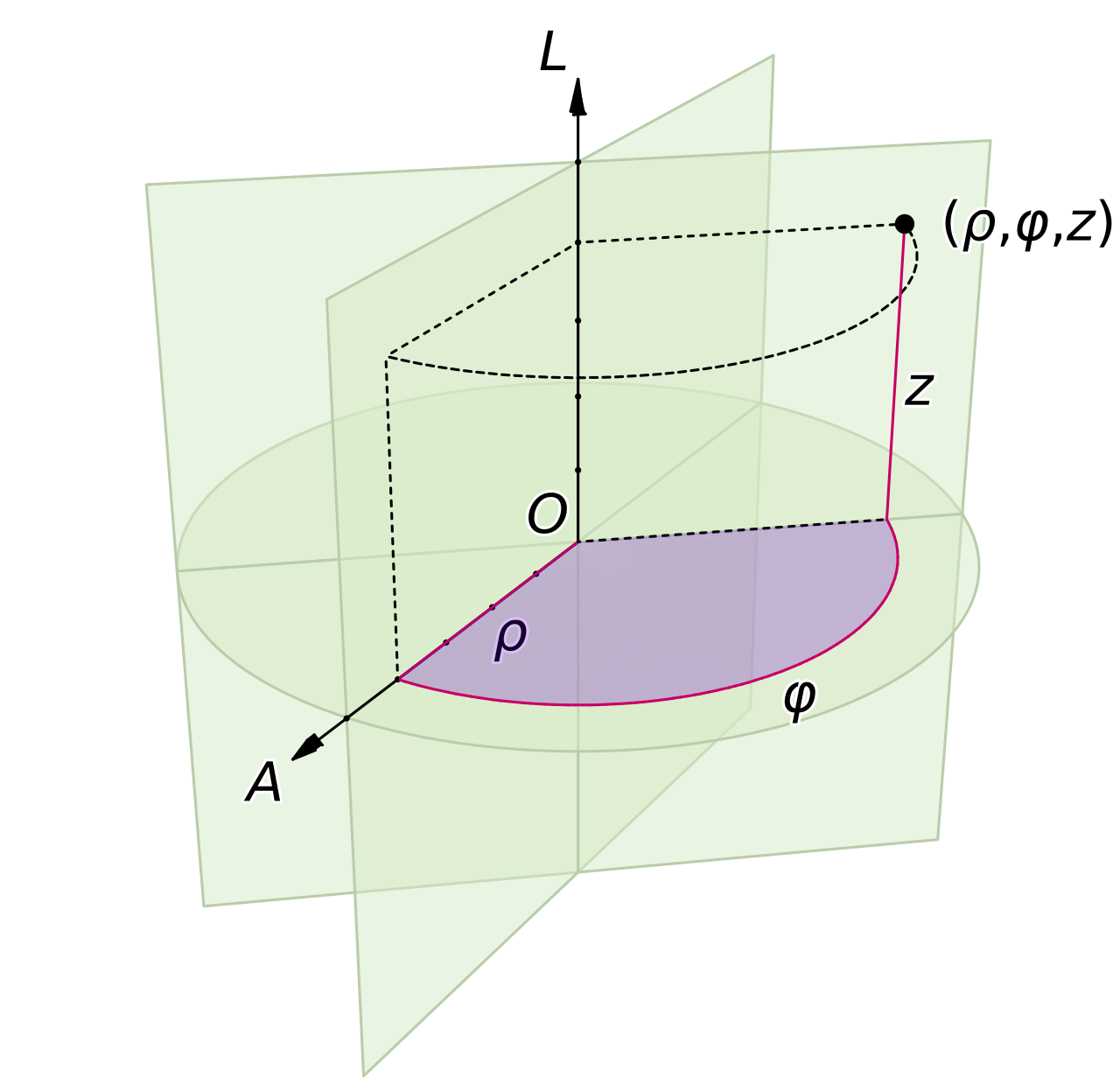 Image: Cylindrical coordinate system, Public domain. Cylindrical coordinates with their basis vectors.

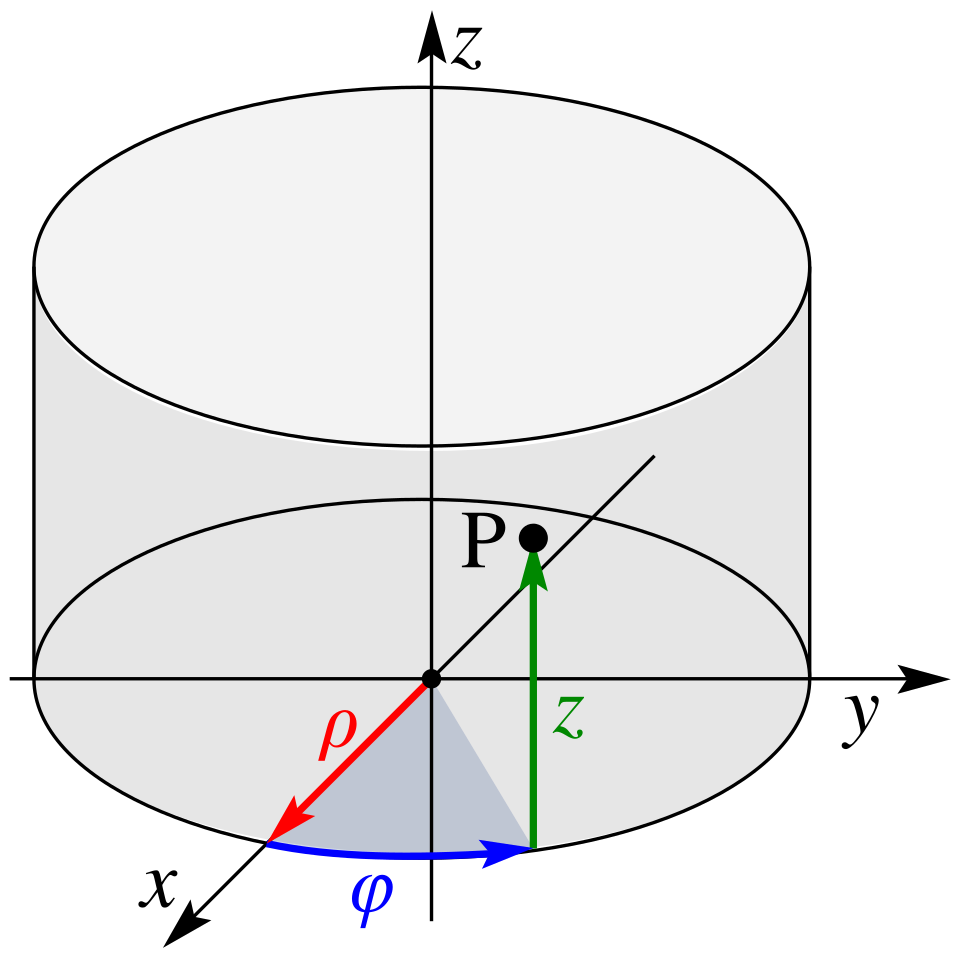 Image: Cylindrical coordinate system (ISO 31-11 convention), public domain

- : perpendicular distance from the -axis,
- : angular position around the -axis, measured from the -axis (),
- : height (same as Cartesian).
Cylindrical coordinates are 2D polar coordinates in the -plane, extruded along . Use them when a problem has rotational symmetry about an axis.
Conversion to Cartesian
Going the other way: , .
Unit vectors
with
- pointing radially outward (in the -plane), away from the -axis,
- tangent to a horizontal circle around the -axis, counterclockwise viewed from above,
- same as .
Cartesian relations:
and are position-dependent: they rotate as changes. Unlike Cartesian , they cannot be pulled outside a derivative or integral without care.
Differential elements
Differential length:
Watch the factor of multiplying . A small angular change at radius corresponds to an arc-length displacement of , not just . Forgetting this factor is the most common error in cylindrical-coordinate integration.
Differential volume:
The factor is the Jacobian of the change of variables from Cartesian to cylindrical.
Surface element on a cylinder of fixed radius :
Outward normal points radially.
When cylindrical is right
- Geometry with rotational symmetry around an axis: a wire, a coil, a circular waveguide, a coaxial cable.
- Fields produced by infinite line charges or currents.
- Fluid flow in a pipe.
The classic example: a uniformly charged infinite wire produces an electric field . Pure radial dependence, no or , so three integrals collapse to one.
Distance between two points
For two points and , the Euclidean distance is
The cross term comes from the law of cosines applied in the -plane: the two radial vectors meet at angle . When (same azimuth), this collapses to plus the piece. When and (two points on a horizontal circle), it becomes , the chord length.
Use this for the distance vector magnitude between a source and field point in Coulomb’s law integrals set up in cylindrical coordinates.
Bridge with Cartesian and spherical
- Setting reduces to 2D polar coordinates in the plane.
- Spherical : same as cylindrical (azimuthal angle); and replace cylindrical and via , .