The Riemann sphere is the extended complex plane , drawn as a sphere via stereographic projection.
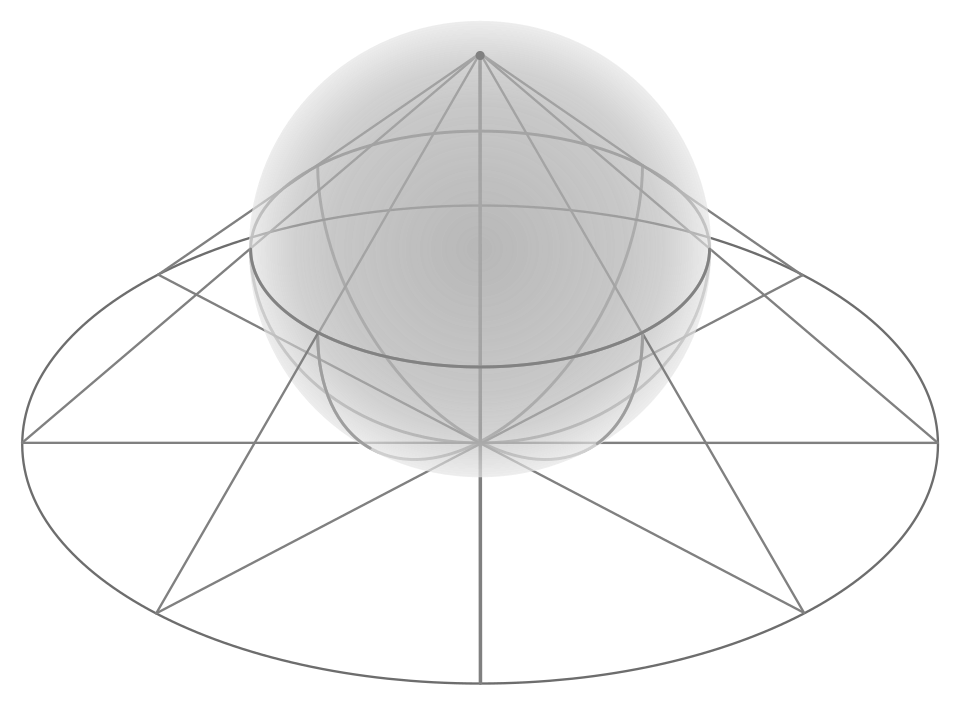 Image: Stereographic projection from the north pole onto a plane, CC BY-SA 4.0

Stereographic projection
Place a unit sphere on the complex plane, with the south pole at the origin. Draw a line from the north pole through any point on the sphere (except the north pole itself) and extend it to the complex plane. The intersection with the plane is the image of that sphere point.
This gives a bijection between the sphere minus the north pole and . The north pole itself corresponds to the point at infinity, denoted .
Why this is useful
- Removes the “point at infinity” oddity. On , is just another point, geometrically equivalent to any finite point. Functions like swap and but are otherwise unremarkable on the sphere.
- Unifies circles and lines. Lines in pass through on the sphere; from the sphere viewpoint, every “line” is actually a circle that happens to pass through the north pole. So the family “circles and lines in ” = “circles on the sphere.”
- Compact. The Riemann sphere is compact (closed and bounded), unlike . Many theorems become cleaner on a compact space.
Möbius transformations as rotations of the sphere
Every Möbius transformation corresponds to a smooth, orientation-preserving conformal map of the Riemann sphere. The rotations of the sphere (the rigid orientation-preserving motions that fix the center) form a subgroup of the Möbius transformations. They’re parameterized by matrices
acting via . These matrices form the group .
The correspondence is two-to-one: the matrices and give the same Möbius transformation (overall sign cancels in the formula), but they’re different elements of . So the rotation group of the sphere is
with a double cover of . This is the same double cover that shows up in quantum mechanics as the spin- structure of electrons; the math is identical because the sphere acts as the configuration space of spin orientations.
In particular, the map swaps and . On the Riemann sphere this is a rotation of the sphere, exchanging south and north poles. Perfectly symmetric, with no special role for either point.
Singularities at
A function has a singularity at if and only if has a singularity at . The classification (removable, pole of order , essential) transfers:
- (): pole of order at (since has a pole of order at ).
- : zero of order at (since ).
- : essential singularity at (since has an essential singularity at ).
A function is rational iff its only singularities on the Riemann sphere (including at ) are poles. Equivalently, rational functions are exactly the meromorphic functions on the Riemann sphere.
In context
The Riemann sphere is the natural setting for:
- Möbius transformations: act as conformal automorphisms of the sphere.
- Rational functions: their natural domain, “everywhere meromorphic” on the sphere.
- Algebraic geometry: is the simplest complex projective space.
- Conformal mapping: Riemann mapping theorem and its variants live most naturally on the sphere.
In this course it mostly serves as a clean way to handle the “point at infinity” in Möbius transformations and the Smith chart, giving a uniform language for the pole of a transformation and its behavior at infinity.