Describe a complex number by its distance from the origin (magnitude) and its angle from the positive real axis (argument), instead of by its real and imaginary components. Equivalent to Cartesian form but easier for multiplication, division, and powers.
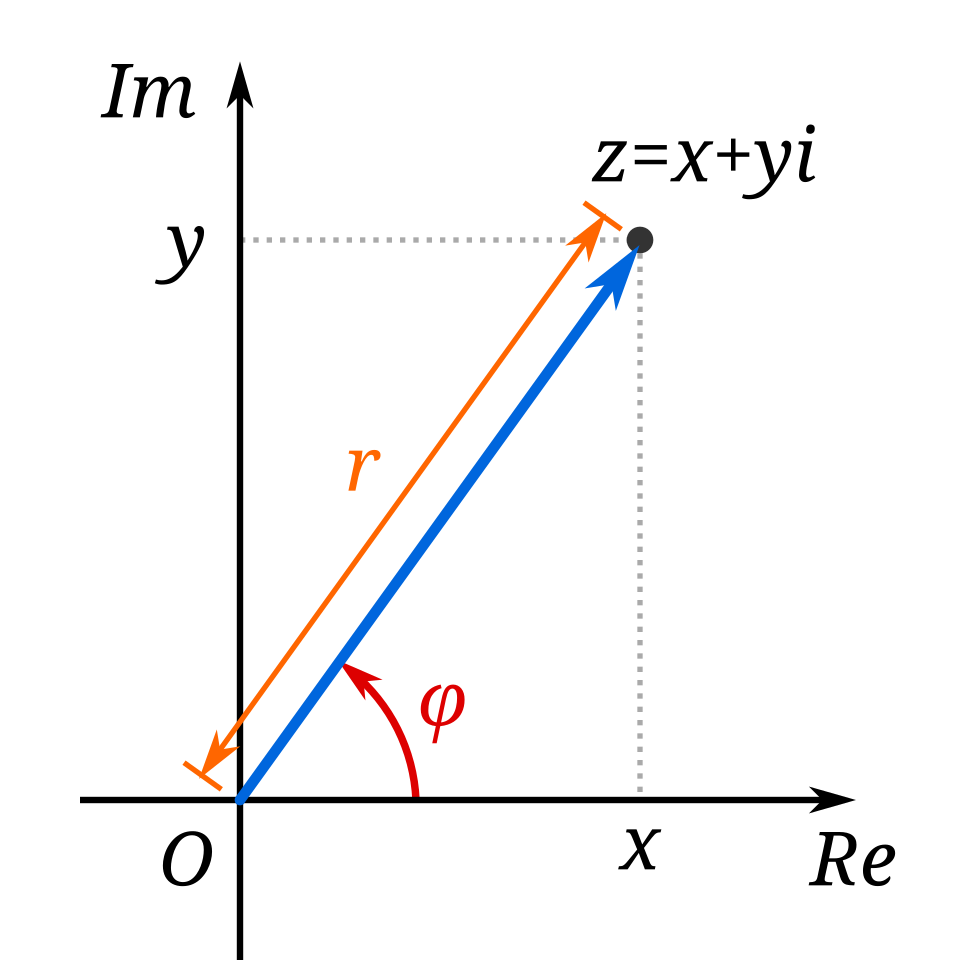 Image: A complex number in modulus–argument form, CC BY-SA 3.0

For a nonzero , define:
- Magnitude (modulus): .
- Argument (angle): = angle from positive real axis to the line from to .
The pair is the polar coordinates of .
Cartesian ↔ polar
Going from Cartesian to polar:
Quadrant warning, this bites every time: returns values only in , so it can’t distinguish a point in the second quadrant () from one in the fourth quadrant (); both can give the same ratio . To get the right , inspect the signs of and and add (or subtract ) when . The two-argument atan2(y, x) does exactly this. Use it instead of atan(y/x) for complex-number arguments.
Going from polar to Cartesian:
Substituting:
This is the trigonometric form.
Euler’s formula
Combining with the trig form:
This is the exponential form, the most compact way to write a complex number.
Special cases:
- (the famous Euler identity, ).
- .
- .
- (full rotation back to start).
Multiplication and division
For and :
Magnitudes multiply, arguments add. Geometrically: scale by , rotate by .
Magnitudes divide, arguments subtract.
These are much easier than the Cartesian formulas for multiplication, etc.
Powers and roots
De Moivre’s theorem:
Exponentiate the magnitude, multiply the angle. That’s the whole thing.
For roots:
There are distinct -th roots, evenly spaced around a circle of radius .
Argument is multivalued
The argument is only defined modulo . The principal value is conventionally taken in (or sometimes ). For the full set of arguments:
This multivaluedness complicates logarithms and fractional powers. Watch which branch you’re on.
Why polar dominates EE
Phasors in AC circuit analysis are complex numbers. Their magnitude is voltage/current amplitude; their argument is phase angle. Multiplying series impedances and dividing currents through parallel paths is all far easier in polar form. See Phasor.
In signals and systems, the Laplace transform and Fourier transforms produce complex-valued frequency-domain representations, almost always handled in polar form.