N-type semiconductor is silicon doped with group V impurities so that mobile negative electrons vastly outnumber holes. The “n” is for the negative majority carrier. It’s one half of every PN junction, the other half being p-type.
How it is made
Silicon is group IV (four valence electrons). Introduce a small concentration of a group V element, typically phosphorus or arsenic, and each impurity atom substitutes for a silicon atom in the lattice. Four of its five valence electrons form the covalent bonds with neighbouring silicon atoms; the fifth electron is surplus to bonding and only weakly held. At room temperature there’s more than enough thermal energy to free it, leaving behind a fixed, positively-charged ionised donor locked in the lattice and one extra mobile electron roaming free.
Because each group V atom donates a conduction electron this way, it is called a donor, and its concentration is written (donors per cm³).
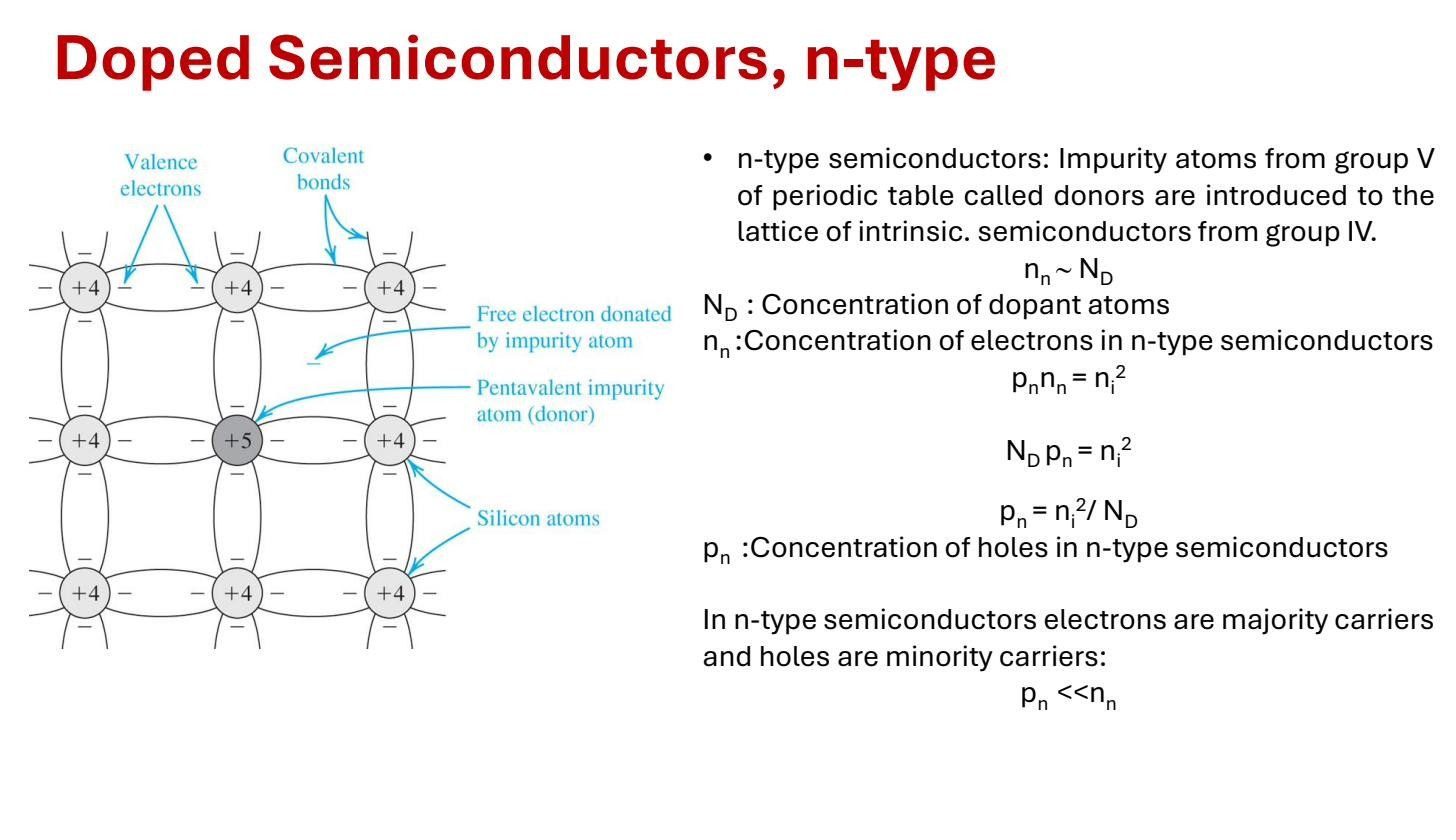 Group V impurities (phosphorus, arsenic) each donate one electron, making electrons the majority carriers.
Carrier concentrations
At normal temperatures essentially every donor is ionised, so each donor contributes one free electron. If greatly exceeds the Intrinsic carrier concentration (it almost always does: vs for silicon), the free-electron concentration is set by the doping:
The hole concentration is then forced down by the Mass-action law :
Worked example: silicon with and gives and
Electrons outnumber holes by about to one. Electrons are the majority carrier; holes are the minority carrier.
Charge neutrality
Despite having all those free electrons, n-type silicon as a whole is electrically neutral. Every freed electron leaves behind exactly one fixed positive donor ion, so the negative mobile charge is balanced by an equal positive fixed charge. This balance is what gets disrupted at a junction: where electrons diffuse away, the uncovered donor ions form part of the Depletion region. The material conducts well because it has many mobile carriers, not because it carries net charge.