MOSFET DC analysis finds a MOSFET circuit’s Operating point (the quiescent , , and ) using the MOSFET large-signal model. Every small-signal/amplifier calculation assumes a known bias point, so this comes first.
The recipe
You have three relations to work with:
- The overdrive definition: .
- The square-law: .
- KVL/KCL around the circuit.
Steps:
- Assume saturation. It’s the usual amplifier region and gives the simple square-law.
- Write KVL through the gate–source loop. The gate draws no current (insulated by the Gate oxide), so nothing flows in the gate path, which cuts the loop equation way down.
- Combine KVL with the square-law. This gives a quadratic in (or in ). Solve it.
- Pick the physical root: the one with (equivalently ). The other root is spurious.
- Compute , then from the drain-loop KVL.
- Check the assumption: is ? If yes, saturation holds and you’re done. If , the device is actually in the MOSFET triode region — discard and redo using the triode equation .
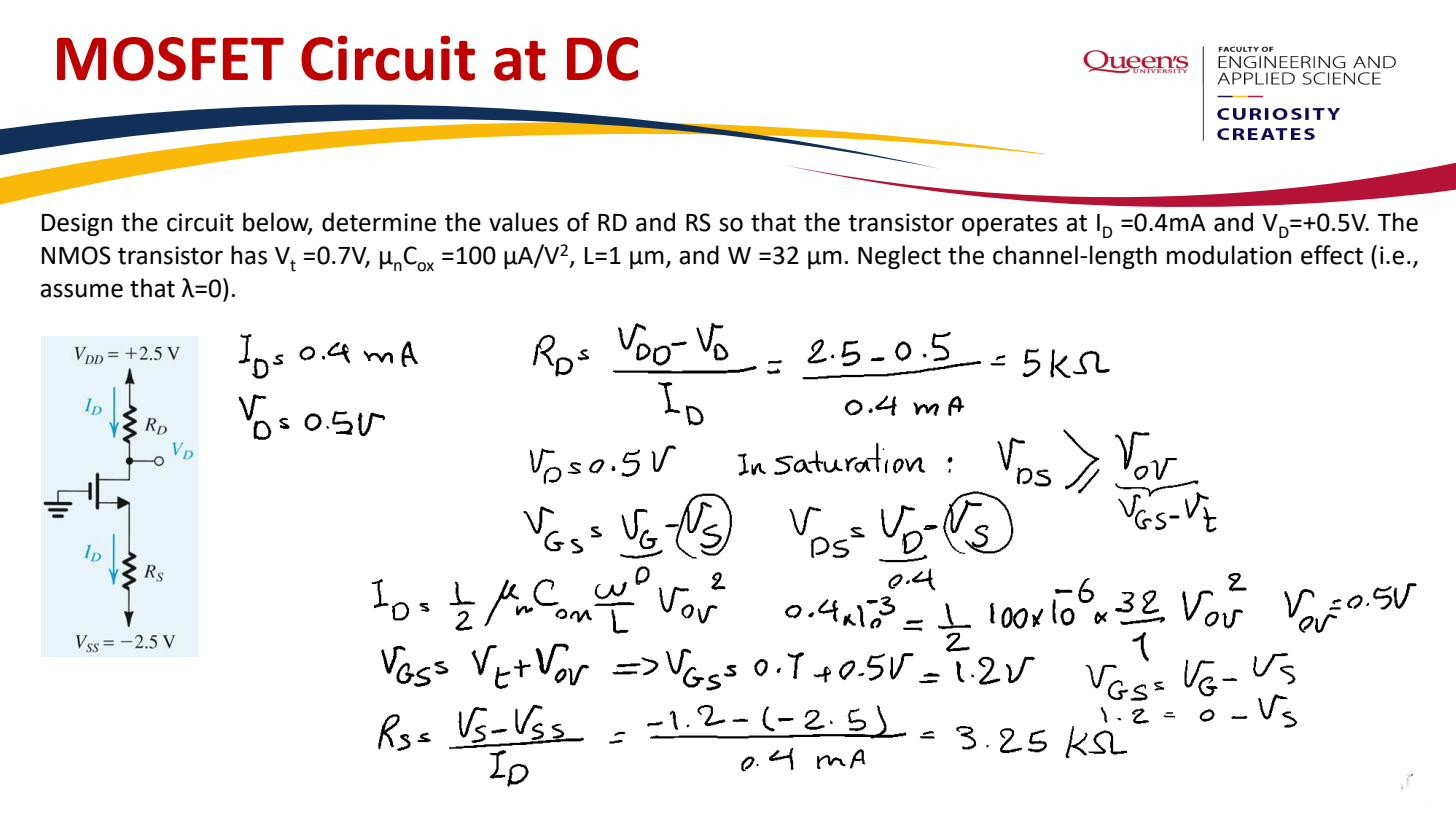 Choose so is at a target with the device saturated.
Worked example
A MOSFET with and has its gate held at through a large resistor, a drain resistor to a supply, and a source resistor to ground. Take . Find , , and verify saturation.
The gate current is zero, so no drop occurs in the gate path and appears directly at the gate. KVL gate → source → ground:
Substitute the square-law :
Let (so ):
(taking the positive root for ). So , , and
With :
Check: ✓ saturation holds, so the answer stands.
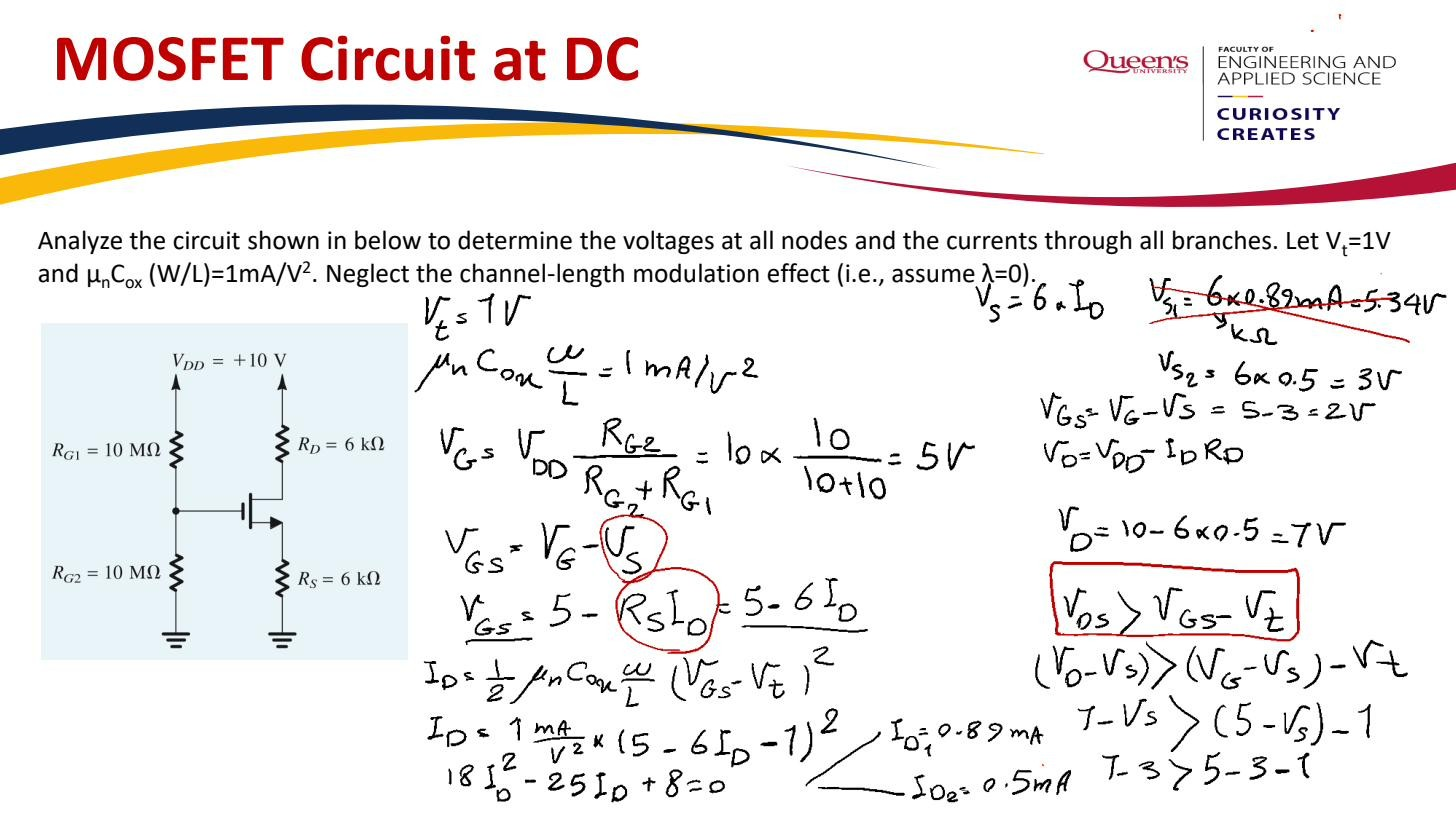 Solve via KVL + square-law + saturation assumption; verify it holds.
The general drain-loop result used above is , and the gate-loop result is the basis of source-resistor MOSFET biasing: if then , almost independent of the wobbly transistor parameters.