Gauss’s law is the statement that the total electric flux through any closed surface equals the total free charge enclosed:
Equivalently, by the Divergence theorem, the local form is
where is the Electric flux density and is the free volume Charge density.
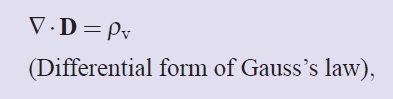 Differential form intuition: shrink the Gaussian surface to a point. The flux per unit volume, , equals the local charge density . The integral form is the same statement summed over the inside of a finite surface.
The integral and differential forms are equivalent. Apply the divergence theorem to a small ball; the integral form turns into the differential form, and vice versa. Which to use depends on the problem: integral form is the practical tool when symmetry makes the flux integral easy; the differential form is the local, source-relating-to-field statement that fits into the differential Maxwell’s equations.
Why it’s true
Coulomb’s law for a point charge gives , a radial field. The flux of through a sphere of radius centered on the charge is . So .
For an arbitrary closed surface enclosing the charge, the same total flux comes through: the field is exactly the geometric “spreading out” of a fixed amount of flux. For surfaces not enclosing the charge, equal flux in and out cancels.
Superposition extends this to any distribution: total flux = total enclosed charge (divided by if you used , exactly enclosed charge if you used ).
When Gauss’s law beats direct integration
Direct integration of Coulomb’s law gives the field at any point, but the integrals are often hideous. Gauss’s law trades general applicability for tractability when symmetry is present: if you can guess the field’s direction and dependence by symmetry, you can pull the magnitude outside the surface integral.
The recipe:
- Identify the symmetry (spherical, cylindrical, planar).
- Pick a Gaussian surface that matches the symmetry, usually one where is constant on it and is parallel or perpendicular to everywhere.
- The flux integral collapses to , with the surface area.
- Set equal to enclosed charge, solve for .
Worked example: point charge
A positive point charge in free space. Spherical symmetry → on a sphere of radius , constant magnitude.
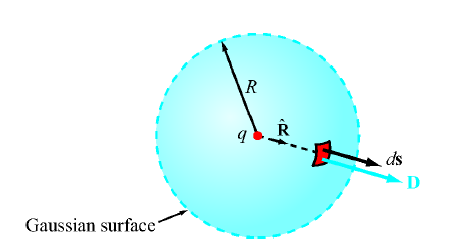
Gaussian surface: sphere of radius .
Enclosed charge is . So , giving
Coulomb’s law falls out of Gauss’s law plus spherical symmetry.
Worked example: infinite line charge
A line on the -axis with line charge density . Cylindrical symmetry → , constant on a cylinder of radius .
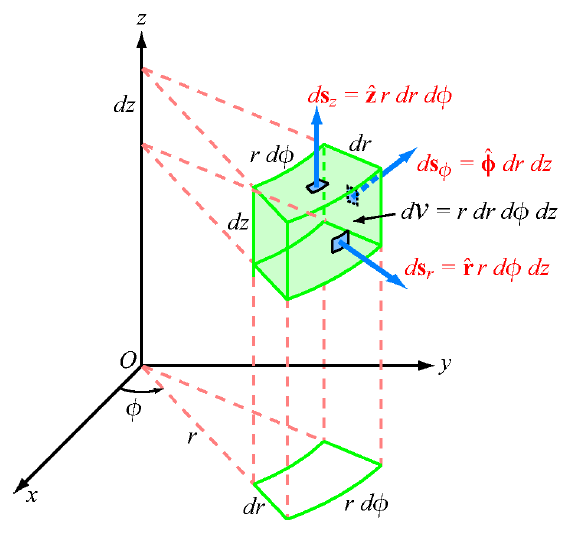
Gaussian surface: cylinder of radius , height . Flux through the curved side is . Flux through top and bottom caps is zero (field is perpendicular to ). Enclosed charge: .
Notice the fall-off, not : line charges spread their flux over an area that grows linearly with (the cylindrical side), not quadratically.
Worked example: infinite plane of charge
By similar logic with a “pillbox” Gaussian surface straddling the plane:
independent of distance: flux doesn’t spread out at all (the area enclosed stays constant as you move away in 1D).
Why and not
Gauss’s law in form has free charge on the right side:
The bound polarization charge inside dielectrics is absorbed into . By contrast, would put bound + free charges on the right, which you can’t easily track.
For free space or anywhere , the two forms differ only by a constant and either works.
In Maxwell’s equations
is one of the four Maxwell’s equations. The other three are (no magnetic monopoles), (Faraday’s law), and (Ampère’s law with displacement current). All four hold in static and dynamic problems alike.