Two questions about an Initial value problem: does a solution exist, and is it the only one?
For the IVP , :
If and are continuous in some rectangle containing , then the IVP admits a unique solution defined on some interval for some .
This is a textbook simplification of two separate theorems:
- Peano existence theorem: continuity of alone is enough to guarantee that at least one solution exists locally. No uniqueness.
- Picard–Lindelöf theorem: continuous and Lipschitz continuous in guarantees existence and uniqueness. The standard textbook hypothesis ” continuous” is a strictly stronger condition that implies Lipschitz on any compact set, which is why it’s used in introductory courses: easier to verify, slightly weaker than necessary.
So in practice:
- Continuity of alone at least one solution exists (Peano).
- Continuity of and Lipschitz in (e.g., continuous) that solution is unique (Picard–Lindelöf).
The solution is local, guaranteed only in a small interval around , not globally.
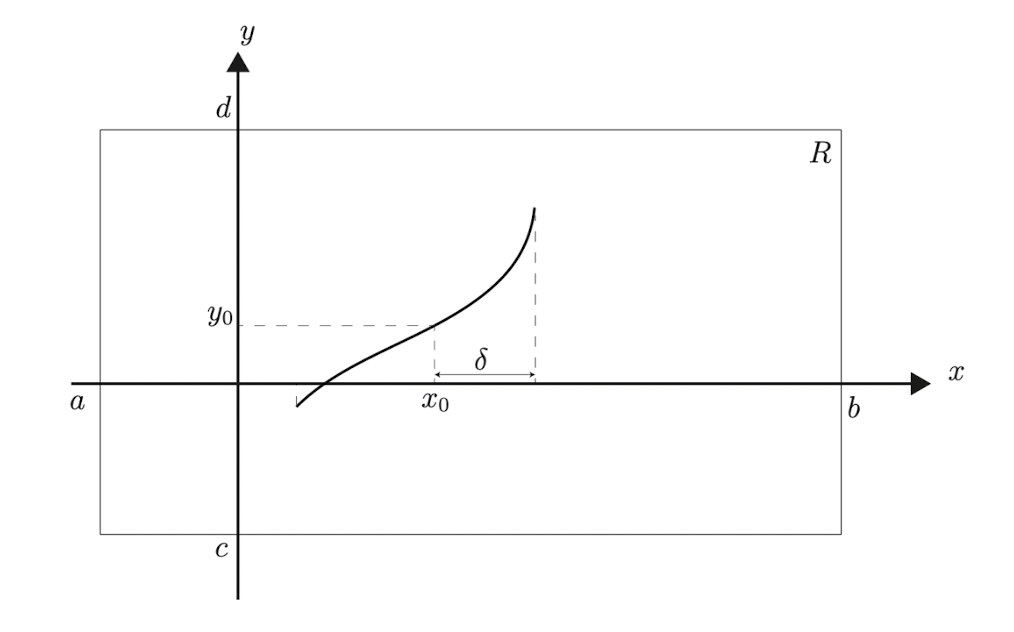
Intuition
Think of as a slope field: it tells you the slope of any solution curve at every point .
If is continuous, the slope field has no gaps. You can follow the slope arrows starting at any point and trace out a smooth curve. So a solution exists.
If is also continuous, nearby slopes don’t change too abruptly — two solution curves can’t merge or branch off each other. So the solution is unique: only one path through any given point.
The rectangle is the “safe zone” where behaves nicely. The number measures how far you can move horizontally from while staying inside the safe zone.
Why both conditions matter
Continuity of is sufficient for existence (Peano’s theorem). Without it the slope field can have a “hole” and no smooth path through. Continuity isn’t strictly necessary. Some discontinuous still admit solutions (e.g. , has solution ), but with continuity you’re guaranteed at least one.
Continuity of (or, more generally, being Lipschitz in ) is sufficient for uniqueness. Without it, two solutions can pass through the same point.
Worked example of failure: at .
is undefined at , so the rectangle around contains points where isn’t defined.
The IVP , has solutions for every . Infinitely many solutions through .
Worked example of existence failure: , . At , undefined. No solution at .
Worked example: showing the theorem applies
The IVP , .
is continuous everywhere on . Its partial derivative is also continuous everywhere.
At , both are continuous. So the theorem guarantees a unique local solution defined on some interval around .
The theorem doesn’t say what is, or how to find . It just guarantees existence and uniqueness.
Linear ODEs: stronger result
For first-order linear ODEs in standard form , a stronger result holds: if and are continuous on an open interval containing , then the IVP has a unique solution defined on all of , globally, not just locally.
This is because linear ODEs can be explicitly solved via the Integrating factor method, and the solution formula is well-defined as long as the integrating factor and the integrals exist.
What it doesn’t say
Three things the theorem doesn’t tell you:
- The size of . Just that some works.
- How to find the solution. The theorem is non-constructive.
- What happens if conditions fail. Failure of continuity doesn’t mean no solution exists, only that the theorem doesn’t guarantee anything.
For a constructive way to build the solution the theorem promises, see Picard iteration.