Electron–hole pair generation: thermal energy (or light) promotes a bound valence electron into the conduction band, freeing a mobile electron and leaving behind a mobile hole. Recombination is the reverse: a free electron drops back into a vacant bond, annihilating one electron and one hole together. Carriers are always created and destroyed in pairs.
Generation
A valence electron is locked in a covalent bond. If it picks up at least a bandgap’s worth of energy, (about for silicon), it escapes the bond into the conduction band and becomes a free carrier. Usual source is heat: at any temperature above absolute zero, lattice vibrations occasionally deliver enough energy to a bond to break it. The instant the electron leaves, the broken bond is a hole. So a single generation event always produces one free electron and one hole at the same time, an electron–hole pair.
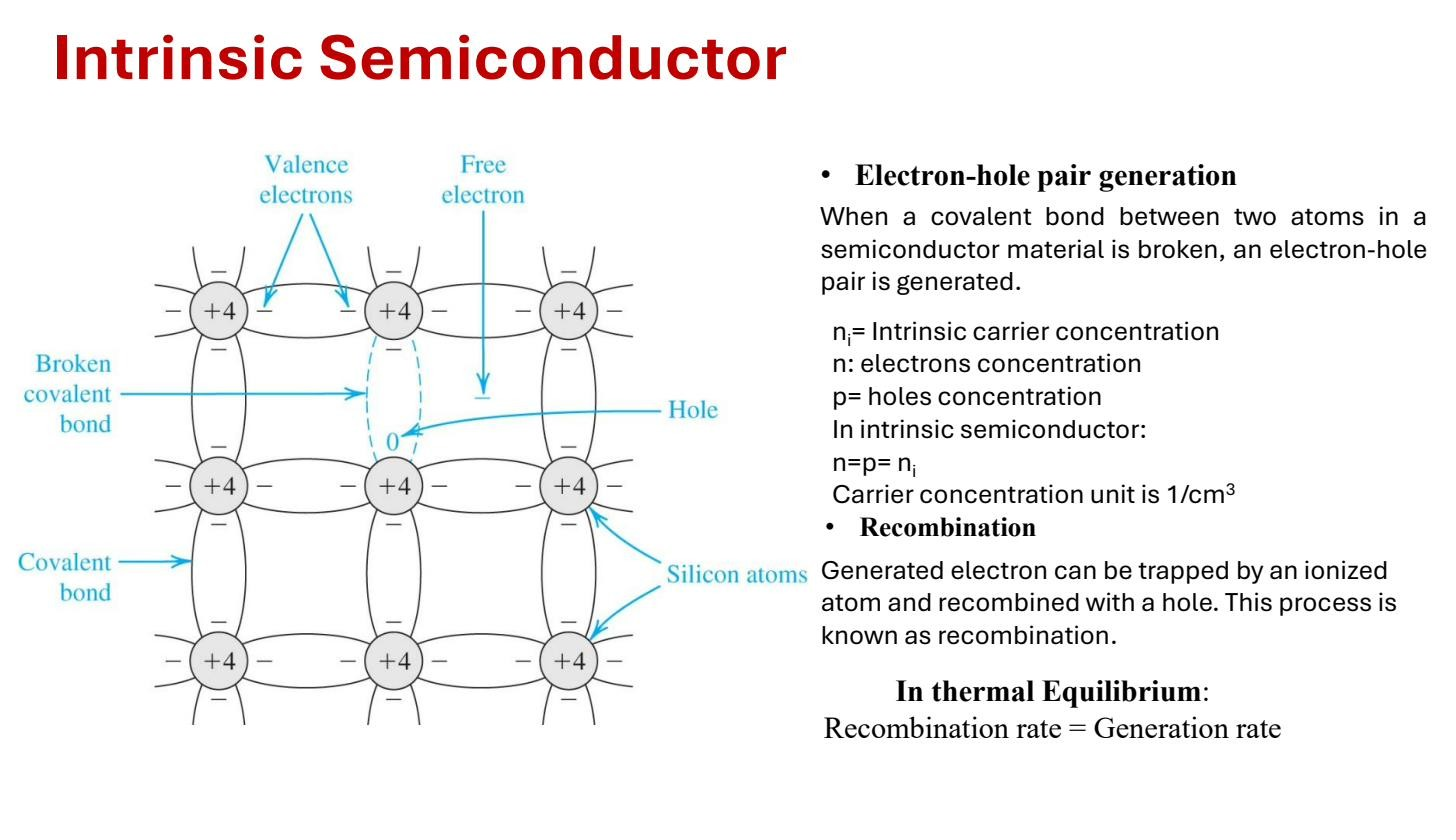 Electron–hole pair generation in intrinsic silicon; in thermal equilibrium the generation and recombination rates are equal.
Recombination
The opposite also happens continuously. A free conduction-band electron wandering through the crystal can fall into a vacant bond (a hole), releasing roughly of energy as heat or light. That event removes one free electron and one hole at once. Recombination is more likely when there are more carriers around, so its rate rises with the carrier concentrations.
Thermal equilibrium: rates balance
At a fixed temperature, generation runs at a steady rate set by how often thermal energy breaks a bond, while recombination runs at a rate that grows with how many carriers are present. The carrier populations adjust until the two rates are exactly equal: generation rate = recombination rate. This is thermal equilibrium. It is not static. Pairs are constantly being created and destroyed, but the concentrations hold steady because creation and destruction balance.
In pure (intrinsic) silicon, equilibrium fixes the electron concentration and hole concentration at the common value
the Intrinsic carrier concentration. Even after Doping shifts and apart by orders of magnitude, equilibrium pins their product through the Mass-action law . That falls straight out of the generation/recombination balance: the same thermal generation rate has to be matched by a recombination rate proportional to .
Where it shows up
Pair-wise generation and recombination sets the intrinsic carrier count, makes the mass-action law hold, and supplies the few minority carriers that carry the Reverse saturation current in a reverse-biased PN junction. Photodiodes and solar cells deliberately use light to drive generation; LEDs drive recombination to emit light.