De Morgan’s laws state how to push a negation through a parenthesis: the negation of an OR becomes an AND of negations, and the negation of an AND becomes an OR of negations.
In the parallel set-theory version, the complement of a union is the intersection of complements, and vice versa.
These laws extend to any number of variables: .
Why they matter
Three reasons you’ll keep reaching for these laws:
-
Converting between gate types. A NAND gate is which by De Morgan equals , an OR of inverted inputs. That equivalence is what makes NAND a universal gate.
-
Distributing a NOT. When you complement a long expression, De Morgan’s laws push the bar inward step by step until each variable carries its own negation.
-
NAND-NAND and NOR-NOR synthesis. Converting an SOP expression into an all-NAND implementation relies on De Morgan to rewrite each AND-then-OR as a chain of NANDs.
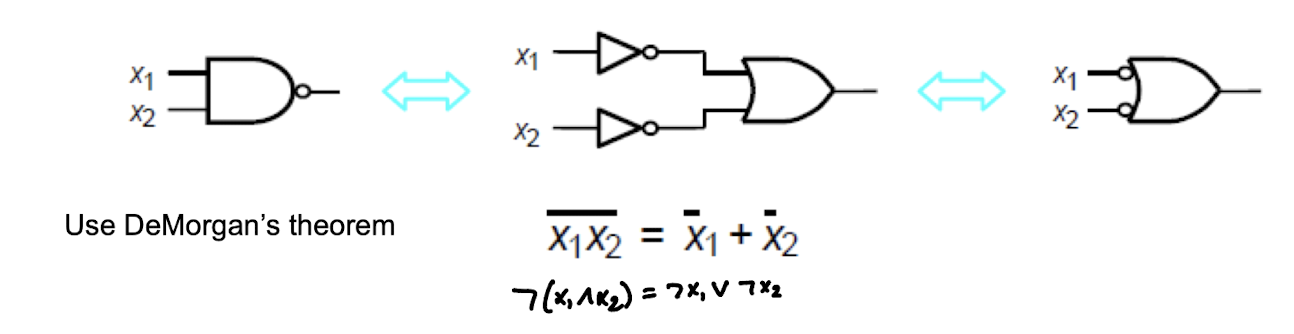
The diagram above shows the same logic implemented three ways: as a NAND, as inverted inputs into an OR, and as a NOR with bubbles on the output. All the same circuit, just drawn with the negation in a different place. De Morgan in pictures.
Worked example
Complement .
Applying De Morgan to the outer OR:
Then to the AND inside:
Distributing:
The original expression and its complement use opposite combinations of operators — every AND in the first becomes an OR in the second and vice versa, with each variable individually negated. That’s De Morgan’s signature.