A binary tree is a tree where every node has at most two children, conventionally the left child and the right child. The two-child constraint makes them easy to reason about and implement. BSTs, AVL trees, red-black trees, and heaps are all built on it.
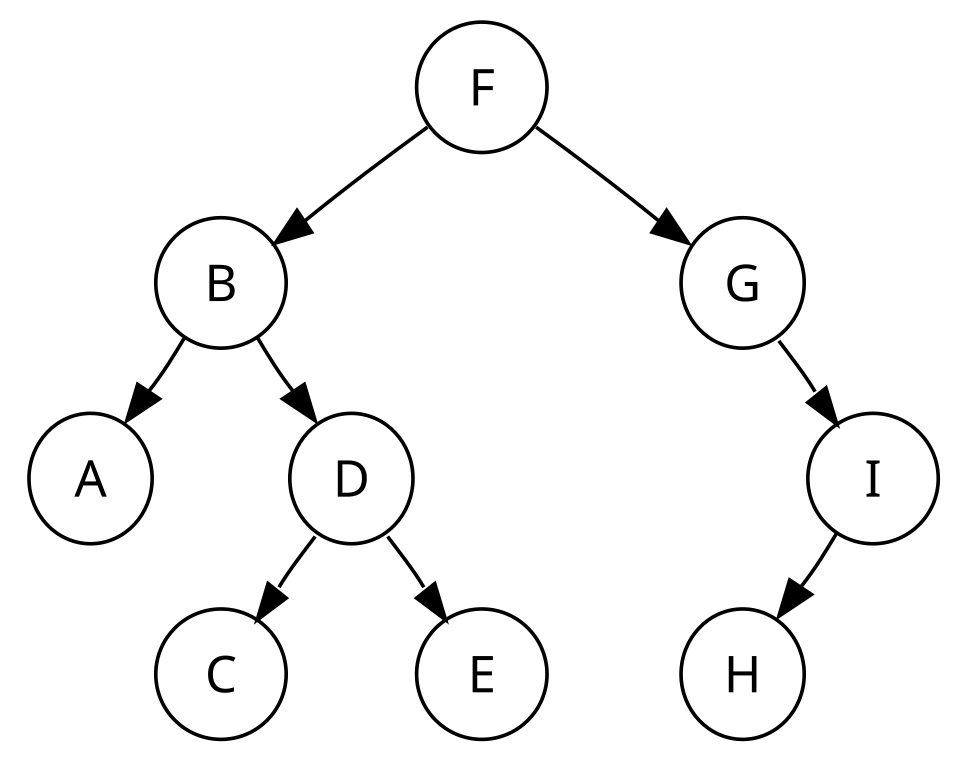 Image: A binary tree (sorted, nine nodes), public domain

typedef struct node {
    int          data;
    struct node *left;
    struct node *right;
} node;
A leaf node has both left and right set to NULL.
Special types
Full binary tree
Every node has either 0 or 2 children. There are no “stragglers” — no node with exactly one child. So the tree is completely binary: a node is either a leaf or a fully-branching internal node.
Complete binary tree
Every level is completely filled, except possibly the last — and the last level fills left to right. So if the last level is missing the rightmost node, the tree is still complete. If a node in the middle is missing while ones to its right exist, it’s not complete.
Complete binary trees can be efficiently stored in an array (parent at index has children at and ). This is exactly how heaps are usually implemented.
Perfect binary tree
Every level is completely filled. A perfect tree of height has exactly nodes. Rare to occur naturally; often used as a theoretical comparison point.
Counting nodes
For a binary tree of height :
- Maximum nodes: (perfect tree).
- Minimum nodes: (a left-skewed or right-skewed chain).
So height varies from (best case, balanced) to (worst case, degenerate chain). This is why balance matters — operations like search are , so is dramatically better than .
Why binary specifically
Two children is the smallest branching factor that lets you split a problem into halves. Binary search relies on it. Decision-making (yes/no choice) maps onto it. Many algorithms are easier to express recursively when each node has exactly two children to handle — process(node.left) and process(node.right).
When you need higher branching factors (e.g., B-trees with hundreds of children for disk-friendly storage), you use multi-way trees. But for most in-memory data structures, binary is the default.
Visiting all nodes
The four standard ways to traverse a binary tree are pre-order, in-order, post-order, and level-order. Each visits every node exactly once but in a different sequence. See Binary tree traversal for the algorithms and use cases.
Operations
A bare binary tree has no built-in ordering — it’s just a structure. Useful operations require an invariant:
- Binary search tree — left subtree < node < right subtree (gives ordered storage with fast search).
- Heap (data structure) — parent ≥ children (max-heap) or parent ≤ children (min-heap), gives priority access.
- AVL tree / Red-black tree — BSTs with self-balancing rules.
Without one of these invariants, a binary tree is just a record of hierarchical relationships, useful for trees that naturally have hierarchy (parse trees, file systems, expression trees).