Amplifier frequency response is how gain magnitude varies with signal frequency. A real capacitively-coupled amplifier doesn’t amplify equally at all frequencies: it has a flat middle band and rolls off at both ends. The response splits into three bands.
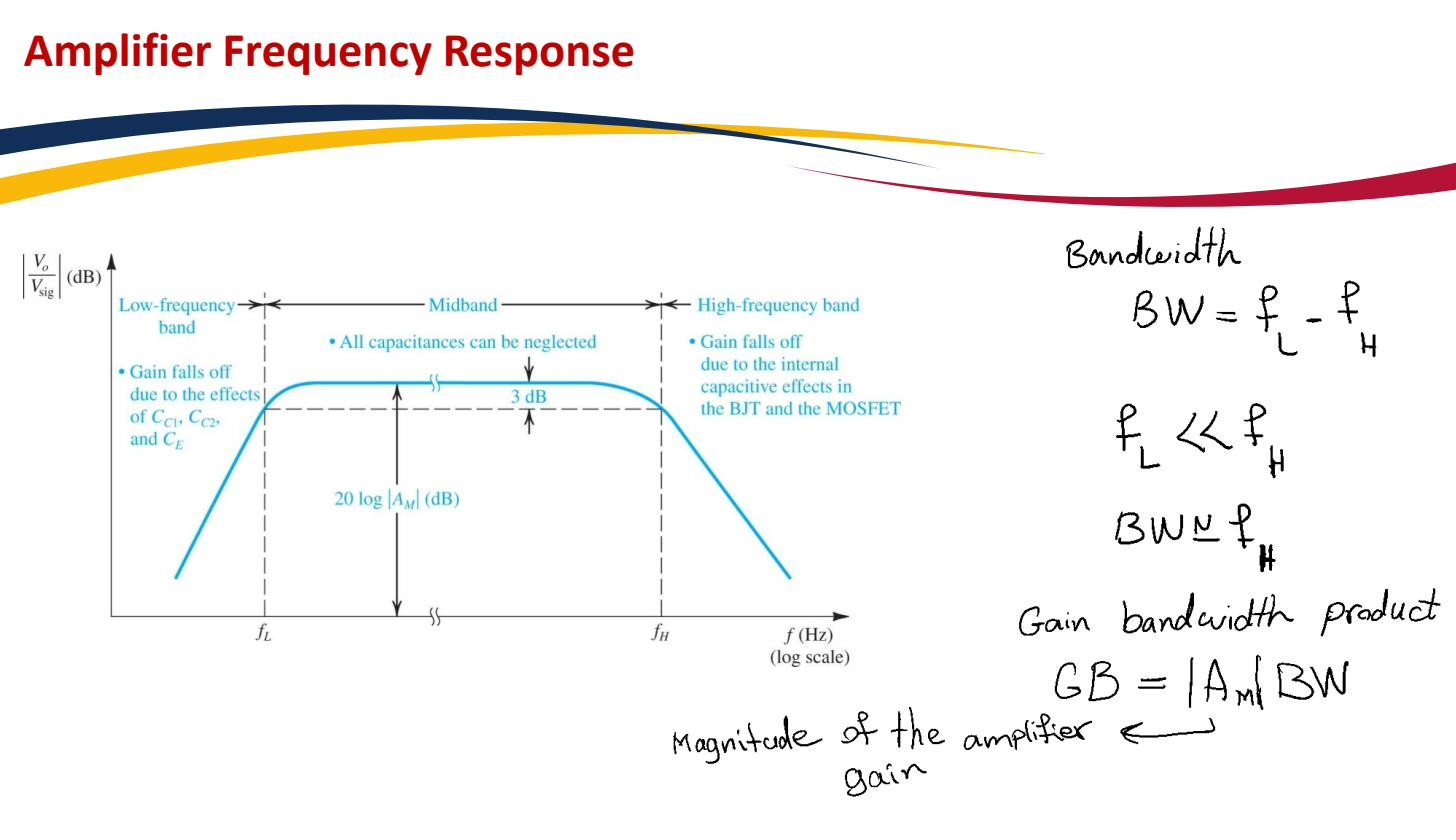 Low band (coupling/bypass caps), flat midband , high band (device parasitics); .
The three bands
- Low-frequency band. Gain falls as frequency drops. The culprits are the large external capacitors: the input/output Coupling capacitors and the source/emitter Bypass capacitor. At low frequency their impedance becomes large enough to matter. Coupling caps stop passing the signal cleanly, the bypass cap stops shorting . Each cap with its surrounding resistance forms an RC highpass corner; together they set the lower edge .
- Midband. A flat plateau at the midband gain . Here every external coupling/bypass capacitor is a near-perfect short (so they vanish from the analysis) and every internal device parasitic is a near-perfect open (negligible too). This is the band the small-signal gain expressions like describe: the amplifier’s “real” gain.
- High-frequency band. Gain falls again as frequency rises. Now the tiny internal device parasitic capacitances dominate: gate-source and gate-drain in a MOSFET, the junction capacitances and in a BJT. (See the Miller effect for how gets amplified.) They short signal away inside the transistor at high frequency, setting the upper edge .
Bandwidth and the design knob
The useful range is the bandwidth
The two ends are set by completely different mechanisms: by the big external caps the designer picks, by the small parasitics baked into the device. That asymmetry is convenient, since the low end is fully under your control. To pass audio down to 20 Hz, make the coupling and bypass capacitors large enough that their corner frequencies sit well below 20 Hz. The high end is then whatever the transistor and stray capacitances allow.
The figure of merit tying gain to bandwidth is the Gain-bandwidth product , roughly constant for a given device: push the midband gain up and the bandwidth shrinks proportionally.